
Key Takeaways
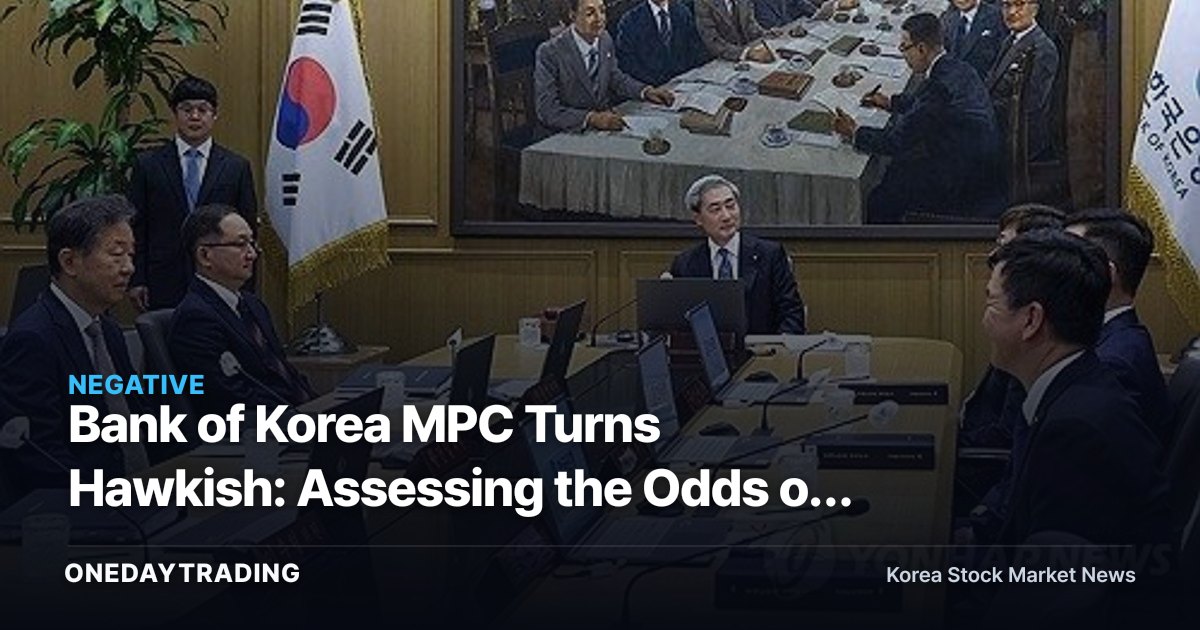
The Bank of Korea's Monetary Policy Committee held the benchmark interest rate steady on the 28th of last month, but the crux is that some members argued inflationary pressure is greater than the headline data suggests and called for a pre-emptive rate hike. Rather than the surface-level outcome of a hold, the strengthening hawkish current within the committee is being read as a signal that will shape the future direction of monetary policy. If the rate path tilts upward again, a divergence could emerge: a burden for growth and highly leveraged industry sectors that are sensitive to discount rates, but a tailwind for banks that benefit from net interest margins.
What Happened
The committee left the benchmark interest rate unchanged, but in remarks akin to meeting minutes, some members judged that inflation is facing stronger upward pressure than official indicators show. They noted that responding only after inflation has fully flared up would be too late, pointing to the need for pre-emptive tightening.
The hold itself is in line with market consensus, but what differs is that some members leaned toward a hike. Monetary policy is often signaled not just by the decision itself but by shifts in the voting stance of committee members, which can foreshadow the direction of the next meeting. A unanimous hold and a hold mixed with a minority dissent in favor of a hike carry entirely different implications for the market.
Background and Context
The Bank of Korea has been walking a tightrope among price stability, the economy, household debt, and the exchange rate. In a phase where a weaker won fuels import prices and FX-driven inflation comes back into focus, the hawkish view that stays wary of underlying pressure gains traction even when inflation indicators appear stable. The case for pre-emptive action is a typical signal that emerges in this kind of environment.
Impact on the Market and Stocks
- Banks and financial shares: Upward pressure on the benchmark interest rate widens the loan-deposit rate spread, which is favorable for net interest margins. For large bank holding companies such as KB Financial Group and Shinhan Financial Group, the higher rates are sustained, the more their resilience in interest income stands out.
- Growth and internet stocks: When the discount rate used to translate future earnings into present value rises, valuations are compressed. Stocks that rely on growth expectations, such as Kakao, carry high rate sensitivity.
- Large-cap exporters: If expectations of a rate hike drive the won stronger, it could become a burden on the translated earnings of exporters such as Hyundai Motor and Samsung Electronics. That said, the exchange rate moves on a complex set of variables, including the Korea-U.S. rate differential.
- Highly leveraged and rate-sensitive real estate sectors: For industry sectors with a large share of funding costs, such as construction and REITs, the rate burden passes through directly to both earnings and financing.
Investor Checkpoints
- Watch for shifts in the voting stance at the next MPC meeting — whether dissents favoring a hike increase or the committee reverts to a unanimous hold.
- Check whether monthly consumer inflation, inflation expectations, and core inflation trends back up the members' concerns.
- Track the won-dollar exchange rate level alongside the Korea-U.S. rate differential. Whether the exchange rate stabilizes will govern the intensity of the hawkish stance.
- For bank shares, focus on net interest margin guidance; for growth stocks, focus on the sustainability of earnings growth in the next results.
Outlook
If inflationary pressure actually re-intensifies, a differentiated market could unfold in which bank shares see hopes of margin improvement while the broader market faces upward pressure on discount rates at the same time. Conversely, if signs of an economic slowdown strengthen, the hold stance could be prolonged despite hawkish remarks, with a rate hike amounting to no more than verbal caution. The key risks are that members' remarks are merely an expression of policy intent rather than a fixed path, and that the conflicting variables of inflation, the exchange rate, and household debt are unlikely to all break in a single direction.
This article is content automatically summarized and analyzed based on the original news report. View original (Yonhap News)