
At a Glance
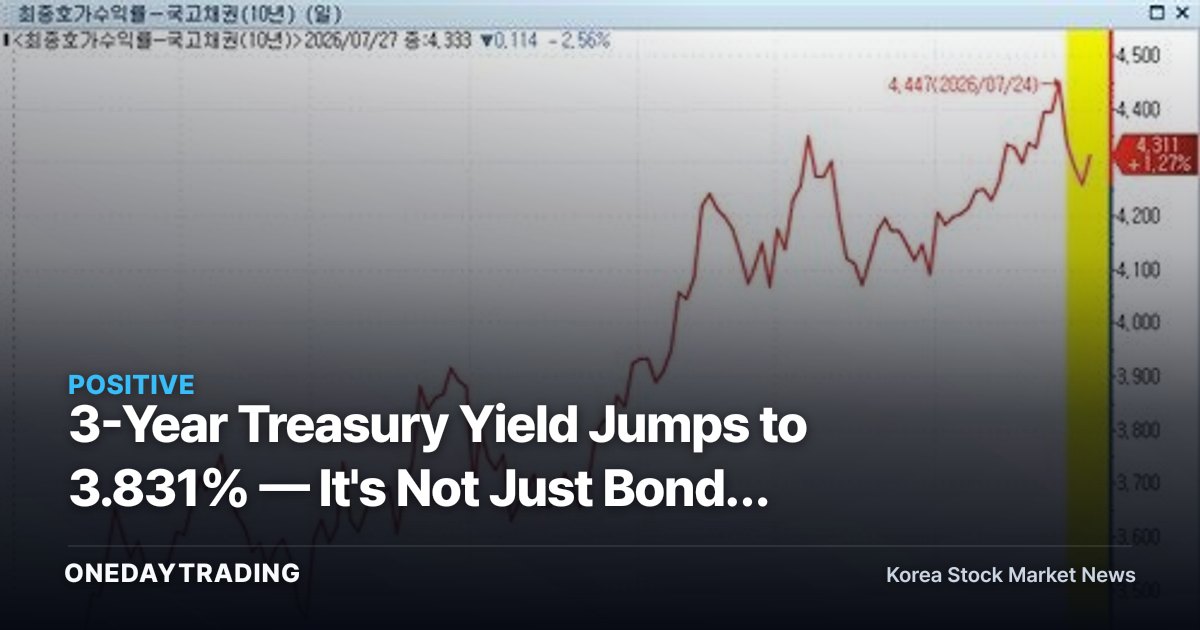
On the 30th, the yield on 3-year Korean Treasury bonds climbed to 3.831% per annum. This wasn't driven by domestic factors — it was a direct, same-day pass-through of the rise in U.S. Treasury yields. What matters now isn't the 3.831% level itself, but whether this move is a one-day reaction or the start of a sustained repricing trend. Depending on the direction, bank stocks and growth stocks could move in opposite directions.
Why It Matters Now
The fact that Korean government bond yields moved in lockstep with U.S. rates — rather than domestic monetary policy — is itself a signal. Given the sizable share of foreign investors holding domestic bonds, when U.S. Treasuries become more attractive, relative selling pressure emerges in Korean bonds as well, pushing yields higher together. Even if the Bank of Korea wants to base its policy decisions purely on the domestic inflation and growth trajectory, its autonomy is constrained when U.S. rates move in a different direction.
Interest rates serve as the discount rate for equity valuations. When Treasury yields rise, the present value of future earnings falls — but this effect plays out differently across industry sectors. For sectors like banking and insurance, which generate profit from loan-deposit margins and reinvestment yields on long-term bonds, rising rates translate directly into margin expansion. Conversely, growth stocks and high-valuation tech names, whose profits are further out on the horizon, see steeper discounting and compressed valuation multiples.
The key question is separating what the market has already priced in from what it hasn't. Bank stocks have already been repriced multiple times during past rate-rising cycles. Whether there's still room for this latest rate increase to be newly reflected in bank stock prices, or whether the benefit has already been priced in with limited further upside, cannot be determined from this single data point alone.
Frequently Asked Questions
- Why does a rise in Treasury yields affect stock prices? Bond yields serve as the benchmark discount rate for equities, so when rates rise, the present value of future profits declines. Growth stocks with earnings concentrated further in the future take the bigger hit.
- Why do Korean rates follow U.S. rates higher? Foreign investors hold a substantial share of the domestic bond market, so when U.S. Treasuries become more attractive, selling pressure on domestic bonds rises in tandem. The Bank of Korea's monetary policy also can't ignore the Korea-U.S. rate gap.
- Will this rate increase also affect loan rates? The 3-year Treasury yield is one of the benchmarks for bank lending rates and corporate bond issuance rates, so it will feed through — with a lag — into the cost of new loans and corporate bond funding.
- Will bank stocks rise automatically? Not necessarily. While margin-expansion expectations exist, much of that benefit may already be priced in after several previous rate-rising cycles.
Related Stocks (Tickers) and Sector Impact
- KB Financial Group, Shinhan Financial Group, Hana Financial Group — Rising rates could translate into wider loan-deposit margins. That said, this expectation has already been priced in to some extent during prior rate-rising cycles.
- Samsung Life Insurance and other life insurers — Life insurers with long liability durations stand to benefit relatively more as reinvestment yields on long-term bonds improve.
- Growth stocks and high-valuation tech names — These face greater valuation pressure from the higher discount rate. Companies whose profits have yet to fully materialize will see the sharpest multiple compression.
- Construction and real estate-related sectors — Higher rates can raise project-financing costs and mortgage burdens, acting as a drag on demand.
- Companies with upcoming corporate bond issuance — Rising funding costs mean higher expenses for new bond issuance, adding to financial burden.
Investment Considerations
- Whether this move is a one-day reaction or a trend-level shift needs to be confirmed by tracking Treasury yields over the coming days.
- The U.S.-driven rate shock constrains the Bank of Korea's policy autonomy. Watch how the Monetary Policy Board addresses this spillover in its next decision.
- Expectations for bank-stock benefits may already be substantially priced in, so the direction of rates alone shouldn't be taken as a guarantee of further upside.
- Keep an eye on the KRW/USD exchange rate as well. A widening Korea-U.S. rate gap can simultaneously increase capital-outflow pressure and upward pressure on the exchange rate.
Overall Outlook
In the optimistic scenario, this increase proves to be a temporary reaction to U.S. developments, with no major shift in Korea's domestic inflation and growth trajectory, allowing Treasury yields to stabilize again. In that case, the impact on KOSPI valuations would be limited. The risk scenario is that the rise in U.S. rates becomes entrenched as a trend. In that case, the Bank of Korea's policy flexibility would narrow further, and repricing pressure could spread across the broader, growth-stock-heavy KOSPI. Key indicators to watch next include the Bank of Korea Monetary Policy Board schedule, domestic and international CPI data, and whether the KRW/USD exchange rate tests a new level.
This article was automatically summarized and analyzed based on the original news source. View Original Article (Yonhap News Agency, Securities)