
3-Point Briefing
- According to The Elec, Qualcomm unveiled its next-generation Hexagon NPU on the 10th local time, optimized for continuously running agentic AI. The key change for investors is that it establishes a foundation for shifting AI computing from feature demonstrations to sustained task execution directly on smartphones.
- According to The Elec, Qualcomm's new Hexagon introduces an element accelerator and a mixture-of-experts, or MoE, architecture for the first time, while expanding shared memory by 50%.
- According to The Elec, further details will be disclosed at the Qualcomm Snapdragon Summit in the United States from the 22nd through the 24th. Investors will need to assess at the event whether the technology translates into real product competitiveness.
How Qualcomm Hexagon Is Reshaping On-Device AI Architecture
Qualcomm Hexagon is a mobile neural processing unit, or NPU, built into the Snapdragon platform. According to The Elec, the investment significance of this announcement lies in Qualcomm defining a computing architecture capable of continuously running agentic AI inside smartphones. Rather than simply supporting larger models, the design selectively processes only the computations required for each task.
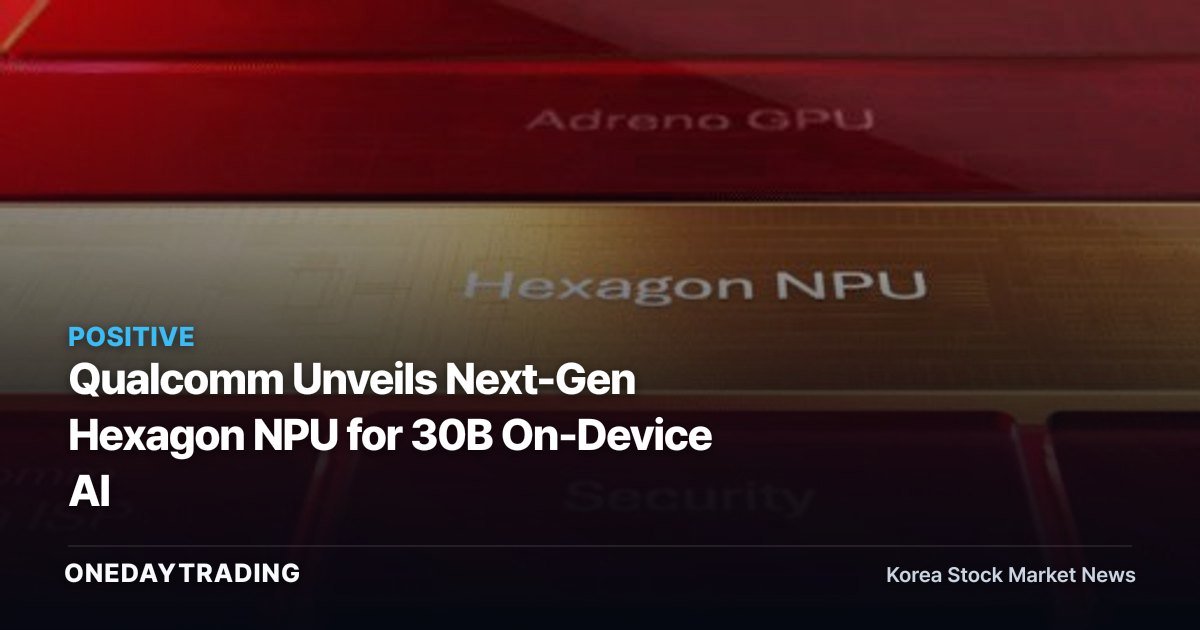
According to The Elec, the new Hexagon combines an element accelerator, expanded shared memory, and an MoE architecture. The Oryon CPU coordinates AI workflows and supplies data to the NPU, while the Adreno GPU incorporates a dedicated acceleration architecture based on NPU design concepts. From an investment perspective, the platform's real-world competitiveness will depend less on the performance of any single processor and more on how the CPU, NPU, and GPU divide and execute a shared workload.
Why Activating 3B Matters More Than Supporting 30B
According to The Elec, Qualcomm's new Hexagon can run MoE models with up to 30 billion (30B) parameters, while approximately 3 billion (3B) parameters are activated during token generation. That means roughly 10% of the supported parameters are active, calculated by dividing 3 billion by 30 billion. This reflects an architecture that selects only the parameters required for a task instead of activating the entire model each time.
According to The Elec, the new Hexagon's shared memory has been expanded by 50%. Taken together with the architecture described by the same source, investors should focus not only on the model's headline size but also on how smoothly the NPU can sustain the selected computations internally. If this architecture performs as intended, it would strengthen the technical feasibility of Qualcomm's vision for handling repetitive agentic AI tasks on smartphones. However, there is not yet enough evidence to quantify the product impact before devices using the technology are confirmed.
What Precision Support and Response Speed Indicate
According to The Elec, Qualcomm's new Hexagon supports 16-bit floating point (FP16), 2-bit integer (INT2), 4-bit integer (INT4), 8-bit integer (INT8), and FP8 formats. Support for multiple precision levels suggests greater flexibility in meeting the computational requirements of different workloads.
According to The Elec, Qualcomm reports up to a 50% improvement in INT4-based prefill speed, with responses beginning within 1.5 seconds. The next validation step for investors is clear: more important than the announced speed itself is whether the Snapdragon platform and actual devices can deliver the same user experience.
Impact Pathways for Qualcomm and the Mobile AI Sector
- Qualcomm: According to The Elec, the new Hexagon will be integrated into Qualcomm's Snapdragon platform. This creates the most direct path for agentic AI computing performance to enhance the platform's competitiveness.
- Mobile AI semiconductors: According to The Elec, the CPU coordinates workloads and supplies data to the NPU, while the GPU also incorporates NPU design concepts. This signals that competition is expanding from individual accelerators to how computing tasks are distributed across the platform.
- Memory and AI model ecosystem: According to The Elec, the project involved collaboration with major memory manufacturers and AI model developers. However, because the companies were not identified, there is no basis for linking the announcement to any individual beneficiary stock (ticker).
Risk Checklist Ahead of the Snapdragon Summit
- The information confirmed by The Elec does not include a launch date for the new Hexagon. The time lag between the announcement and commercialization therefore cannot yet be determined.
- According to The Elec, no specific devices featuring the new Hexagon have yet been confirmed. If adoption is limited to a narrow product range, the assessment of its platform-wide impact would change.
- According to The Elec, the specific details to be announced at the summit remain unknown. The key question is whether information released from the 22nd through the 24th connects the current technical specifications to specific products.
- According to The Elec, Vinesh Sukumar said the new Hexagon NPU establishes a foundation for agentic AI. This is the company's characterization, and actual performance in commercial devices will require separate verification.
Bottom Line
According to The Elec, Qualcomm's new Hexagon expands the technical foundation for on-device agentic AI by running MoE models with 30 billion (30B) parameters while selectively computing approximately 3 billion (3B) parameters. The key inflection point for investors will be whether Qualcomm reveals supported devices and launch information at the Snapdragon Summit from the 22nd through the 24th.
Frequently Asked Questions
When will Qualcomm's new Hexagon launch?
The launch date for the new Hexagon was not confirmed in the information reported by The Elec. Further details are scheduled to be announced at the Qualcomm Snapdragon Summit in the United States from the 22nd through the 24th.
Which smartphones will feature the new Hexagon?
According to The Elec, the new Hexagon will be integrated into the Snapdragon platform, but no specific devices have been confirmed. Linking it to a particular smartphone or manufacturer would therefore go beyond the available information.
Can investors identify Korean beneficiary stocks from Qualcomm's announcement alone?
According to The Elec, major memory manufacturers and AI model developers participated in the collaboration, but their names were not disclosed. Assessing whether any individual Korean stock (ticker) will benefit directly requires further confirmation of the partners and supply relationships.
Qualcomm Key MetricsAs of 2026-09-13
| Period Return | 1 Week +7.95% 1 Month +11.59% |
|---|
Price and supply-demand (order flow) data are real-time figures from Korea Investment & Securities (KIS), while supply-demand (order flow) and news-tone aggregates are calculated independently by OneDayTrading.
This article was automatically summarized and analyzed based on the original news report. View original article (The Elec)