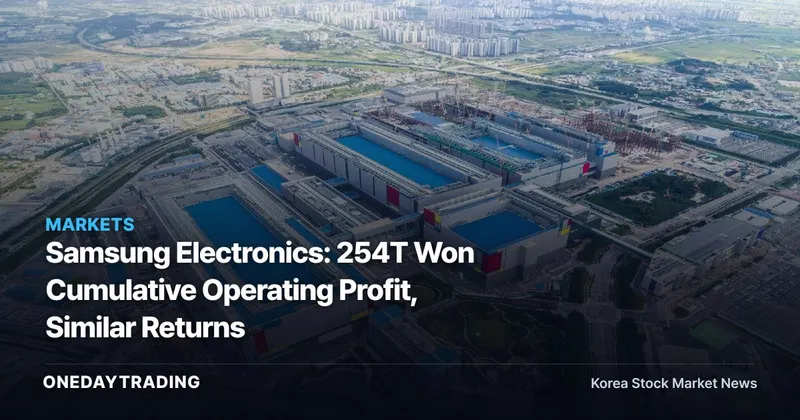

Samsung Electronics presented its third-quarter 2026 earnings and annual shareholder-return plan. According to a 2026-10-29 report by Maeil Business Newspaper’s securities desk, the key point for investors is not the record quarterly earnings themselves, but that the surge in profit did not translate into a wider gap in shareholder returns.
Samsung Electronics Earnings and Shareholder Returns in Three Points
- Samsung Electronics posted record quarterly earnings, driven by the artificial intelligence (AI) semiconductor boom.
- Samsung Electronics’ cumulative operating profit through the third quarter this year reached 254 trillion won, about 40% more than SK hynix over the same period.
- Despite the difference in profit, Samsung Electronics’ annual shareholder-return plan was similar in scale to SK hynix’s.
What the 254 Trillion Won Figure Does Not Reveal
Cumulative operating profit of 254 trillion won demonstrates the scale of Samsung Electronics’ profit generation. Combined with its record quarterly earnings, it also clearly shows that the AI semiconductor boom has benefited the company’s earnings. Separating what has and has not been confirmed, the absolute level of profit and Samsung’s lead over its competitor are established, while exact third-quarter revenue and operating profit remain unconfirmed.
The announcement therefore should not be extended into a detailed profitability analysis of the individual quarter. Because revenue and operating profit for the quarter were not provided, there is no basis for calculating how much each business contributed to earnings. The link between the AI semiconductor boom and record quarterly earnings has been confirmed, but assigning contributions to individual business units would go beyond the available data.
Samsung Earned 40% More Than SK hynix but Planned Similar Returns
Samsung Electronics’ cumulative operating profit through the third quarter was about 40% higher than SK hynix’s, yet the companies’ annual shareholder-return plans were similar in scale. Rather than establishing which company returned more money, this comparison shows that the profit gap did not translate directly into a corresponding gap in planned shareholder returns.
This is also where the investment assessment diverges. Record earnings may be viewed as evidence of strong profit-generating capacity, but that alone does not establish that the intensity of shareholder returns increased as well. If Samsung Electronics maintains a plan similar in scale to SK hynix’s, investors will need to assess profit size and shareholder-return policy separately.
Conversely, because the exact annual shareholder-return amounts were not provided, it is impossible to calculate either company’s payout ratio or the burden relative to profit. The comparison can go no further than the confirmed relationship that the plans were at a “similar level.” Determining the precise difference in amounts and their relative efficiency requires the actual figures for each company’s plan.
Interest Rates and AI Investment: Variables Beyond Semiconductor Earnings
The U.S. Federal Reserve (Fed) held interest rates steady. The related material also cited a figure of 78% for December, but the level at which rates were held was not confirmed. Rather than directly linking the interest-rate variable to Samsung Electronics’ earnings and drawing a firm conclusion, investors should separately monitor whether the Fed maintains its hold at its next policy decision.
Within the AI industry, earnings and funding pressures have not moved in only one direction. Concerns have emerged over the cash-flow burden from Google’s large-scale AI investment, while OpenAI’s fundraising in the Middle East has attracted attention. This is why investment growth cannot immediately be equated with demand for AI semiconductors. As no investment or fundraising amounts or schedules were provided, there is also no basis for translating these developments into an impact on Samsung Electronics’ profit and loss.
Samsung Electronics Metrics to Watch in the Next Announcement
- Quarterly earnings: Investors should check whether exact revenue and operating profit are disclosed, allowing the earnings contribution from the AI semiconductor boom to be assessed in greater detail.
- Shareholder returns: The actual annual amounts for Samsung Electronics and SK hynix must be confirmed before comparing the intensity of returns relative to profit.
- Monetary policy: Whether the U.S. Federal Reserve (Fed) continues to hold rates at its next decision remains an external variable.
- AI fund flow: Investors should watch whether specific amounts and timelines emerge for Google’s investment burden and OpenAI’s Middle East fundraising.
Record quarterly earnings confirmed Samsung Electronics’ profit-generating strength. The next question for investors is not whether the company earned more, but how those profits will be allocated to actual shareholder returns within the AI investment environment.
Samsung Electronics Key MetricsAs of 2026-10-29
| Period Return | 1 Week +6.88% 1 Month -15.09% |
|---|---|
| Trading Value · Trading Volume | 936.3 billion won · 28,218,259 shares |
| Supply-Demand (Order Flow) | Foreign Investors Net buying of 59.7 billion won (3 consecutive days) Institutional Investors Net selling of 115.8 billion won |
| Recent News Tone | Positive Catalyst 16 · Negative Catalyst 1 |
Price and supply-demand (order flow) data are real-time figures from Korea Investment & Securities (KIS), while supply-demand (order flow) and news-tone tallies are calculated independently by One Day Trading.
Supply-Demand (Order Flow) and Momentum Assessment🟡 Neutral · Wait and See
With positive and negative signals diverging, this is a period to watch.
- ▲Order-Flow ContinuityForeign investors posted net buying for 3 consecutive days (+59.7 billion won)
- ▲News FlowPositive catalyst 16 vs negative catalyst 1 — positive catalysts prevail
Upcoming Events to Watch
- 11.12Index Options ExpirationLowKOSPI 200 options expiration
- 11.26Bank of Korea Monetary Policy BoardHighBenchmark interest rate decision meeting
- 12.09FOMC Policy Rate DecisionHighU.S. Federal Reserve monetary-policy announcement — direction of interest rates and the dollar
- 12.10Futures and Options ExpirationMediumQuadruple witching — watch for volatility and supply-demand (order flow) disruptions
This article was automatically summarized and analyzed from the original news report. View original article (Maeil Business Newspaper Securities)