
KOSPI at 6,000 Signals a Semiconductor Revaluation
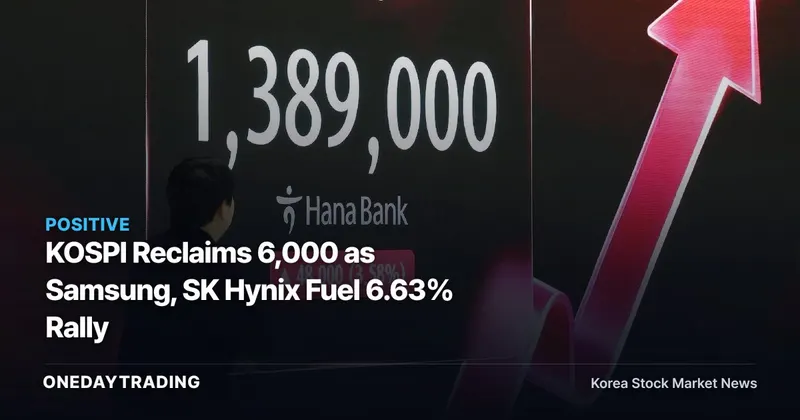
The KOSPI closed at 6,012.44 on October 28, 2026, up 6.63%. The investment implications of the rebound reported by Maeil Business Newspaper’s securities desk are clearer than the index milestone itself. Buying was concentrated in Samsung Electronics and SK Hynix, with SK Hynix quantifying how AI demand is translating into earnings and shareholder returns.
Separating what has been confirmed from what has not, earnings improvement at large semiconductor companies is evident, but there is no proof that AI optimism has translated into earnings across all technology stocks. The KOSPI’s return above 6,000 may reflect a reassessment of semiconductor earnings, but the available data do not support concluding that profit expectations for the entire market have risen at the same pace.
KOSPI Regains 6,000 at the Close After 10 Trading Days
The KOSPI ended at 6,012.44, up 374.10 points from the previous session. It reclaimed the 6,000 level on a closing-price basis for the first time in 10 trading days since October 14. The opening price was 5,763.85, up 125.51 points or 2.23%, before the index reached 6,003.22 at around 11 a.m., extending its gain to 6.47%.
The speed of the advance was also unusual. At 9:54:24 a.m., a buy-side program trading curb was triggered on the KOSPI market for a second consecutive day. This mechanism suspends program buy orders for five minutes during sharp market swings.
Samsung Electronics and SK Hynix Drive the Index
Samsung Electronics closed at 242,000 won on October 28, 2026, up 9.01%. SK Hynix ended the same session at 1,487,000 won, gaining 10.89%. Because the simultaneous sharp gains (surges) of the two largest stocks by market capitalization drove the KOSPI higher, the rally was shaped more by price moves in semiconductor heavyweights than by the number of advancing stocks.
On the KOSPI market, 582 stocks advanced and 289 declined. The KOSDAQ also closed at 771.28, up 27.45 points or 3.69%. The broader number of gainers and the KOSDAQ’s advance show that the rebound was not confined to the two semiconductor stocks. However, the influence of Samsung Electronics and SK Hynix must be considered separately when assessing the size of the KOSPI’s gain.
SK Hynix Earnings Show How AI Demand Is Flowing Through
SK Hynix disclosed preliminary third-quarter revenue of 104.6155 trillion won, up 327.9% year over year. Operating profit increased 632.1% to 83.3338 trillion won, while net profit rose 215.7% to 39.7756 trillion won. These figures provide evidence that the AI investment narrative has translated into revenue and profit for a memory-chip company.
The company also decided to provide more than 60 trillion won in additional shareholder returns through share buybacks and cancellations. Combined with the 40 trillion won announced in August, total shareholder returns projected for this year amount to 100 trillion won. The significance for shareholder value is that profit growth will not remain solely within the company but will lead to share repurchases and cancellations.
Lee Jae-won, an analyst at Yuanta Securities, described this as “a process in which earnings are disproving concerns about the sustainability of artificial intelligence (AI) investment and the theory that memory profits have peaked.” Expectations for an Anthropic initial public offering and news of a $63 billion AI infrastructure financing transaction were also said to have boosted market sentiment, but the actual IPO timetable and the specific parties and terms involved in the financing have not been confirmed.
Foreign and Institutional Buying Meets Retail Selling
As of 3:50 p.m., foreign investors had purchased a net 1.1488 trillion won and institutional investors a net 1.1719 trillion won on the KOSPI market. Retail investors sold a net 2.3193 trillion won. The index’s rise clearly coincided with net buying by both foreign and institutional investors, but whether this supply-demand (order flow) will persist requires further observation.
If buying by foreign and institutional investors continues, the index momentum centered on semiconductor heavyweights may be sustained. Conversely, if supply-demand (order flow) weakens, moves in Samsung Electronics and SK Hynix—both of which posted substantial short-term gains—could again increase KOSPI volatility.
The Next Figures Semiconductor Investors Should Watch
- SK Hynix earnings: Investors should check whether the trends in revenue, operating profit, and net profit continue in the next earnings release. Third-quarter figures were strong, but a single quarter’s growth rates cannot establish that the profit trend is sustainable.
- Execution of shareholder returns: Subsequent disclosures should be monitored for a detailed schedule and execution plan covering the additional share buybacks and cancellations of more than 60 trillion won.
- Supply-demand (order flow) in large-cap stocks: Investors should watch whether net buying by foreign and institutional investors continues and whether the day’s supply-demand (order flow), accompanied by net retail selling, proves temporary.
- Evidence supporting AI investment: Disclosure of Anthropic’s IPO timetable and the parties and terms involved in the $63 billion AI infrastructure financing transaction would mark the point at which expectations become verifiable facts.
What Could Sustain or Derail the KOSPI Rebound
In the bullish scenario, SK Hynix’s profit growth continues in its next disclosure and the additional shareholder returns are carried out through actual share purchases and cancellations. If foreign and institutional buying of Samsung Electronics and SK Hynix is also sustained, the KOSPI’s recovery above 6,000 would look more like an earnings revaluation than a simple price rebound.
The risk lies in the gap between expectations and verifiable figures. Until Anthropic’s IPO timetable and the terms of the AI infrastructure financing transaction are disclosed, the precise causal effect on market sentiment cannot be calculated. The next call will depend less on the first digit of the index than on the durability of semiconductor earnings and the execution of shareholder returns.
KOSPI Index MetricsAs of 2026-10-28
| Performance | 1 Week +4.83% 1 Month -15.09% |
|---|
Index, commodity, and exchange rate figures are based on global markets and reflect values at the time of publication.
Samsung Electronics Key MetricsAs of 2026-10-28
| Returns by Period | 1 Week +8.72% 1 Month -14.89% |
|---|---|
| Trading Value · Trading Volume | 121.4 billion won · 28,090,463 shares |
| Supply-Demand (Order Flow) | Foreign Investors Net buying of 383.2 billion won Institutional Investors Net buying of 407 billion won |
| Recent News Tone | Positive Catalysts 13 · Negative Catalysts 2 |
Price and supply-demand (order flow) data are real-time figures from Korea Investment & Securities (KIS), while supply-demand (order flow) and news-tone aggregates are calculated independently by One Day Trading.
Upcoming Dates to Watch
- 10.28FOMC Policy Rate DecisionHighU.S. Federal Reserve monetary policy announcement — direction of interest rates and the dollar
- 11.12Index Options ExpirationLowKOSPI200 options expiration
- 11.26Bank of Korea Monetary Policy BoardHighBenchmark interest rate decision meeting
- 12.09FOMC Policy Rate DecisionHighU.S. Federal Reserve monetary policy announcement — direction of interest rates and the dollar
This article was automatically summarized and analyzed from the original news report. View the original article (Maeil Business Newspaper Securities)