
What Bloomberg Reclassification Would Mean for Investors
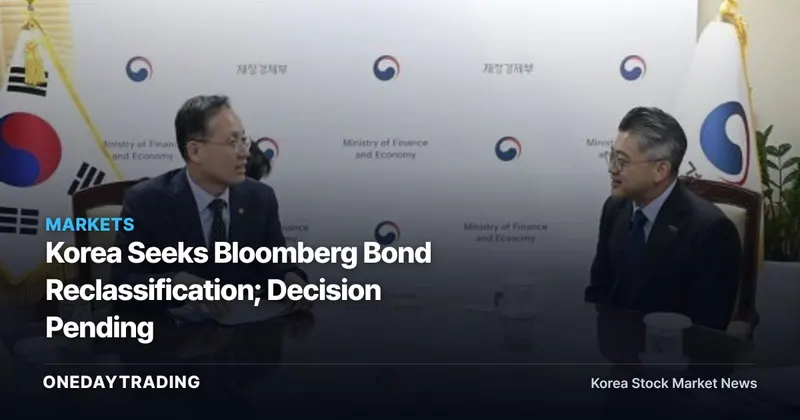
The government’s push to change Korea’s classification in the Bloomberg Aggregate Bond Index does not immediately determine the direction of bond prices. According to Asia Economy Securities, the Ministry of Finance and Economy said Deputy Prime Minister Lee Hyoung-il and Bing Li, Bloomberg’s Asia-Pacific regional head, discussed possible approaches to reclassifying Korea as a developed market on 2026-10-28. Investors should first distinguish between the government’s request and Bloomberg’s decision.
Country classifications in the Bloomberg Aggregate Bond Index determine which market group Korea’s financial market belongs to within the index. So far, only the reclassification initiative and discussions between the two sides have been confirmed. Whether the classification will change, and when a decision might be made, remain unknown.
Classification Issue Raised Within the Three Major Bond Indices
Asia Economy Securities described the Bloomberg Aggregate Bond Index as one of the world’s three major global bond indices. The other systems cited were the WGBI, operated by Financial Times Stock Exchange (FTSE) Russell, and JPMorgan’s Emerging Markets Bond Index. The current discussion is not about Korea’s inclusion in the index, but whether classifying it as an emerging market within Bloomberg’s framework remains appropriate under current conditions.
Korea has retained emerging-market status since joining the Bloomberg Aggregate Bond Index in 2002. This history shows that the current request concerns a review of an existing country classification, not entry into a new index. Investors should likewise avoid conflating “new index inclusion” with a “market-group change.”
The Ministry’s Case for Reclassification
Deputy Prime Minister Lee Hyoung-il said it was necessary to review whether the emerging-market classification remains appropriate, citing Korea’s international economic standing, growth of its government bond market, and improved market accessibility. He also emphasized that the International Monetary Fund (IMF) and World Bank classify Korea as a developed economy. The government’s case is that Bloomberg’s country classification should reflect both Korea’s current financial-market standing and its classification by other international organizations.
Bing Li expressed a commitment to maintaining communication and cooperation with the Korean government. Bloomberg and the government agreed to continue working together to connect markets and deepen global investors’ understanding of Korea’s financial market. A willingness to cooperate, however, is clearly distinct from approval of reclassification.
How Korean Bonds and Related Markets Could Be Affected
- Korean government bond market: If developed-market reclassification occurs, the country classification applied to Korean bonds would change. The available information is insufficient to conclude that investment would expand or prices would change.
- Bloomberg Aggregate Bond Index: The issue under discussion is whether Korea’s emerging-market status remains appropriate, not whether Korea should be included in the index. The classification criteria must be disclosed before investors can assess how the government’s arguments would be treated in any evaluation process.
- Individual listed companies: The disclosed facts identify no companies that would directly benefit or suffer, nor any channel through which earnings would be affected. Labeling particular financial or securities stocks as beneficiaries would go beyond the available evidence.
What the Market Knows—and What It Does Not
What has been confirmed is that the government is seeking developed-market reclassification and has discussed the matter with Bloomberg. What cannot yet be assumed to be reflected in prices is whether reclassification will ultimately occur or when it might happen. If Bloomberg formally proceeds with a country-classification review, the matter would move from the request stage to the evaluation stage, but that alone would not constitute approval.
The trigger for a downside scenario would be a mismatch with the evaluation criteria. If specific criteria are disclosed and Korea’s international standing and improved market accessibility, as emphasized by the government, fail to satisfy them, the case for reclassification would weaken. Because the current materials do not specify the criteria, compliance cannot be assessed in advance.
Signals Investors Should Watch Next
- Review timeline: Investors should watch for confirmation of when Bloomberg will review the country classification. No schedule has been disclosed.
- Evaluation criteria: The starting point for any assessment is whether Bloomberg provides specific conditions for developed-market reclassification.
- Wording of the decision: Continued discussions, the launch of a review, and a reclassification decision have different meanings. Investors should distinguish how far the process has advanced in subsequent announcements.
- Scope of cooperation: Investors should watch how the Korean government and Bloomberg continue communicating to deepen global investors’ understanding of the market.
Focus on the Decision Process, Not Reclassification Hopes
The optimistic path would involve Bloomberg formally reviewing whether Korea’s classification remains appropriate and incorporating the government’s arguments about government bond market growth and improved accessibility into its evaluation. This would move the developed-market reclassification discussion for Korean bonds one step forward. The first things to confirm are not expectations, but the launch of a review and its evaluation criteria.
The risk lies in pricing the initiative as though it were already complete when neither a timeline nor criteria have been provided. If Bloomberg maintains the existing classification, the discussions will not lead to reclassification. The next macro triggers are not arbitrary levels for interest rates or the exchange rate, but Bloomberg’s review schedule, decision criteria, and final classification announcement.
This article was automatically summarized and analyzed based on the original news report. View original article (Asia Economy Securities)