
What Nvidia’s $3 Billion Investment Means for Investors
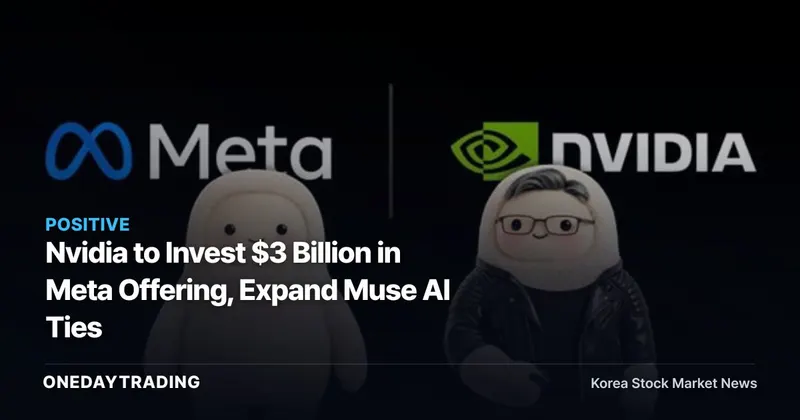
Nvidia said on the 26th local time that it would invest $3 billion in Meta’s paid-in capital increase. The key investment takeaway from the announcement, as reported by The Elec, is not simply the equity acquisition but the integration of Meta’s “Muse” AI model with Nvidia’s computing infrastructure. The partnership combines capital investment, expanded server-rack deployments and model performance improvements in a single framework.
The Muse collaboration will connect Nvidia’s computing infrastructure and related technologies to improve the training and inference performance of Meta’s AI models. Investors should distinguish between the announced capital relationship and actual business results. Nvidia’s participation in the paid-in capital increase has been confirmed, but the scale of equipment purchases and the collaboration schedule have not been disclosed, making it too early to quantify the potential revenue contribution or performance gains.
Structure of Meta’s Offering and Nvidia’s $3 Billion Participation
Meta announced an offering of 250 million Series A depositary shares priced at $50 per share and Class A common stock priced at $625 per share. The Class A common stock offering totals $25 billion, or approximately 33.202 trillion won. Because the prices and offering sizes of different securities were presented together, the figures should not be combined or interpreted as a single per-share price or identical issuance terms.
Nvidia’s participation was stated at $3 billion, or approximately 3.984 trillion won. The figure shows that the companies’ interests will be linked through capital, but the materials do not specify the exact stake Nvidia will acquire. Neither the completion of the paid-in capital increase nor its closing date has been confirmed, so the announced investment amount should not be treated as equivalent to the final acquisition outcome.
The Path from “Muse” to Vera Rubin
The direct relevance to Nvidia’s business lies in Meta’s plan to expand purchases and data-center deployments of “Vera Rubin” and “Vera CPU” server racks. Improving model training and inference requires computing infrastructure to be deployed in actual data centers. The quality of the partnership therefore depends less on the equity investment announcement itself than on whether the planned deployment expansion translates into specific purchase volumes and amounts.
The technical collaboration extends beyond hardware. Meta is considering adopting Nvidia’s “OpenShell” reference architecture, while the two companies are discussing ways to use the Sentry integrated security software framework. Addressing models, server racks, reference architecture and security systems together suggests an effort to broaden the foundation for developing and operating AI agents. However, consideration and discussion do not mean implementation has been completed.
Diverging Implications for Nvidia and Meta
- Nvidia: If Meta expands its server-rack purchases and deployments, the path from Nvidia’s equity participation to a tangible AI infrastructure supply relationship will become clearer. Conversely, until purchase volumes and the total amount are specified, the business contribution cannot be calculated from the $3 billion participation alone.
- Meta: Meta will combine Nvidia hardware and related technologies to improve the training and inference performance of the Muse product family. The performance-improvement objective has been confirmed, but the duration and implementation schedule of the partnership agreement have not been disclosed.
- AI infrastructure: The announcement covers not only computing equipment but also server racks, reference architecture and integrated security software. Investors should separately assess whether each element progresses beyond the review stage into actual deployment and use.
Orders, Not the Equity Stake, Are the Next Metric to Watch
Speaking through The Elec, Jensen Huang described AI agents as a new computing paradigm capable of understanding goals, reasoning and using tools autonomously. He also said the companies aim to optimize the full computing infrastructure stack to support the achievements and ambitions of billions of people. These remarks indicate the direction of the partnership, but they do not establish purchase-contract volumes or earnings.
The next items to confirm are whether and when the paid-in capital increase closes, Nvidia’s exact acquired stake, the duration of the partnership agreement and the detailed implementation schedule. From a business perspective, the key inflection points will be the number and total value of Meta’s Vera Rubin and Vera CPU server-rack purchases. If orders and installations follow, investors will have a basis for assessing the partnership’s economic scope. If disclosure is delayed, the gap between the investment announcement and earnings will remain.
Key Nvidia MetricsAs of 2026-10-28
| Period return | 1 week +1.32% 1 month -4.17% |
|---|---|
| Trading value · Trading volume | 279,593 shares |
| Recent news tone | 1 positive catalyst · 2 negative catalysts |
Real-time price and supply-demand (order flow) data are provided by Korea Investment & Securities (KIS), while supply-demand (order flow) and news-tone figures are calculated independently by OneDayTrading.
Supply-Demand (Order Flow) and Momentum Assessment🟡 Neutral · Wait and see
Positive and negative signals are mixed, suggesting a wait-and-see stance.
- ▼News flow1 positive catalyst vs 2 negative catalysts — negative catalysts prevail
This article was automatically summarized and analyzed based on the original news report. View the original article (The Elec)