
Cybersecurity Safe-Harbor Debate: What Investors Should Watch
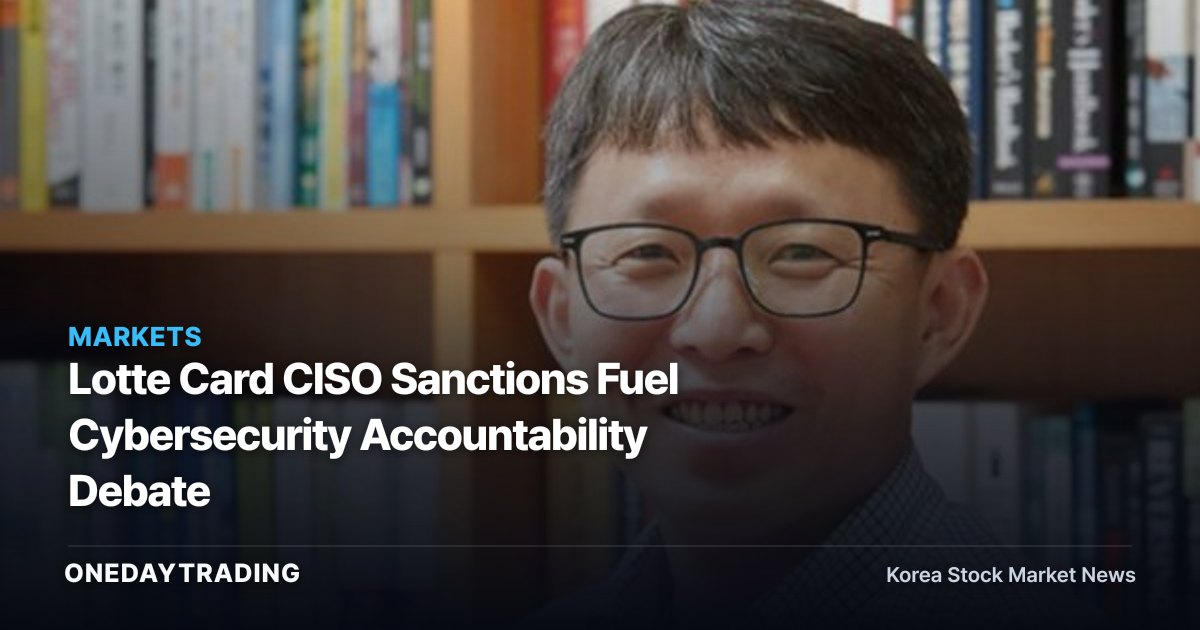
How far to assign responsibility when a security incident occurs affects companies’ cost structures and their ability to recruit security professionals. According to TheElec, Kim Chang-hoon, a professor in Daegu University’s Department of Computer and Information Engineering, argued at a Cyber Summit Korea (CSK) 2026 session held at COEX in Seoul on the 17th that a system should recognize safe-harbor protection for security personnel who meet technical standards and improve their treatment. There is still no evidence that the proposal has been adopted as actual policy, but it raises the question of whether security-investment assessments should shift from a punishment-centered approach to one centered on the level of controls.
What Lotte Card CISO Penalties Reveal About Asymmetric Accountability
Professor Kim cited a case involving current and former Lotte Card CISOs who received three-month suspensions and were barred from employment in the financial sector for four years after disciplinary action in connection with a customer-information leak. The case has raised concerns that security personnel may face severe punishment based solely on the outcome of an incident even when they followed control procedures. For companies, hiring and retaining security staff becomes more expensive, while individual officials gain an incentive to take a defensive stance in decision-making.
The standard he proposed is not a guarantee that incidents will never occur. His statement that “Korea also needs a structure under which no administrative fine is imposed when prescribed technical safe-harbor standards have been followed” means that enforcement decisions should reflect whether predetermined controls were observed. If the standards are vague, safe-harbor protection will remain merely formal; if they are set too low, the effectiveness of personal-information protection could deteriorate.
Kim Chang-hoon’s Proposal and Policy Conflicts
Professor Kim also delivered a presentation in place of Hong Kwan-hee, chief information security officer (CISO) of LG Uplus, who was absent from the session hosted by the National Intelligence Service. He asked rhetorically, “Can the Personal Information Protection Commission itself avoid having personal information stolen?” and stressed that security is not a matter of divine power. The core of his remarks was that responsibility assessments should include the level of technical controls and records of implementation, rather than rely on promises to eliminate the possibility of incidents.
He also pointed out that security systems are moving in different directions across institutions. The public sector is pursuing the National Intelligence Service’s National Network Security Framework (N2SF), the private sector the Ministry of Science and ICT’s zero-trust guidelines, and the defense sector the Ministry of National Defense’s Korean Risk Management Framework (K-RMF). The Financial Services Commission has moved to ease network-separation regulations with the goal of an artificial-intelligence-centered defense system, expanding the entities targeted for abolition of the network-separation requirement to include second-tier financial institutions and electronic financial service providers.
The Issues: The Safe-Harbor Threshold and Common Standards
- Objectivity of technical standards requires designing them around verifiable items established in advance, such as log retention, access controls, and detection and response procedures. The materials did not specify detailed safe-harbor requirements.
- Separating incident outcomes from management processes is necessary. Penalizing officials who followed controls and those who neglected procedures by the same standard could increase responsibility avoidance among security personnel.
- Consistency in terminology and structure across ministries is crucial. If one side strengthens separation through zero trust while another pursues eased network-separation rules, companies’ investment priorities could become unstable.
- Whether the system will be institutionalized remains unconfirmed. Professor Kim’s proposal has been verified as remarks at an event, and there is no evidence that it has been reflected in laws or supervisory regulations.
Related Stocks (Tickers) and Sector Impact
It is difficult to estimate any listed company’s revenue or earnings based solely on these remarks. LG Uplus and Lotte Card appeared in the examples and context, but the report provided no information on either company’s security spending, changes in profit and loss, or share-price impact. Investment decisions should therefore remain focused on identifying the direction of security regulation rather than assuming short-term beneficiaries among individual stocks (tickers).
If policy clarifies technical standards and multiple ministries adopt common criteria, companies may be able to reduce the cost of repeatedly redesigning their security investments. Conversely, conflicting standards or unclear safe-harbor requirements would prolong the cost of building control systems and regulatory uncertainty for financial and telecommunications companies. How zero trust is combined with eased network-separation rules will determine the demand path for related industries.
Points to Consider When Investing
- Check whether the safe-harbor proposal is formalized through laws, supervisory regulations, or administrative guidelines.
- Monitor whether the Financial Services Commission further changes the scope and covered entities under eased network-separation regulations.
- Check whether common technical standards among the National Network Security Framework (N2SF), zero-trust guidelines, and K-RMF are disclosed.
- Compare how companies describe security-incident response costs, internal-control investments, and sanctions against responsible officials in their filings.
Until Policy Adoption, the Wording of the Standards Remains the Variable
If a safe-harbor system is introduced and technical compliance can be objectively demonstrated, it could improve the hiring and decision-making environment for security personnel. But confidence in the system would weaken if it were misunderstood as a procedure for avoiding responsibility after an incident, or if institutions reached different conclusions about whether standards had been met. Common standards would stabilize corporate security design, while continued divergence in ministry requirements would limit potential cost savings.
What has been confirmed so far is Professor Kim Chang-hoon’s proposal, the security systems being pursued by each institution, and the Financial Services Commission’s direction on regulatory easing. The next indicators to watch are official documentation of safe-harbor requirements, the scope of application in the financial sector, and consistency in technical standards across institutions. Until these three points are confirmed, there is insufficient basis to connect policy expectations with corporate earnings or a stock-price revaluation.
This article is automatically summarized and analyzed based on the original news report. View original article (TheElec)