
Summary
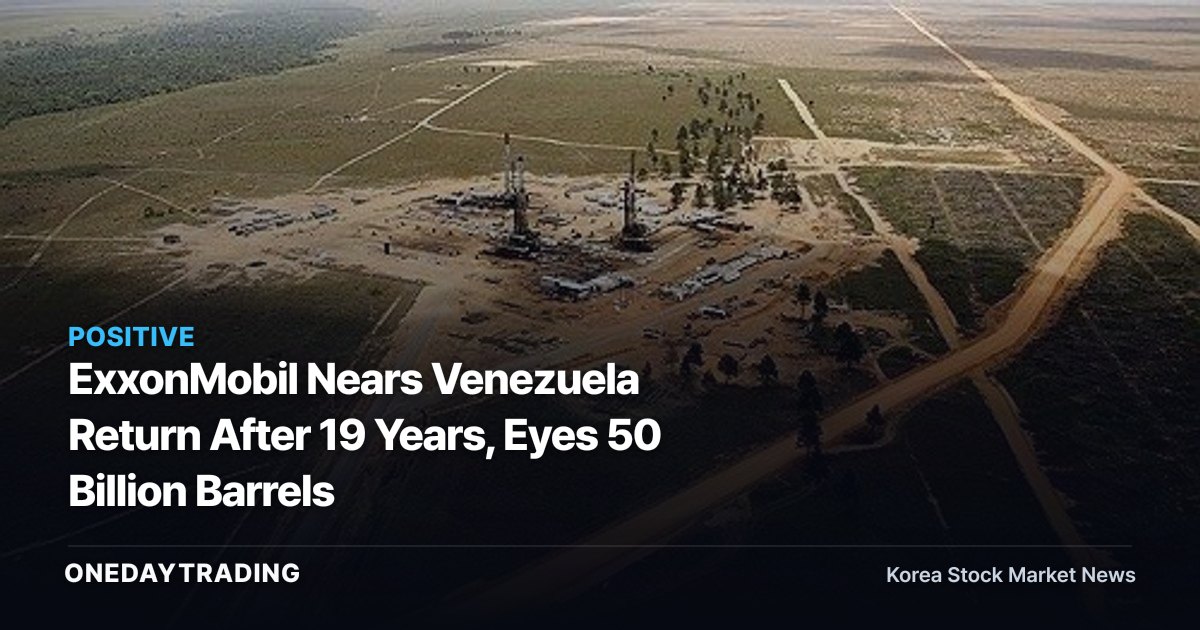
ExxonMobil is nearing a memorandum of understanding (MOU) with Venezuela's state oil company PDVSA covering several oil fields, the Wall Street Journal (WSJ) reported on the 16th (local time), citing sources. If finalized, it would mark the company's return after a 19-year absence following Venezuela's 2007 nationalization of its assets. The fields under negotiation reportedly hold more than 50 billion barrels, with a signing possible this month — though the report also leaves open the possibility of delay or collapse.
19 Years Later: What's Changed?
ExxonMobil and ConocoPhillips had their Venezuelan assets seized in 2007 under a nationalization drive by then-President Hugo Chavez, and the resulting compensation lawsuits are still ongoing. What makes this MOU push notable is that ExxonMobil is looking to put fresh capital into the same country while that litigation remains unresolved. The market's focus has been on whether a "return" is happening at all, but the real question is whether the calculus around nationalization risk has actually changed since 19 years ago. Venezuela claims oil reserves of 300 billion barrels, making the roughly 50 billion barrels now under discussion a slice of that broader resource base.
The backdrop is a political shift. In January, the United States carried out a military operation that captured President Nicolas Maduro and brought him to the U.S., and President Trump and Secretary of State Marco Rubio have since pushed for $100 billion in U.S. corporate investment in Venezuela. On the 31st of last month, the Trump administration signed an agreement with the Venezuelan government securing access to one-fifth of the country's oil reserves. ExxonMobil's MOU push is seen as one of the follow-on moves after that agreement.
Rivals Have Already Moved
While ExxonMobil is still at the negotiation stage, Chevron has already acted. Earlier this month, Chevron signed a deal through a local joint venture to invest $7 billion over the next five years, aiming to double daily output to 600,000 barrels. Continental Resources, led by billionaire Harold Hamm, has also signed an MOU with PDVSA to operate and develop the "Ayacucho 2 Block" in the Orinoco oil belt. Separately, North American BlueEnergy Partners (NABEP), the country's second-largest private oil company, is set to receive 100-year leases on 17 oil fields, with the U.S. Department of Defense's Office of Strategic Capital acquiring a 35% stake in the company while securing 20% of the extracted oil at production cost. It's a picture of private capital and U.S. government capital entering the same fields simultaneously.
What the Market Hasn't Priced In Yet
The news flow so far has been easy to read as a simple "Venezuela is opening up" narrative. But what the WSJ reported was a planned signing, not a completed one — and the report explicitly notes the negotiation could still be delayed or fall through this month. ExxonMobil's specific investment size, the exact MOU signing date, and the final terms have not yet been disclosed. Chevron's and Continental Resources' deals are already locked in with concrete figures ($7 billion, five years, 600,000 barrels), whereas ExxonMobil's is known only as "a negotiation spanning roughly 50 billion barrels." That gap is likely to determine how quickly the market reacts to each company.
Industry Sector and Stock (Ticker) Impact
- ExxonMobil (XOM) — If the MOU leads to an actual signing, the company would secure development rights to roughly 50 billion barrels of oil fields it has been locked out of for 19 years. The key question is how the market prices in the risk premium of re-entering while the 2007 nationalization compensation lawsuit is still pending.
- Chevron (CVX) — Already under contract and moving to expand output toward a doubling of daily production to 600,000 barrels, putting it ahead of rivals in execution.
- ConocoPhillips (COP) — Alongside ExxonMobil, a party to the compensation lawsuit over 2007 nationalization losses, making it a direct stakeholder in any shift in Venezuela policy.
Bull vs. Bear Scenarios
In the bullish scenario, the MOU is signed as planned this month, and further discussion at the G20 energy ministers' meeting translates into concrete terms. In that case, ExxonMobil would become the third major to rejoin Venezuela after Chevron and Continental Resources, securing priority development rights to the roughly 50-billion-barrel resource base.
In the bearish scenario, the negotiation is delayed or collapses. The WSJ report itself leaves that possibility open, and the fact that litigation from the 2007 nationalization remains unresolved leaves a fundamental question mark over Venezuela's reliability in honoring contracts. The fact that ConocoPhillips and ExxonMobil are still disputing compensation suggests that even if this MOU goes through, regime risk has not been fully resolved.
Investor Action Points
- Watch for whether ExxonMobil-related discussions become more concrete at this week's G20 energy ministers' meeting in Houston.
- Track whether the MOU is actually signed and on what date — this has not yet been confirmed.
- Monitor how close Chevron gets to its 600,000-barrel-per-day target as a leading indicator of execution progress.
- Follow the status of the ConocoPhillips and ExxonMobil compensation lawsuits tied to the 2007 nationalization as a gauge of whether Venezuela policy risk persists.
ExxonMobil Key MetricsAs of 2026-09-17
| Period Returns | 1W -0.55% 1M +1.15% |
|---|
Price and supply-demand (order flow) data are real-time figures from Korea Investment & Securities (KIS); supply-demand and news-tone aggregates are OneDayTrading's own calculations.
Supply-Demand (Order Flow) & Momentum Signal🟡 Neutral · Wait-and-See
Bullish and bearish signals are mixed, warranting a wait-and-see approach.
This article was automatically summarized and analyzed based on the original news report. Read original (Yonhap News Agency, Securities)