
What the KOSPI’s Sharp Drop (Plunge) Signals
Corporate earnings forecasts actually rose while the KOSPI collapsed. Yonhap News’ securities desk reported on 2026-11-28 on the KOSPI’s sharp drop (plunge), earnings and valuation indicators, and Daishin Securities’ 2027 outlook. The real message is not that an earnings collapse has been confirmed, but that the price investors are willing to pay for earnings fell sharply first.
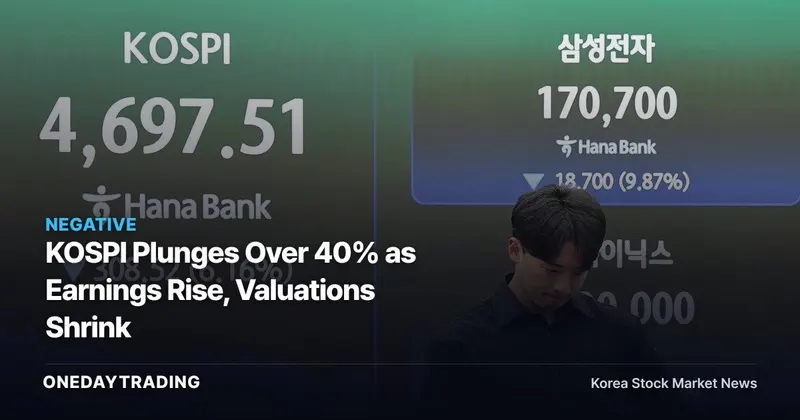
The KOSPI fell more than 40% in just five months, from 9,115p on June 22 this year to 5,060p as of November 6. It rebounded to 5,291p on November 13, but dropped another 3.6% on November 16, retreating toward the 5,100 level. Such rapid price moves may fuel expectations for a rebound, but the report also cautioned that it is too early to declare a V-shaped recovery.
Why Earnings and Share Prices Moved in Opposite Directions
12-month forward earnings per share (EPS) divides projected earnings over the coming year by the number of shares outstanding. According to Yonhap News’ securities desk, the KOSPI’s 12-month forward EPS has increased 32.7% since its June peak. The 2027 operating profit forecast was also raised 7.5% over the past month to 1,356 trillion won.
Over the same period, the KOSPI’s price-to-earnings ratio (PER) contracted 58%, while its 12-month forward PER fell to 3.58 times. Its price-to-book ratio (PBR) stands at 0.96 times. The distinction between what has and has not been confirmed is clear: the improvement in earnings forecasts is supported by data, but whether those forecasts will translate into actual earnings—and the precise timing of the index’s bottom and peak—remains unknown.
From Interest Rates to Valuations and Semiconductors
The U.S. 10-year Treasury yield stood at 5.31% on October 5. When investors lower the price they are willing to pay for earnings in a high-rate environment, PER and PBR multiples compress, with industry sectors that had carried the highest expectations seeing the largest repricing within the index. What the market has already priced into this correction is concern over declining earnings; what remains unconfirmed is the actual scale of that decline.
The semiconductor industry sector trades at a PER of 2.3 times, implying that current prices reflect an assumption that semiconductor earnings will fall 80% next year. That would be deeper than the 60% decline in semiconductor earnings during the 2019 downcycle. Yet semiconductor exports increased 331% year over year from November 1 to 10. If export growth continues, the gap between the downturn priced into the market and the indicators confirmed by data will widen further.
KOSPI Bottom Signals and Near-Term Range
- Outstanding margin loans have declined 33% from their peak, indicating that leverage pressure eased during the sharp drop (plunge).
- Seven of the bottom signals monitored by Daishin Securities have appeared. However, the full methodology and underlying data for those signals were not available in the provided materials.
- The proposed near-term KOSPI range is 4,600–5,900p. Its midpoint of 5,330p corresponds to a PBR of 1 time.
- Among instances since 1980 when the KOSPI fell 30% or more, the median 12-month return after the bottom exceeded 60%. That historical median is a reference point, not a guaranteed outcome for the current cycle.
Implications for the KOSPI and Semiconductor Industry Sector
- KOSPI: 12-month forward EPS has risen while PER and PBR have fallen. If earnings forecasts hold, valuations retain room to normalize; if forecasts weaken, low multiples alone will not be enough to confirm a bottom.
- Semiconductor industry sector: A PER of 2.3 times and the assumption of an 80% earnings decline next year reflect severe downturn concerns. A rerating will depend on whether export growth from November 1 to 10 translates into actual earnings.
- Individual companies: With no company-specific operating profit forecasts provided, there is insufficient evidence to determine which listed companies may benefit or suffer.
Daishin Securities’ 2027 Trajectory
Daishin Securities projects a 2027 KOSPI range of 5,200–8,200p and expects the index to be stronger in the first half before weakening in the second. Its quarterly ranges are 6,000–7,500p for the first quarter of 2027 and 6,500–8,200p for the second quarter. It recommends taking profits above 7,700 in the second quarter and forecasts a year-end 2027 level of 6,900p.
The key to the outlook is the sequence, not the size of the advance: depressed valuations recover first, after which pressure builds again. This echoes John Templeton’s observation that “bull markets are born on pessimism, grow on skepticism, mature on optimism, and die on euphoria,” but whether the forecast will materialize and when the exact peak will occur remain unknown.
Three Numbers to Watch Next
- Watch whether the KOSPI’s 12-month forward EPS sustains the 32.7% increase recorded since its June peak.
- Check whether year-over-year growth in semiconductor exports continues beyond November 1–10.
- The won-dollar exchange rate moved from 1,560 won in May–June this year to the recent 1,330-won range. If the exchange rate trend reverses again, the valuation calculus will also change.
Warren Buffett said, “The stock market is a device for transferring money from the impatient to the patient.” The patience required now is not confidence in calling the bottom. It is the discipline to keep testing whether Daishin Securities’ projected path remains valid by monitoring which turns first: earnings forecasts, semiconductor exports, interest rates, or the exchange rate.
KOSPI Index MetricsAs of 2026-11-28
| Performance | 1 Week -4.32% 1 Month -18.24% |
|---|
Index, commodity, and exchange rate figures are based on global markets and reflect values at the time of publication.
This article was automatically summarized and analyzed based on the original news report. View Original Article (Yonhap News Securities)