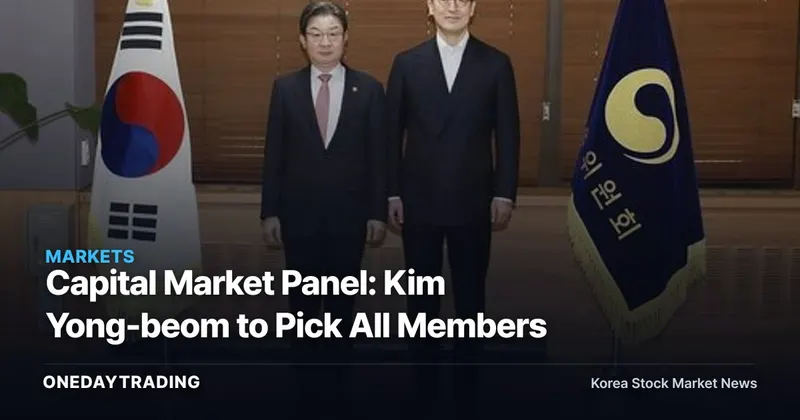

On 2026-11-26, the Financial Services Commission announced that Kim Yong-beom, vice chairman of Meritz Holdings, will lead the government’s capital-market reform body, the Capital Market Transformation Committee, with the selection of its members and reform work entrusted to the private sector. For investors, the significance of the decision reported by Yonhap News’ securities desk lies less in the direction of reform than in whether the policy proposals ultimately translate into actual rules and National Assembly legislation—the benchmark by which the market will assess the initiative.
Capital Market Transformation Committee: Three-Point Briefing
- Kim Yong-beom plans to personally select an entirely private-sector membership for the Capital Market Transformation Committee.
- The committee will identify issues through fact-finding and stakeholder consultations, recommend policies, and monitor implementation progress.
- Its conclusions will be reported directly to President Lee Jae Myung, while the Financial Services Commission will pursue institutionalization through reviews by relevant ministries and National Assembly legislation.
Kim Yong-beom Has Been Given Agenda-Setting Power, Not Just a Title
The Capital Market Transformation Committee is a capital-market reform body in which private-sector figures investigate market problems and propose policy alternatives. Because the government appointed only the chair and left the selection of all other members to Kim Yong-beom, the first test will not be the committee’s name but which private-sector figures are appointed and which problems they place on the agenda.
The path forward is also clear. After the committee gathers evidence and views and submits its proposals, the Financial Services Commission will consult relevant ministries, while measures requiring statutory changes will proceed to the National Assembly. This means that even if the private sector designs the reform plan, implementation and institutionalization must still pass through government and legislative procedures.
One Controlling Shareholder Share and One Ordinary Shareholder Share
The principle articulated by Kim Yong-beom, as reported by Yonhap News’ securities desk, can be summed up as follows: “One share held by a controlling shareholder has the same value as one held by an ordinary shareholder.” From an investor’s perspective, what matters more than the declaration itself is how this principle will be reflected in the committee’s policy recommendations.
After referring to Article 1 of the Constitution of the Republic of Korea, Kim said the system would be designed so that all shareholders can share in the benefits of corporate-value growth. What is clear at this stage is the direction: equal value among shareholders will serve as the standard. Specific policy measures have yet to be disclosed.
How Policy Proposals Translate Into Market Assessments
The market impact will unfold through a sequence of committee research, policy recommendations, reviews by relevant ministries, and National Assembly legislation. If the proposals become policy, the rules applying to companies and shareholders will take shape. If measures requiring legislation are also institutionalized, investors will gain a basis for assessing the policies’ durability.
Conversely, if the recommendations are revised during interministerial consultations or fail to advance to National Assembly legislation, a gap will remain between the committee’s principles and the actual rules. At this stage, there is therefore insufficient evidence to identify specific listed companies as winners or losers. Neither company-level eligibility criteria nor detailed policy proposals have been disclosed.
Why Investors Should Distinguish Meritz Holdings From the Broader Market
- Meritz Holdings and Meritz Financial Group: Kim Yong-beom was described as vice chairman under both company names. The only confirmed link is his current position; no information has been provided on how the committee’s work might affect either company’s earnings.
- Broader capital market: The principle that all shareholders should share in the benefits of corporate-value growth targets the market as a whole. There is no evidence that it will apply only to a particular industry sector or company.
- Individual listed companies: Until the policies and their scope are disclosed, it is more accurate to identify the measures subject to institutionalization and the entities bearing obligations than to compile a list of potential beneficiaries.
Four Variables Investors Should Check First
- Committee roster: Once the members other than Kim Yong-beom are announced, investors will have their first indication of the committee’s areas of expertise and agenda-setting priorities.
- Policy proposals: Investors should watch how the stated principles are translated into specific rules following research and stakeholder consultations.
- Government review: The extent to which the Financial Services Commission and relevant ministries adopt the proposals as policy will determine their implementation potential.
- National Assembly action: The timetable and final outcome for measures requiring legislation must be confirmed before the definitive scope of the rules can be assessed.
Uncertainty Over the Exact Launch Date
The committee’s exact launch date and the roster of members other than Kim Yong-beom have not been confirmed. Specific policy proposals, the related legislative timetable, and final outcomes also remain undisclosed. Until these four gaps are filled, the market can price in only the committee’s private-sector-led operating model and its direct reporting line to the president.
The Line Between Policy Direction and Investment Decisions
Delegating agenda-setting to the private sector and establishing equal value among shareholders as a guiding principle provide a clear direction for capital-market reform. However, the real inflection points for investment decisions will be the committee roster, policy proposals, the extent of adoption by relevant ministries, and the outcome of National Assembly legislation. The next focus should be not on expectations, but on what ultimately becomes institutionalized.
This article was automatically summarized and analyzed based on the original news report. View original article (Yonhap News’ securities desk)