
What the KOSPI Plunge Really Signals
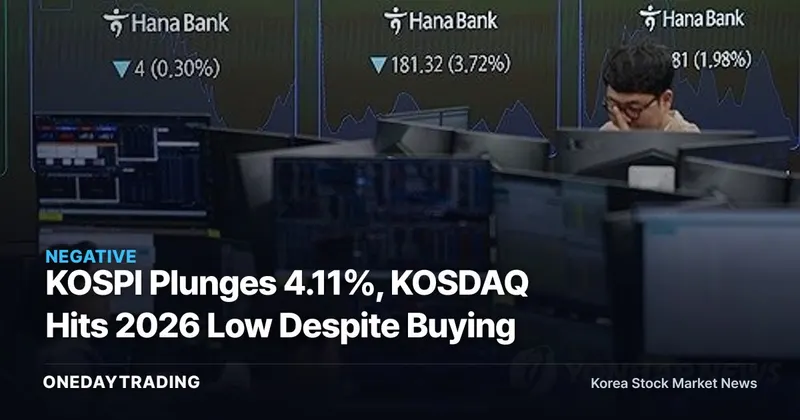
More important to investors than the KOSPI falling over 4% intraday on November 23, 2026, is that both the scale of the decline and supply-demand (order flow) deteriorated at the same time. According to Yonhap News’ securities report, the KOSPI stood at 4,669.82 as of 11:12 a.m., down 200.14 points, or 4.11%, from the previous session. This indicates that selling pressure spread across the broader index rather than remaining confined to a correction in a handful of stocks.
At the same time, the KOSDAQ was down 17.30 points, or 2.68%, at 628.38. It fell as low as 625.21 intraday, breaking the previous 2026 intraday low of 629.17 set on November 6. The intraday decline and new yearly low have been confirmed, but the cause of the selloff and the closing results have not.
Intraday Slide Takes KOSPI into the 4,600s
The KOSPI opened at 4,734.90, down 135.06 points, or 2.77%, from the previous session. The decline later widened to 4.26%, taking the index to an intraday low of 4,662.34. Because the index extended its losses after opening sharply lower, the morning move was more than an opening-price shock.
The KOSDAQ opened at 634.93, down 10.75 points, or 1.66%, from the previous session. It briefly turned higher before falling again, with its intraday loss widening to 3.17%. Unlike the KOSPI, the KOSDAQ reversed direction once before slipping below its yearly low, underscoring its intraday volatility.
Foreign and Retail Selling Diverges from Institutional Buying
In the KOSPI market, foreign investors shifted from net buyers immediately after the open to net sellers, recording foreign net selling of 115.7 billion won as of 11:12 a.m. As of November 23, 2026, this marked a seventh consecutive trading day of foreign net selling. Retail investors were also net sellers of 246.3 billion won, while institutional investors posted institutional net buying of 247.2 billion won.
In the KOSDAQ market, retail investors and foreign investors were net sellers of 83.6 billion won and 4.7 billion won, respectively, while institutional investors posted institutional net buying of 88.3 billion won. Institutional buying appeared in both markets but failed to reverse the morning’s index declines. If selling by foreign and retail investors continues, institutional buying alone would not be enough to conclude that supply-demand (order flow) has turned.
Weakness Spreads to Samsung Electronics and SK Hynix
- Semiconductors: At 11:12 a.m., Samsung Electronics was trading at 175,500 won, down 4.15%, while SK Hynix was down 3.32% at 1,076,000 won. Major semiconductor stocks weakened alongside the KOSPI.
- Largest stocks by market capitalization: SK Square was down 1.77%, LG Energy Solution 2.5%, Samsung Biologics 5.09%, and KB Financial 4.2%. The declines were not confined to a single industry sector.
- Industry sectors: Every industry sector declined, with construction down 7.41%, insurance 5.49%, telecommunications 5.1%, and pharmaceuticals 5.04%. The intraday pattern showed index weakness spreading across multiple sectors.
- Relative strength: KT&G gained 0.11%, APR rose 8.92%, and Korea Cosmetics advanced 10.37%. Even amid broad market weakness, individual stocks did not all move in the same direction.
Stock-Level Divergence as KOSDAQ Hits a Yearly Low
Among the largest KOSDAQ stocks by market capitalization, Alteogen fell 3.5%, EcoPro BM 2.66%, EcoPro 3.37%, and Rainbow Robotics 1.47%. Major biotechnology, secondary-battery, and robotics stocks weakened together while the index traded below its previous intraday low for the year.
By contrast, Robotis gained 4.71%, Wonik IPS rose 0.23%, and PharmaResearch advanced 1.27%. Because performance diverged even within the same market and related fields, the index decline alone cannot be used to characterize every stock’s trajectory. The available data cover only intraday prices and supply-demand (order flow).
Investor Checklist Through the Market Close
- KOSPI decline: Investors should distinguish subsequent moves from the 11:12 a.m. level of 4,669.82 and the intraday low of 4,662.34.
- KOSDAQ yearly low: After reaching 625.21 intraday, the key question is where the index closes relative to its previous yearly low of 629.17.
- Foreign-investor supply-demand (order flow): Investors should watch whether the KOSPI market’s seven-session streak of foreign net selling continues through the close.
- Institutional response: Whether intraday institutional net buying of 247.2 billion won in the KOSPI and 88.3 billion won in the KOSDAQ holds through the close will be critical to assessing supply-demand (order flow).
Conditions for a Rebound and Remaining Downside Risks
In an optimistic scenario, the KOSPI and KOSDAQ would pare their losses after hitting their intraday lows, while foreign investors would shift away from net selling. At the stock level, divergence would continue if KT&G, APR, Korea Cosmetics, and the KOSDAQ-listed Robotis, Wonik IPS, and PharmaResearch maintain moves that run counter to the indexes.
Downside risk would increase if combined selling by foreign and retail investors accelerates and the indexes fall below their intraday lows despite institutional net buying. The closing index levels, final price change rates, investor-category net trading totals at the close, causes of the decline, and subsequent market direction cannot be confirmed from the available data. Declaring a bottom or reversal based only on the morning figures would therefore lack sufficient evidence.
Samsung Electronics Key MetricsAs of 2026-11-23
| Period Returns | 1 Week -11.94% 1 Month -19.58% |
|---|---|
| Trading Value · Trading Volume | 256.4 billion won · 17,336,769 shares |
| Supply-Demand (Order Flow) | Foreign Investors Net selling of 32.6 billion won (6 consecutive days) Institutional Investors Net buying of 40 billion won |
| Recent News Tone | 2 positive catalysts · 3 negative catalysts |
Price and supply-demand (order flow) data are real-time figures from Korea Investment & Securities (KIS), while supply-demand (order flow) and news-tone aggregates are calculated independently by OneDayTrading.
Supply-Demand (Order Flow) and Momentum Assessment🔴 Caution
Foreign-investor, news, and momentum indicators are showing negative signals.
- ▼Supply-Demand (Order Flow) ContinuityForeign net selling for 6 consecutive days (−32.6 billion won)
- ▼Trend AlignmentShort- and medium-term bearish alignment (Today -5.4% · 1 week -11.9% · 1 month -19.6%)
- ▼News Flow2 positive catalysts vs. 3 negative catalysts — negative catalysts prevail
Upcoming Events to Watch
- 11.26Bank of Korea Monetary Policy Board MeetingHighBenchmark interest rate decision meeting
- 12.09FOMC Policy Rate DecisionHighU.S. Federal Reserve monetary-policy announcement — direction of interest rates and the dollar
- 12.10Futures and Options ExpirationMediumQuadruple witching — watch for volatility and supply-demand (order flow) disruptions
- 01.14Index Options ExpirationLowKOSPI200 options expiration
This article was automatically summarized and analyzed from the original news report. View the original article (Yonhap News — Securities)