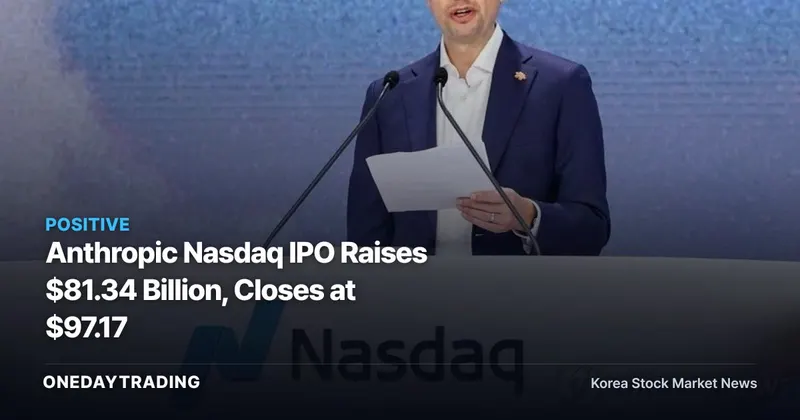

What Anthropic’s IPO Tells Investors
Anthropic listed on the Nasdaq on the 19th (local time) after completing the largest initial public offering in history. The investment significance of the event, as reported by Maeil Business Newspaper’s securities desk, extends beyond the stock’s first-day gain. Capital poured into the AI company’s rapid revenue growth, but trading also showed that the market remains unsettled over how much that growth is worth.
An initial public offering (IPO) is the process through which a company raises capital by offering shares to the public and begins trading on a public market. Anthropic’s case illustrates both how the AI industry’s technology narrative has translated into large-scale fundraising and how its valuation must subsequently be validated by earnings.
The Gap Between the $83 Offer Price and First-Day Trading
Anthropic set its offer price at $83, above the initial target range of $70 to $78. It also increased the number of shares offered from 825 million to 980 million. Raising both the price and the deal size indicates that demand was strong during the offering.
The stock opened at $111.50 on its first trading day, 34.3% above the offer price, and finished at a closing price of $97.17, up 17.1% from the offer price. While the market focused on the positive first-day return, the more revealing move was the narrowing of the intraday gain. The offering’s strong reception was clear, but the expectations reflected in the opening price did not fully hold through the close.
The IPO was valued at $81.34 billion, while the total transaction reached $107.34 billion when including a separate $26 billion private share placement. The ability to absorb fundraising on this scale is encouraging. However, the first day’s trading price alone cannot determine the company’s future profitability or whether its valuation is sustainable.
What Anthropic’s Revenue Showed Over Two Quarters
According to Reuters, Anthropic told investors before its listing that third-quarter revenue this year reached $16.8 billion, up 45% from $11.6 billion in the second quarter. With first-quarter revenue at $4.7 billion, quarterly revenue more than tripled over two quarters.
These figures suggest that demand for the offering was not driven solely by vague enthusiasm for AI. But the connection investors need to assess does not end with revenue growth. Evidence that top-line expansion is translating into profit will be necessary to reassess the first-day valuation on the basis of earnings.
At the listing ceremony, Dario Amodei said the company would control the pace at which AI systems are trained and deployed, taking the time needed to ensure that humans remain in control. He also expressed an intention to build a successful company. The message was that Anthropic would manage technological expansion, safety and business performance together, but its future profitability remains unproven.
The Gap Between OpenAI’s Listing Prospects and Its Losses
According to The Wall Street Journal (WSJ), OpenAI has confidentially filed listing-related documents with the U.S. Securities and Exchange Commission (SEC). Reports have suggested a possible listing around next year, but no specific timetable, expected offer price or offering size has been publicly confirmed.
Sarah Friar told Yahoo Finance that OpenAI’s third-quarter revenue this year reached $10 billion, up 50% from the previous quarter. Enterprise revenue doubled over the same period. Judged solely by the pace of top-line growth, the company now has data supporting the case for a public listing.
Conversely, Reuters, citing The Wall Street Journal (WSJ), reported that OpenAI’s third-quarter operating loss widened to $10.9 billion from $10.1 billion in the previous quarter. Its adjusted operating profit margin improved from negative 150% to negative 109%, but its absolute operating loss increased. This is why revenue growth and narrowing losses should not be treated as equivalent.
How the Impact Reaches AI Stocks and the Nasdaq
- Anthropic: The higher offer price, expanded share offering and first-day close above the offer price confirmed investor demand. The focus now shifts to whether revenue growth can translate into profitability.
- OpenAI: Its competitor’s listing provides a useful comparison for its own potential offering. However, a third-quarter operating loss exceeding revenue makes it difficult to assume in advance that its IPO would enjoy equally strong demand.
- AI sector: The transaction showed that high growth rates can support large-scale fundraising. At the same time, post-listing prices are now positioned to respond not only to the pace of growth but also to the direction of losses.
- Nasdaq: It is clear that the exchange served as the venue for the largest IPO in history. The information provided is insufficient to isolate any specific impact on the index or the share prices of other listed companies.
Risks to Separate From the IPO’s Strong Reception
- First-day price: The stock opened at $111.50 and closed at $97.17. Although the closing price remained above the offer price, investors should also consider the decline in expectations during the session.
- Profitability: The future profitability of Anthropic and OpenAI remains unconfirmed. There is no basis for interpreting rapid revenue growth as immediate profit growth.
- Listing timing: Sam Altman said at The New York Times DealBook Summit on the 18th that OpenAI intends to go public in the future, but he gave no timetable. It also remains unclear whether Anthropic’s successful offering will accelerate OpenAI’s actual listing.
- Limits of comparison: Although the two companies are described as competitors, they do not disclose revenue and loss data to the same extent. Applying one company’s IPO result directly to the other’s expected valuation would overlook differences in the underlying basis for comparison.
Indicators That Will Shape the Next Investment Decision
In the optimistic scenario, Anthropic sustains its revenue growth and subsequently provides evidence of profitability. Its earnings would then support the demand seen during the offering. OpenAI could also strengthen the weaker link in its listing case if it expands revenue while reducing its operating loss.
The risk scenario is one in which top-line growth and losses continue moving in opposite directions. In particular, if OpenAI’s operating loss widens, its listing valuation will become harder to justify on revenue growth alone. The next factors to watch are Anthropic’s post-listing earnings and profitability, changes in OpenAI’s operating loss, and the specific listing terms disclosed through proceedings involving the U.S. Securities and Exchange Commission (SEC).
Nasdaq Index IndicatorsAs of 2026-11-21
| Performance by period | 1 week -10.02% 1 month -13.04% |
|---|
Index, commodity and exchange rate figures are based on global markets and reflect values at the time of publication.
This article was automatically summarized and analyzed based on the original news report. View the original article (Maeil Business Newspaper Securities)