
What the KOSPI’s Sharp Drop (Plunge) Signals
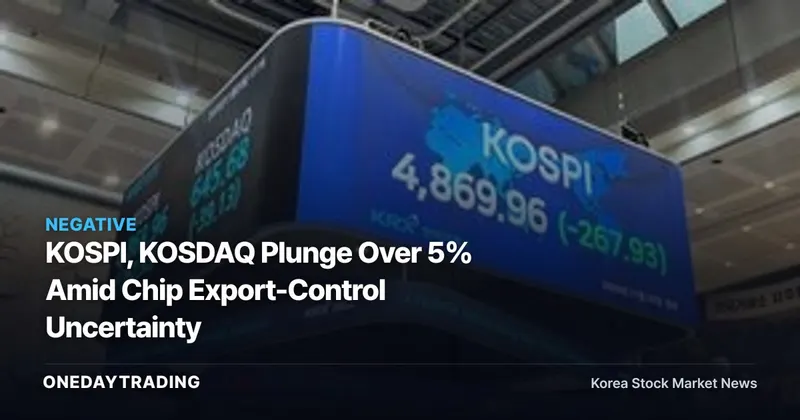
The simultaneous sharp drop (plunge) in the KOSPI and KOSDAQ was more than a routine correction: prices reflected both uncertainty over semiconductor regulations and an exodus in supply-demand (order flow). According to the Nov. 20, 2026 closing results reported by Infostock Daily, foreign investors and institutional investors were net sellers in both markets, while declines in major semiconductor stocks coincided with the index losses.
The KOSPI closed at 4869.96 on Nov. 20, 2026, down 5.21%. The KOSDAQ ended the same day at 645.68, down 5.71%. The KOSDAQ suffered the larger percentage decline, and sell-side sidecars were activated in both markets.
The combination of sell-side sidecar activations and net selling by both foreign investors and institutional investors shows that this was not confined to individual stocks. What is clear is that selling pressure spread across the broader market. What remains unclear is how much each of the various factors cited in the report contributed to the declines.
What KOSPI and KOSDAQ Supply-Demand (Order Flow) Had in Common
Foreign investors and institutional investors were net sellers in both the KOSPI and KOSDAQ markets. In other words, the same supply-demand (order flow) trend appeared across both indexes rather than being limited to one market or one group of stocks. With index declines and selling by the same investor groups occurring together, investors assessing the prospects for a rebound should watch for a reversal in supply-demand (order flow), not just price movements.
Sell-side sidecars were activated in both the KOSPI and KOSDAQ markets that day. This confirms that short-term price volatility was elevated, but the activations themselves do not determine the market’s subsequent direction. Continued net selling by foreign investors and institutional investors would keep pressure on the indexes, while a shift to net buying would provide grounds to reassess the supply-demand (order flow) environment.
Impact of Reports That Samsung Electronics and TSMC Halted Shipments
The Financial Times reported that Samsung Electronics and TSMC halted shipments of certain chips to Chinese customers under new U.S. export controls. For investors, the key issue is not the shipment suspension itself but the fact that its scope has yet to be disclosed. Without clarity on the affected products and Chinese customers, there is insufficient basis for quantifying the impact on each company.
The materials provided also contain no detailed provisions governing the new U.S. export controls. The suspension of shipments by Samsung Electronics and TSMC therefore should not be interpreted as applying to all products or every Chinese customer. If the rules’ scope expands, the potential burden will need to be recalculated. If the restrictions prove limited, investors may be able to distinguish between current broad-based concerns and the actual impact.
Declines in Samsung Electronics, SK hynix and Hanmi Semiconductor
- Samsung Electronics fell 7.01% on Nov. 20, 2026. Because the company was directly named alongside TSMC in the report on suspended shipments of certain chips, the focus going forward will be on confirming the scope of the suspension and the products affected.
- SK hynix fell 5.92% that day. The materials provided do not identify SK hynix as a party to the shipment suspension, so there is no basis for concluding that it faces the same regulatory impact as Samsung Electronics.
- Hanmi Semiconductor fell 10.79% that day. Although this was the largest decline among the three stocks, no data were provided that would allow the loss to be attributed to any single factor.
The simultaneous declines in all three stocks indicate heightened caution toward the semiconductor sector overall, but the facts differ by company. Failing to distinguish between companies explicitly named in the shipment-suspension report and those that were not would conflate the direct effects of the regulations with the impact of market sentiment.
How to Interpret Anthropic and AMD
Anthropic is the developer of the Claude generative AI model. AMD was also mentioned among the factors behind the day’s market decline, but the facts provided are insufficient to calculate either company’s individual impact or its contribution to the KOSPI and KOSDAQ losses.
The appearance of multiple company names does not mean they share the same causal relationship. What the market has already priced in is uncertainty surrounding AI and semiconductors. What remains difficult to assess is the extent to which each factor will affect actual shipments and company-specific results.
What Semiconductor Investors Should Watch Next
- Investors should confirm which products and Chinese customers are covered by Samsung Electronics’ and TSMC’s suspension of certain chip shipments.
- They should determine the specific provisions and scope of the new U.S. export controls.
- They should watch whether foreign investors and institutional investors continue selling both the KOSPI and KOSDAQ or shift to net buying.
- They should monitor whether Samsung Electronics, SK hynix and Hanmi Semiconductor continue moving in the same direction.
Conditions That Will Determine a KOSPI Rebound or Further Pressure
In an optimistic scenario, the specific scope of the export controls becomes clear and the suspension of certain chip shipments proves limited to a narrow group of targets. If foreign investors and institutional investors also shift to net buying, conditions would emerge for reassessing the uncertainty priced into the indexes and semiconductor stocks.
The risk scenario is that the regulations broaden in scope while net selling continues across both markets. In that case, it would be difficult to dismiss the KOSPI’s 5.21% decline and the KOSDAQ’s 5.71% loss as one-off volatility. The next assessment should begin with the original text of the regulations, the products subject to the shipment restrictions and the direction of supply-demand (order flow), rather than forecasts.
Samsung Electronics Key MetricsAs of 2026-11-21
| Period Returns | 1 Week -12.18% 1 Month -15.66% |
|---|---|
| Trading Value · Trading Volume | 143.5 billion won · 28,657,500 shares |
| Supply-Demand (Order Flow) | Foreign Investors Net selling of −514.6 billion won (5 consecutive days) Institutional Investors Net selling of −408.7 billion won |
| Recent News Tone | 1 positive catalyst · 3 negative catalysts |
Price and supply-demand (order flow) data are real-time figures from Korea Investment & Securities (KIS), while supply-demand (order flow) and news-tone tallies are calculated independently by One Day Trading.
Supply-Demand (Order Flow) and Momentum Assessment🔴 Caution
Foreign investors, institutional investors, news and momentum indicators are showing negative signals.
- ▼Order-Flow PersistenceForeign investors net sold for 5 consecutive days (−514.6 billion won)
- ▼Concurrent SellingForeign investors −514.6 billion won · institutional investors −408.7 billion won in concurrent selling
- ▼Trend AlignmentShort- and medium-term trends aligned downward (day -8.1% · 1 week -12.2% · 1 month -15.7%)
- ▼News Flow1 positive catalyst vs 3 negative catalysts — negative catalysts dominate
Upcoming Dates to Watch
- 11.26Bank of Korea Monetary Policy BoardHighBenchmark interest rate decision meeting
- 12.09FOMC Policy Rate DecisionHighU.S. Federal Reserve monetary policy announcement — direction of rates and the dollar
- 12.10Futures and Options ExpirationMediumQuadruple witching — watch for volatility and supply-demand (order flow) disruptions
- 01.14Index Options ExpirationLowKOSPI200 options expiration
This article was automatically summarized and analyzed based on the original news report. View the original article (Infostock Daily)