
What the 291.4 Trillion Won Money Market Fund Balance Means
What the 291.4 trillion won balance in money market funds (MMFs) really shows is not the direction of risk assets, but where cash held by companies and institutional investors is being parked. According to Korea Financial Investment Association data reported by Yonhap News Securities, the total balance on the 17th was the highest since comparable statistics began in 2006. For investors, this is not an immediate signal to buy stocks. Rather, it indicates that the pool of money being managed in short-term instruments until uncertainty clears has grown.
The Record MMF Balance in Three Points
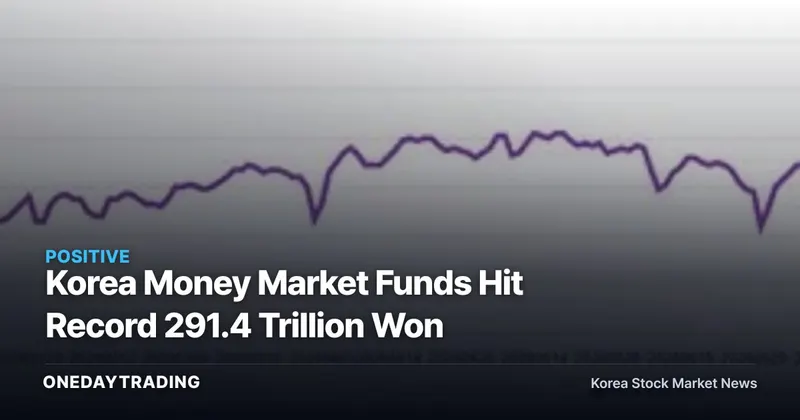
- The total MMF balance compiled by the Korea Financial Investment Association reached 291.4 trillion won on the 17th, up 28.4 trillion won from 263.1 trillion won at the end of last month.
- The total increased 10.8% from the end of last month. Compared with 193.4 trillion won at the end of last year, it has risen 50.7%, or about 98 trillion won, this year.
- Over the same period, corporate MMFs increased by 28.6 trillion won, while retail MMFs declined by about 200 billion won. Corporate funds, not retail investors, were the main driver of this trend.
The Divergence Between Corporate and Retail Funds Tells a Clearer Story
The balance of corporate MMFs rose from 242.4 trillion won at the end of last month to around 271 trillion won on the 17th. Over the same period, the balance of retail MMFs declined from 20.7 trillion won to 20.5 trillion won. The headline that the total balance reached an all-time high could easily be interpreted as broad-based demand for cash awaiting investment. Breaking down the sources of funds, however, shows that increased short-term cash-management demand from companies and institutional investors drove the gain.
This distinction is also essential when assessing what comes next. Corporate funds move according to the disbursement and withdrawal schedules of companies and institutional investors, so there is no basis for treating the increase in MMF balances as buying power that will necessarily flow directly into the stock market. It remains unclear how much of the recent inflow will stay through year-end or which individual companies and institutions supplied the funds.
How MMF Money Reaches Short-Term Funding Markets
Money market funds (MMFs) invest in short-term financial instruments such as bonds with short maturities, commercial paper (CP), and certificates of deposit (CDs). Under the Financial Investment Services and Capital Markets Act, they are classified as collective investment vehicles for short-term financial instruments. The direct market impact of a higher balance is therefore greater buying demand for short-term financial instruments, not the earnings of any particular stock (ticker).
Lee Seung-jae of iM Securities said, “The fact that MMF balances, a major source of demand for short-term instruments such as CP, are increasing beyond seasonal patterns suggests that the likelihood of a market-wide funding squeeze is limited.” A bond broker at another securities firm also explained that, although the effect varies by maturity, MMF buying demand can push down rates on short-term financial instruments or help contain upward pressure. This buying base will persist if balances remain high, but the same interpretation will become less compelling if corporate funds decline rapidly.
Interest-Rate Uncertainty and Semiconductor Funds: What Is Confirmed
The Bank of Korea has raised the benchmark interest rate twice this year. Lee attributed the inflows into MMFs to macroeconomic and interest-rate uncertainty, which encouraged investors to favor instruments offering short-term flexibility, and said that some of the money could also be surplus cash from semiconductor companies. A short-term funding-market specialist in the bond market similarly pointed to parking funds amid stock-market uncertainty and corporate inflows led by semiconductor companies.
There is an important limit to this interpretation. The data provide neither the exact amount of money from semiconductor companies nor a list of the individual companies that placed funds in MMFs. Linking these statistics to the cash positions or future investment plans of a specific semiconductor stock (ticker) would therefore go beyond the available evidence. What is confirmed is the increase in corporate MMFs; semiconductor-related funds remain an expert explanation without a specified amount.
Three Conditions Investors Should Monitor
- Total balance: Investors should watch whether the balance remains near the 291.4 trillion won recorded on the 17th. If it does, the buying base for short-term financial instruments will remain in place.
- Source of funds: Corporate and retail MMFs should be assessed separately. Because corporate balances increased while retail balances declined, the headline figure alone offers limited insight into overall market sentiment.
- Whether funds remain through year-end: It is not yet clear how much of the recent inflow will stay through year-end. Changes in balances driven by corporate disbursements and withdrawals will determine whether the current trend is sustainable.
- Interest-rate conditions: The current assessment rests partly on the absence of clear MMF outflows even after the Bank of Korea raised the benchmark interest rate twice. If this trend reverses, the short-term funding market’s capacity to absorb pressure will need to be reassessed.
Cash Reserves Are Ample, but the Stock Market’s Direction Is a Separate Matter
The record MMF balance of 291.4 trillion won is supportive of the buying base in short-term funding markets. At the same time, its concentration in corporate parking funds is far from a signal that risk appetite has recovered. The key variables for the next assessment are not the total balance itself, but whether corporate balances hold through year-end and whether demand for short-term financial instruments such as CP persists.
This article was automatically summarized and analyzed from the original news report. View the original article (Yonhap News Securities)