
How Day Trading in Korea-Listed ETFs Is Reshaping Investment Decisions
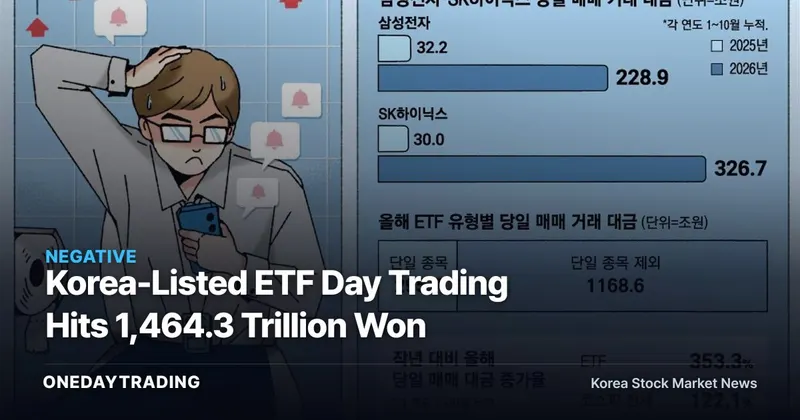
Retail investors’ day-trading value in Korea-listed ETFs surged to 1,464.3305 trillion won from January through October this year, Maeil Business Newspaper’s securities desk reported. The 4.5-fold increase from the same period last year suggests investors should assess trading frequency and costs together, rather than simply viewing it as an expansion of profit opportunities. The specific impact of increased ETF trading on market prices and individual investors’ actual gains and losses has not been confirmed.
ETFs are exchange-traded funds that track specified benchmarks such as indexes, industry sectors, or stocks and trade on the stock market like shares. Although ETF sales are exempt from securities transaction tax and liquidity providers post bid and ask prices, investors still incur brokerage fees and costs from bid-ask spreads. This is why a rise in trading value alone cannot be interpreted as improved investment performance.
Korea Exchange (KRX) Data Shows a 4.5-Fold Expansion
According to Korea Exchange (KRX) data cited by Maeil Business Newspaper, the number of same-day ETF trades by retail investors increased 3.3-fold, from 68.41 million in January–October last year to 224.78 million in the same period this year. The fact that trading value grew faster than the number of trades confirms that short-term trading expanded both in value and frequency.
Single-stock leveraged ETFs alone cannot explain the overall trend. From January through April this year, ETF day-trading value reached 453.4262 trillion won, already up 4.4-fold from the same period last year. This indicates that short-term trading had spread across established ETFs even before activity in a specific product category became prominent.
The product base has also broadened. As of the 18th, 1,190 ETFs were listed in Korea, with a combined market capitalization of 395.9 trillion won. John Bogle launched the world’s first index fund in 1975, and Korea introduced its first ETFs in 2002. Today, the domestic market accommodates ETFs used both for long-term diversified investing and for day trading.
Short-Term Trading Persists Despite Leveraged ETF Regulations
Day-trading value in single-stock leveraged ETFs fell from 166.0429 trillion won in July to 4.7576 trillion won in August. It totaled 2.6648 trillion won in September and 2.7052 trillion won in October, representing a 98.4% decline from July to October. The figures show how quickly trading enthusiasm for high-risk products can cool.
By contrast, the share of day trading in established ETFs excluding single-stock ETFs moved from 60.62% in July to 68.43% in August, 67.3% in September, and 67.57% in October. Even after trading in single-stock leveraged ETFs declined, short-term trading in established products remained elevated. Investors should distinguish between contraction in regulated products and the broader trading behavior across the ETF market.
Rapid Turnover Concentrated in SK Hynix and Samsung Electronics
- SK Hynix: Retail investors’ day-trading value reached 326.6826 trillion won from January through October this year, 10.9 times the 29.9663 trillion won recorded in the same period last year. Day trading’s share of total retail trading value also rose from 29.07% in January–October last year to 36.12% in the same period this year.
- Samsung Electronics: Retail investors’ day-trading value totaled 228.9412 trillion won from January through October this year, up 7.1-fold from 32.2296 trillion won in the same period last year. Day trading’s share on the same basis increased from 22.98% to 28.22%.
- ETF market: Jeon Gyun, senior researcher on Samsung Securities’ ETP Strategy Team, attributed the increase in ETF day trading to greater stock-market volatility, heavy concentration in semiconductors, and a stronger appetite for leveraged investing. The figures for the two semiconductor stocks indicate that short-term trading expanded not only in ETFs but also in their underlying stocks.
Costs Do Not Disappear Just Because There Is No Transaction Tax
Lee Jin-wook, who oversees ETF management at Korea Investment Management, explained that ETFs are convenient to trade because sales are exempt from securities transaction tax and liquidity providers continuously post quotes. This accessibility makes it easy to buy and sell repeatedly. The problem is that brokerage fees and bid-ask spreads reduce returns with every transaction.
Lee Hyo-seob, head of the Financial Services Industry Division at the Korea Capital Market Institute, noted that retail investors tend to buy leveraged ETFs at high prices and sell them at low prices. If day-trading value expands again, investors should compare actual execution prices and costs before focusing on trading convenience. The aggregate statistics should not be used to infer ETF-level transaction details or investor gains and losses that are absent from the data.
Four Indicators Investors Should Monitor
- Check whether retail investors’ day-trading value and number of trades in Korea-listed ETFs continue moving in the same direction.
- Watch whether trading value in single-stock leveraged ETFs rises from October’s 2.7052 trillion won level.
- If the day-trading share of established ETFs excluding single-stock ETFs falls from October’s 67.57%, it could provide evidence that the preference for short-term trading is easing.
- For SK Hynix and Samsung Electronics, compare not only day-trading value but also day trading’s share of total retail trading.
When Trading Growth and Investment Performance Diverge
In an optimistic scenario, ETFs retain their trading convenience and broader product selection, allowing investors to trade their desired exposures quickly. However, even if trading volume increases, higher turnover will result in accumulating costs unless returns exceed brokerage fees and bid-ask spreads.
The next decision points will be whether trading in single-stock leveraged ETFs recovers and how day trading’s share of established ETFs changes. A recovery in leveraged trading would provide grounds to suspect a renewed expansion in high-risk short-term trading. If the share also declines among established ETFs, it could signal that excessive turnover is easing across the broader market. Before looking at trading value, investors should focus not on how much was bought and sold, but on the costs and prices at which trades were executed.
SK Hynix Key MetricsAs of 2026-11-18
| Period Returns | 1 Week -9.01% 1 Month -4.99% |
|---|---|
| Trading Value · Trading Volume | 59.6 billion won · 5,177,981 shares |
| Supply-Demand (Order Flow) | Foreign Investors Net selling of 41.3 billion won (5 consecutive days) Institutional Investors Net buying of 44.2 billion won |
| Recent News Tone | 1 positive catalyst · 3 negative catalysts |
Price and supply-demand (order flow) data are real-time figures from Korea Investment & Securities (KIS), while supply-demand (order flow) and news-tone aggregates are calculated independently by One Day Trading.
Supply-Demand (Order Flow) and Momentum Assessment🟡 Neutral · Wait and See
With positive and negative signals diverging, this is a period to remain on watch.
- ▼Supply-Demand (Order Flow) ContinuityForeign investors posted net selling for 5 consecutive days (41.3 billion won)
- ▼News Flow1 positive catalyst vs. 3 negative catalysts — negative catalysts prevail
Upcoming Events to Monitor
- 11.26Bank of Korea Monetary Policy BoardHighBenchmark interest rate decision meeting
- 12.09FOMC Policy Rate DecisionHighU.S. Federal Reserve monetary policy announcement — direction of interest rates and the dollar
- 12.10Futures and Options ExpirationMediumQuadruple witching — watch for volatility and supply-demand (order flow) disruptions
- 01.14Index Options ExpirationLowKOSPI 200 options expiration
This article was automatically summarized and analyzed based on the original news report. View original article (Maeil Business Newspaper Securities)