
What Jung Jeom-sik’s Remarks Signal to Investors
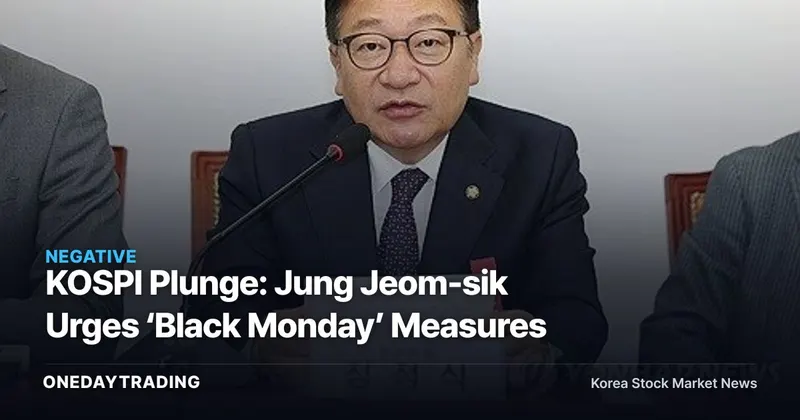
People Power Party floor leader Jung Jeom-sik urged the government to prepare for a “Black Monday,” citing sharp drops (plunges) in the South Korean and U.S. stock markets. Investors should distinguish between a signal that another sharp drop (plunge) is certain and a political warning calling for a policy response. The confirmed facts are the declines in the indexes and the call for emergency measures; the available information does not yet show the market’s actual direction on the 23rd or whether the government will take action.
According to a Yonhap News Agency securities report by reporter Kim Yeon-jeong, Jung said both the KOSPI and KOSDAQ plunged more than 5% last Friday. The real message is not where the market bottom lies, but that a public call has been made for measures to ease market anxiety.
What Jung Jeom-sik Meant by “Black Monday”
In this context, “Black Monday” refers to the possibility of another stock-market plunge on Monday the 23rd. Jung said, “I hope the government will prepare emergency response measures in advance for the possibility of a ‘Black Monday.’” This was a call to prepare a plan, not confirmation that measures had been implemented or market stability achieved.
Figures reported by Maeil Business Newspaper’s securities desk provide further context for the warning. Jung noted that the U.S. Nasdaq Composite fell 5.3% on the 20th local time and KOSPI 200 overnight futures were down 7.01% as of the morning of the 21st. The simultaneous weakness in U.S. stocks and futures linked to South Korean equity indexes was cited as the basis for growing concern about the 23rd.
Claims of the KOSPI at 4,800 and a Market Capitalization Loss
Jung claimed that after surpassing 9,000 points at one point this year, the KOSPI had fallen to around 4,800 as of the time of his remarks, while market capitalization had declined by 3.4 quadrillion won from its peak. These figures were used to emphasize not only the current price level but also the scale of cumulative losses from the peak.
The dividing line between what is confirmed and what remains unverified is clear. Although the KOSPI level and the decline in market capitalization were presented as grounds for his criticism, the calculation methodology and underlying data for those figures were not included in the available materials. There is also insufficient evidence to determine the cause of the stock-market decline.
Impact on Equity Indexes and Related Markets
- KOSPI and KOSDAQ: The reported declines of more than 5% in both indexes last Friday demonstrate the weakness already recorded. If losses continue on the 23rd, the warning of a “possible further sharp drop (plunge)” would carry more weight; if the indexes recover, the premise of a Black Monday would need to be reassessed.
- KOSPI 200 overnight futures: The 7.01% decline as of the morning of the 21st is a directly observed indicator ahead of the cash market’s opening on the 23rd. However, the fall in overnight futures alone cannot determine the KOSPI’s actual performance.
- Nasdaq Composite: The 5.3% decline on the 20th local time shows that a sharp drop (plunge) also occurred outside the South Korean market. Because the materials do not state the cause, there is no basis for extrapolating the move to the earnings or losses of any particular industry sector or company.
- Seoul apartment prices: Jung cited reports that Seoul apartment prices had risen for 93 consecutive weeks as of the time of his remarks, contrasting that trend with stock-market weakness. While this contrast formed part of his criticism of the government, no causal relationship has been established between the stock-market decline and rising apartment prices.
What to Verify About the Government’s Response
Jung’s demand focused on preparing an emergency response to reduce market anxiety, losses, and disruption. His statement that “what the government and ruling party should be focused on now is not impeachment, but the stock market” was also a political argument intended to pressure policymakers over their priorities. It has not been confirmed what measures, if any, the government has actually prepared.
- Market on the 23rd: The first point to verify is whether the KOSPI and KOSDAQ decline further or recover their losses.
- KOSPI 200 overnight futures: Investors should determine whether the 7.01% decline recorded as of the morning of the 21st carries over into the cash market.
- Government measures: It remains to be seen whether the call for an emergency response leads to actual preparations or implementation.
- Verification of figures: Investors should watch for disclosure of the calculation methodology and underlying data supporting the KOSPI level near 4,800 and the claimed 3.4 quadrillion won decline in market capitalization from its peak.
Two Scenarios for the 23rd
In the optimistic scenario, the KOSPI and KOSDAQ recover their losses on the 23rd, easing concerns about another sharp drop (plunge). If the government discloses emergency-response preparations, its policy response would also become verifiable. In either case, the effectiveness of any measures should be assessed separately from the market’s actual performance.
In the downside scenario, weakness in the KOSPI and KOSDAQ continues, and the decline in KOSPI 200 overnight futures is also reflected in the cash market. Even then, the available information is insufficient to determine future prices, market direction, or the cause of the decline. The next triggers to watch are not new forecasts, but the market’s actual movement on the 23rd and whether the government announces an official response.
KOSPI Index MetricsAs of 2026-11-22
| Performance | 1 Week -7.95% 1 Month -12.00% |
|---|
Index, commodity, and exchange rate figures are based on global markets and reflect values at the time of publication.
This article was automatically summarized and analyzed based on the original news report. View original article (Yonhap News Agency Securities)