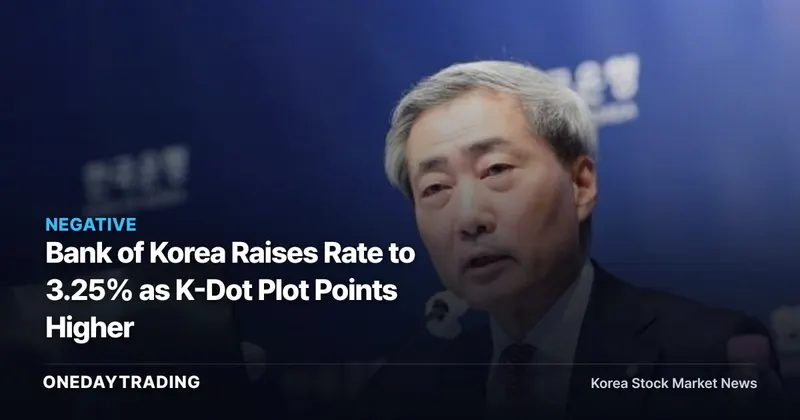

Bank of Korea Rate Hike: The Path Matters More Than the Number
The Bank of Korea’s Monetary Policy Board raised the benchmark interest rate by 0.25 percentage point to 3.25% per year on 2026-11-26. The real message is not the single hike but the range of possible next moves. Alongside the current 3.25% rate, investors should factor into valuations the possibility of 3.50% and 3.75% indicated by the six-month K-dot plot.
The decision, reported by Asia Economy Securities, accompanied this year’s final monetary policy meeting and revised economic outlook. The K-dot plot shows the distribution of Monetary Policy Board members’ conditional projections for the benchmark interest rate over the next six months. It should be viewed as an indication of the potential policy range, not a firm commitment.
Dispersion in the Monetary Policy Board’s K-Dot Plot
Of the Monetary Policy Board’s 21 projections for the next six months, eight, or 38.1%, pointed to a benchmark interest rate of 3.50%. Seven, or 33.3%, indicated 3.75%, while six projected that the rate would remain at 3.25%. Rather than converging on a single direction, the dot plot leaves room for both further hikes and a hold at the current level.
Hwang Geon-il and Lee Soo-hyung issued minority opinions favoring unchanged rates. Shin Hyun-song said, “We exchanged many views on uncertainty in the semiconductor sector and the resulting tactical differences in policy responses.” Looking only at the two votes for a hold could suggest that the intensity of tightening has eased, but the upper end of the K-dot plot limits that interpretation.
How the 4.1% Growth Forecast Weighs on the Rate Decision
The Bank of Korea forecast growth of 3.9% this year and real GDP growth of 4.1% next year. Regarding next year’s forecast, Shin Hyun-song said, “It is well supported and is not subject to major uncertainty.” If the growth outlook holds, the Monetary Policy Board retains room to consider further hikes, consistent with the upper end of the K-dot plot.
Private consumption is forecast to grow 1.8% this year and 2.4% next year. The growth and consumption outlooks do not convey the same degree of strength. Kim Ji-na, an analyst at Eugene Investment & Securities, said, “Regardless of whether 4.1% is achievable, the meeting reaffirmed the Bank of Korea’s strong commitment to its rate-hike stance.”
Current Account Outlook Supports the Economic Scenario
The Bank of Korea forecast a current account surplus of $500 billion this year and $540 billion next year. The cumulative surplus through the third quarter of this year was $340.7 billion, compared with a full-year surplus of $123.1 billion last year. The forecast for 2028 is $360 billion, meaning the current projections should not be extrapolated at the same level over an extended period.
Nominal GDP is forecast at 3,000 trillion won this year, while semiconductor-related operating profit is projected at 700 trillion won. These figures indicate the semiconductor sector’s weight in the Bank of Korea’s growth outlook. Continued semiconductor momentum would support the growth forecast, but the sector uncertainty cited directly by Shin Hyun-song remains a factor that broadens the range of possible policy paths.
How Rates Flow Through to Valuations and Industry Sectors
- Financials: More important than the benchmark interest rate rising to 3.25% is the fact that most dots point to 3.50% or 3.75% in six months. If the rate path remains elevated, the burden of higher discount rates applied to asset valuations will persist.
- Semiconductors: This year’s 700 trillion won in semiconductor-related operating profit is a key figure underpinning the Bank of Korea’s growth outlook. As the sector is both the basis for growth and a source of uncertainty in the policy response, earnings expectations are difficult to separate from the prospect of further tightening.
- Domestic demand: Private consumption growth forecasts of 1.8% this year and 2.4% next year imply a recovery. If rates rise further, whether consumption meets those projections will be a key test for domestic-demand valuations.
Three Distinctions Investors Should Make
- What has been confirmed is a benchmark interest rate of 3.25% and a 25bp hike. The actual terminal rate following this increase has not been determined.
- Investors should consider the full distribution across 3.25%, 3.50%, and 3.75%, rather than focusing only on the center of the K-dot plot. The wide distribution itself argues against confidence in any single path.
- The 3.9% and 4.1% growth rates and the current account surpluses of $500 billion and $540 billion are forecasts. Until actual results are confirmed, projected figures should not be priced in as though they have already been achieved.
- The next items to watch are future benchmark interest rate decisions by the Monetary Policy Board and revised economic forecasts. If the growth outlook weakens, the case for further hikes will diminish; if it holds, the prospect of a higher rate path will remain significant.
Scenarios That Could Diverge at the Next Rate Decision
In the optimistic scenario, the benchmark interest rate remains at 3.25% while the growth and current account forecasts hold. The foundations of the growth outlook would remain intact, while the additional rate burden on valuations would be limited. Conversely, if the benchmark interest rate rises to 3.50% or 3.75%, the market is likely to recalculate the impact of a higher discount rate before reassessing the strength of growth.
For now, prices can reflect the confirmed hike and the range indicated by the K-dot plot. The timing of future benchmark interest rate changes, the terminal rate, and whether the growth and current account forecasts will be achieved are not yet known. At the next Monetary Policy Board meeting, whether the dot distribution or the growth outlook moves first will be the macro trigger determining leadership among industry sectors.
This article was automatically summarized and analyzed based on the original news report. View the original article (Asia Economy Securities)