
3-Point Briefing
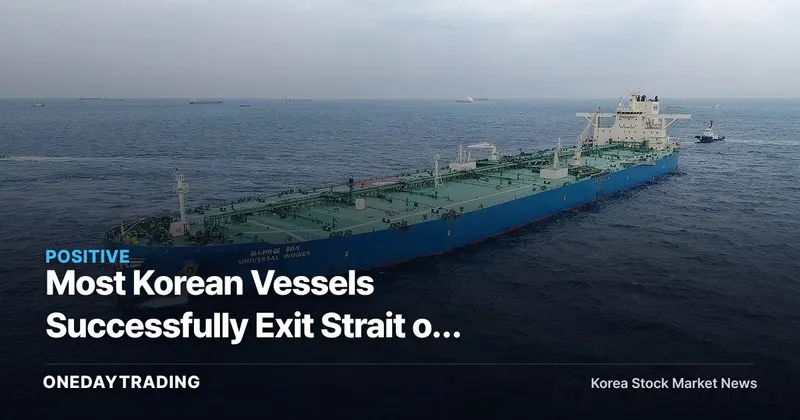
- Following the U.S.-Iran ceasefire agreement, most Korean vessels that had been detained in the Strait of Hormuz have cleared the waterway without casualties.
- Three vessels remain inside the strait, making it premature to declare the crisis fully resolved.
- An easing of tensions in the strait could serve as a signal for the normalization of Korean shipping operations and the restoration of Middle Eastern crude oil and LNG supply routes.
What Changes From Here
The significance of this development for shipping and energy investors extends well beyond the resolution of a geopolitical event. The Strait of Hormuz is the world's critical energy artery, carrying approximately 20% of global crude oil trade and around 25% of LNG trade. Korea sources more than 70% of its crude oil imports from the Middle East, meaning a prolonged blockade would have dealt a direct blow to both refinery cost structures and vessel operations. The successful exit of most Korean vessels signals that this worst-case scenario has not materialized.
For shipping companies, this translates into a reduction in the additional fuel and charter costs incurred from operating on alternative routes. Bypassing Hormuz requires diverting around Africa's Cape of Good Hope, more than doubling voyage distances and stacking schedule delays on top of insurance surcharges. A return to normalcy in the strait removes this cost burden. Refiners likewise see a reduction in cost volatility risk as uncertainty over Middle Eastern crude supply-demand (order flow) dissipates.
By the Numbers
The Strait of Hormuz handles approximately 17 million barrels of crude oil and over 30% of international LNG trade by volume per day. Korea's reliance on this corridor for crude and LNG imports is overwhelming — even a one-month blockade would simultaneously compress refining margins and spike LNG procurement costs. Should the three remaining vessels return without further incident, shipowners' exposure to insurance claims and liability payouts would also be eliminated. That said, investors should note that even after a ceasefire agreement, a gap of days to weeks may remain before full navigational safety within the strait is guaranteed.
Stocks to Watch — Beneficiaries and Risks
- HMM: Korea's largest container shipping line stands to directly benefit from lower rerouting costs as Middle Eastern routes normalize. Tied closely to the recovery of container freight rates.
- Pan Ocean: A bulk and tanker-focused carrier positioned to benefit from increased charter demand as Middle Eastern commodity and energy cargo volumes recover.
- S-Oil: Given its equity ties to Saudi Aramco, S-Oil has an exceptionally high dependence on Middle Eastern crude; stabilized supply-demand (order flow) improves cost predictability.
- SK Innovation: Across its integrated refining and chemicals business, the removal of crude procurement uncertainty translates into reduced inventory valuation risk.
- Korean Air: An indirect beneficiary through the normalization of Middle Eastern transit cargo routes and stabilization of fuel hedging costs.
Risk Checklist
- Three vessels still in the strait: If the remaining ships are delayed in returning or a further incident occurs, the risk of the situation reigniting cannot be ruled out.
- Fragility of the U.S.-Iran agreement: The ceasefire is sensitive to political and military variables — a breakdown by either party could immediately reignite strait tensions.
- Crude price headwind: If supply resumption triggers a sharp drop (plunge) in international oil prices, refiners face the risk of inventory write-downs and compression of refining margin spreads.
- Delayed insurance normalization: Marine insurers will take time to reprice risk, meaning shipping companies may not see immediate improvements in their cost structures.
Bottom Line
The easing of Hormuz tensions has steered Korea's shipping and refining sectors away from the worst-case scenario for now — but until the fate of the three remaining vessels is resolved and the durability of the U.S.-Iran agreement is confirmed, it is difficult to conclude that the sector's risk premium has been fully unwound.
HMM — Real-Time Data Snapshot
HMM's most recent closing price was KRW 18,310 (−1.88% vs. the prior day). Its composite signal — integrating foreign investor and institutional investor supply-demand (order flow) alongside news and momentum — reads 🟡 neutral·wait-and-see. Positive and negative signals are mixed, warranting a cautious stance.
- ▼ Supply-demand (order flow) continuity — Foreign investors have net-sold for 7 consecutive sessions (−KRW 4.9 billion)
- ▼ Trend alignment — Short- and medium-term downtrend alignment (day: −1.9% · 1 week: −9.1% · 1 month: −7.2%)
- ▼ 52-week positioning — Within 5% of the 52-week low
- ▲ News flow — Positive catalysts 8 vs. negative catalysts 0 — positive catalysts dominant
Recent related news shows 8 positive catalyst items and 0 negative catalyst items — a favorable backdrop.
※ Price and foreign investor/institutional investor supply-demand (order flow) data are sourced from Korea Investment & Securities (KIS) and reflect the time of publication.
This content has been automatically summarized and analyzed based on the original news report. View original article (Yonhap News)