
At a Glance
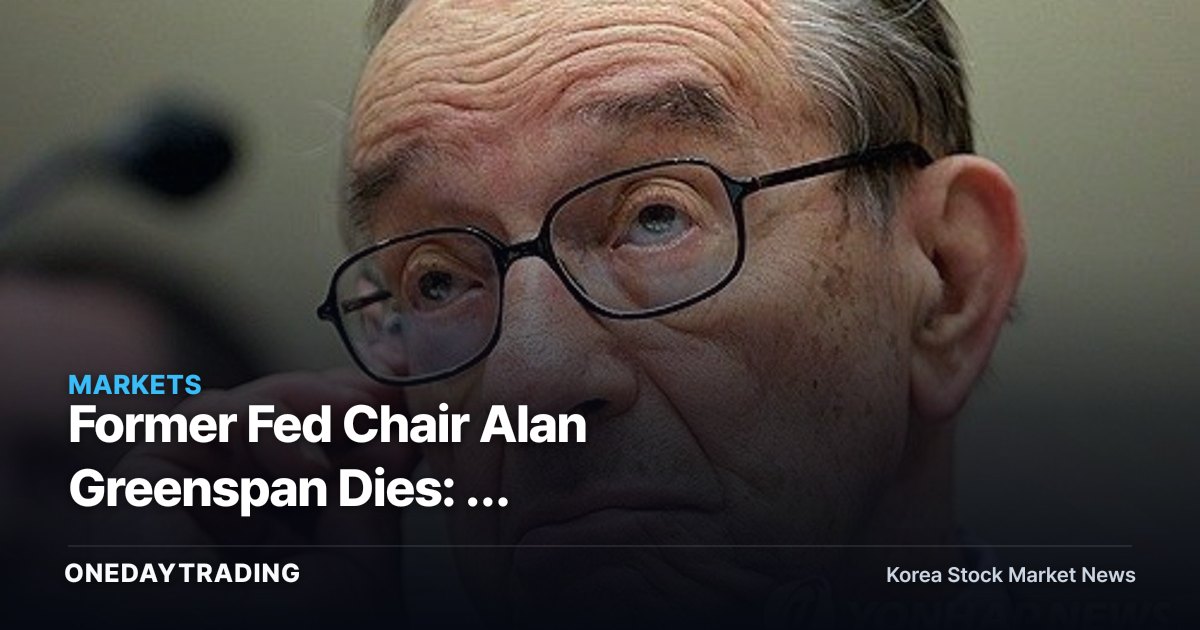
The passing of former U.S. Federal Reserve (Fed) Chair Alan Greenspan is not an event that directly alters any individual stock's earnings. Yet the monetary-policy paradigm he built over 19 years still serves as the framework shaping valuations across rate-sensitive industry sectors, acting for investors as a mirror for revisiting the Fed's current policy path.
Reviewing his era—spanning four administrations from 1987 to 2006, under Reagan, George H.W. Bush, Clinton, and George W. Bush—is a starting point for understanding how monetary policy transmits into asset markets.
Why It Matters Now
Greenspan's legacy has two faces. He is seen on one hand as a symbol of the monetary policy that drove the long boom and low inflation of the 1990s, and criticized on the other for the dot-com bubble and the low rates of the 2000s that laid the groundwork for the global financial crisis. The asymmetric easing stance he left behind—the so-called expectation that the Fed will step in to cushion the market when it collapses—became a structural backdrop for risk-asset appetite.
The point at which this retrospective touches today's investing is clear. The current Fed, too, is in a tug-of-war with the market over the timing and pace of rate cuts, and those decisions transmit directly to Korean equities through the won-dollar exchange rate and foreign-investor fund flows. The variables of the direction of rates and the credibility of monetary policy work the same way no matter how the era changes.
Especially in a market like Korea—where foreign investors make up a large share and the export economy is sensitive to U.S. rates and the dollar—the Fed's monetary-policy framework is close to a constant in KOSPI valuations. The lesson of the Greenspan era is that low rates do not last forever, and the bill for easing comes due with a lag.
Frequently Asked Questions
- Does this obituary directly affect share prices? No. The passing of an individual is itself a commemorative issue unrelated to corporate earnings or supply-demand (order flow), and is not a short-term price catalyst.
- What is the core legacy of the Greenspan era? A prolonged period of low rates and a market-friendly easing stance. It comes with both praise for propping up asset prices and criticism for inflating bubbles.
- What can Korean investors take away? The structural linkage by which the direction of U.S. monetary policy transmits to domestic equities through the exchange rate and foreign-investor supply-demand (order flow).
- What should you watch now? The current Fed's rate decisions, the dot plot, and inflation indicators are far more direct variables than the Greenspan era.
Impact on Related Stocks and Sectors
- Financials such as banks and brokerages Their earnings are tied directly to the rate level and net interest margins, making them the most sensitive to the monetary-policy framework.
- Large-cap exporters Their price competitiveness and FX gains/losses shift with dollar strength or weakness, placing them within the indirect reach of Fed policy.
- Rate-sensitive growth stocks Their valuations swing heavily with changes in the discount rate, amplifying volatility in line with monetary-policy expectations.
- REITs and high-dividend names As an asset class that competes directly with bond yields, the strength of buying and selling shifts with the direction of rates.
Points to Watch When Investing
- An obituary is merely an emotional retrospective; using it as a basis for trading should be guarded against.
- The success formula of the past low-rate era does not apply directly to today's high-inflation, high-rate environment.
- Because Fed policy works with a lag, the real-economy and equity-market impact of rate changes must be checked on a quarterly basis.
- The exchange rate and foreign-investor supply-demand (order flow) are two-way variables, hard to pin down as a one-sided positive catalyst or negative catalyst.
Overall Outlook
Greenspan's passing is both the period at the end of an era and an occasion to revisit the mark monetary policy has left on asset markets. Viewed optimistically, the coexistence of stable inflation and growth that his era displayed is the ideal of the soft landing the current Fed aims for. On the other hand, the financial crisis that erupted as an aftereffect of low rates is also a warning not to forget the risks that accumulate when easing runs long. From an investor's standpoint, the real variable is not the commemoration but the rate decision at the next Fed meeting and the inflation indicators, and it is more practical to read those signals together with the exchange rate and foreign-investor supply-demand (order flow).
This article is content automatically summarized and analyzed based on the original news report. View original (Yonhap News)