
Summary
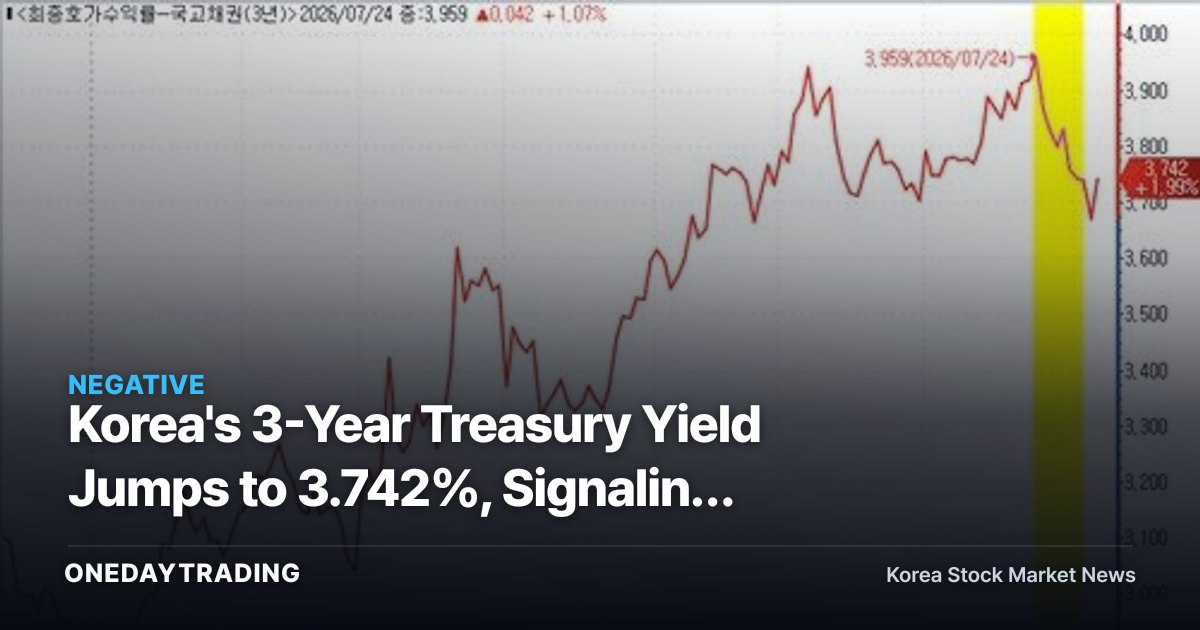
On the 6th, South Korea's government bond yields rose in tandem across all maturities. The 3-year yield climbed to an annualized 3.742%, and the market is interpreting this as the start of a reversal in the sharp yield declines seen recently. The key question is whether this reversal is just a few days' worth of technical rebound, or a sign that the rate-cut expectations the bond market had already priced in were simply overdone.
What Happened
On this day, government bond yields rose together not just in the 3-year segment but across the entire curve. Since bond prices and yields move inversely, a broad-based rise in yields across maturities points to weakness across the bond market as a whole. The fact that the entire curve shifted together—rather than a spike in just one segment—suggests this reflects a reassessment of the broader trend rather than an isolated supply-demand (order flow) issue.
In short: the pace at which yields had fallen (and bond prices had risen) had run ahead of actual expectations for the timing and scale of benchmark interest rate cuts, and what's happening now is that expectation realigning with reality. Because yields dropped so sharply beforehand, this reversal may not end as a mild correction.
Structural Background
Government bond yields reflect both the market's expectations for the Bank of Korea's benchmark interest rate path and the trend in U.S. Treasury yields. When rate-cut expectations recede, yields rise—and that in turn means the discount rate used to value future cash flows in equities rises too. As the discount rate climbs, the multiples of high-valuation growth stocks, whose earnings are concentrated further out in the future, are the first to come under pressure.
Banks, conversely, tend to benefit when rates rise, since they can raise lending rates before—and by more than—deposit rates, improving their net interest margin (NIM). However, this holds only when the rate increase is gradual and the lag in loan-deposit repricing stays intact; if a sharp spike completely unwinds rate-cut expectations, the resulting rise in funding costs could spread to weigh on banks as well.
Stock (Ticker) and Sector Impact
- KB Financial Group and Shinhan Financial Group: Since loan repricing outpaces deposit repricing, expectations for NIM improvement remain intact, but if the yield spike also drives up funding costs, the degree of improvement could be limited
- Life insurers such as Samsung Life Insurance: Interest income yields on new and reinvested bonds rise, but valuation losses on existing bond holdings widen at the same time
- Builders such as GS Construction and Daewoo E&C: As project-financing costs are tied to government bond yields and climb accordingly, the interest burden on unsold housing projects increases
- High-valuation growth stocks (tickers) in semiconductors and biotech: A rising discount rate is the first pressure point for stocks whose valuations depend heavily on earnings far in the future
- Bond funds and pension products: They face valuation losses in the near term, but newly added holdings lock in a higher carry (interest income)
Bullish vs. Bearish Scenarios
In the yield-reversal-lower scenario, this move is seen as the tail end of an overdone pullback. If the Bank of Korea's Monetary Policy Committee reaffirms its easing stance at the next meeting, government bond yields would fall again—easing the valuation burden on growth stocks even as NIM expectations for bank stocks pull back somewhat.
In the further-rate-rise scenario, correlation with U.S. Treasury yields or a renewed pickup in inflation would coincide. In that case, government bond yields would climb another notch, intensifying pressure on construction/real estate and high-valuation growth stocks, while bank stocks alone would retain relative defensiveness.
Investor Action Points
- Watch the schedule of the next Monetary Policy Committee meeting and individual board members' remarks for differences in view on the pace of rate cuts
- Track U.S. inflation data and Fed commentary to gauge the direction of the Korea-U.S. rate spread
- Keep an eye on the KRW/USD exchange rate level as well—if it coincides with foreign investors pulling out of bonds, upward pressure on yields could intensify
- Cross-check builders' project-financing (PF) exposure and banks' NIM guidance when earnings are released
This article was automatically summarized and analyzed based on the original news report. View original (Yonhap News, Securities section)