
3-Point Briefing
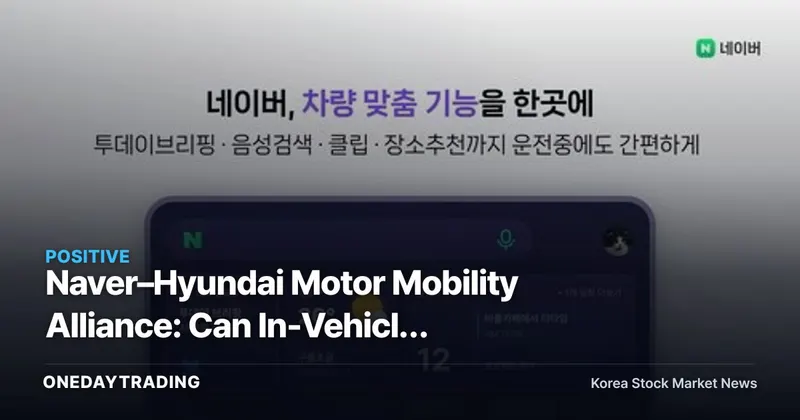
- Naver will supply its Naver app, Naver Maps, and Whale browser to Hyundai Motor Group's next-generation infotainment system, securing the vehicle as a new traffic touchpoint.
- Hyundai Motor is accelerating its shift to software-defined vehicles (SDVs) by partnering with an established external player in search, maps, and content — areas that would be costly to develop in-house.
- The key question is not whether Naver can deliver one-off features, but whether the in-vehicle advertising, commerce, and subscription revenue model can generate sustained returns.
What Changes
At its core, this partnership reflects both companies riding the wave of a fundamental shift: the automobile evolving from a simple mode of transport into an always-connected digital terminal. For Naver, securing the vehicle as a third screen — after PC and mobile — is highly significant. When drivers consume navigation, search, and content within the Naver ecosystem while in the car, the path opens for extending search advertising and map-based local commerce into the vehicle.
For Hyundai Motor, the move reads as an outsourcing strategy for software capabilities. While global automakers race to build their own operating systems and app marketplaces, Hyundai has chosen to bring Naver — the dominant player in Korean search and maps — on board rather than building those capabilities from scratch, rapidly closing gaps in the user experience. Infotainment satisfaction has emerged as a growing factor in new-car purchase decisions and residual value, adding a product competitiveness dimension to this deal as well.
The critical question, however, is who holds the upper hand in data and revenue-sharing. Which side controls vehicle user data, advertising inventory, and payment flows will ultimately determine where the real benefit lies.
By the Numbers and Context
Information disclosed so far covers only the scope of the partnership — supplying the Naver app, Naver Maps, and Whale browser — with no specific figures provided on revenue-sharing ratios, eligible vehicle models, or timelines. Accordingly, a meaningful quantitative assessment will only be possible once the scale of model rollout and the in-vehicle advertising and subscription monetization structure are made public, rather than any near-term earnings contribution. Investors should treat the range of vehicle models covered and the terms of data and revenue-sharing cooperation as the key variables to watch in subsequent announcements.
Winners and Losers by Stock (Ticker)
- Naver: Gains a new advertising and commerce touchpoint in the vehicle. The expansion of Maps and search traffic, along with demand for cloud and AI integration, add up to a medium-to-long-term growth option.
- Hyundai Motor & Kia: Improved infotainment user experience enhances new-vehicle product appeal in Korea and potentially globally, while partially reducing SDV transition costs.
- Domestic IT platforms (Kakao, etc.): If Naver solidifies its lead in in-vehicle navigation and platform services, competitive pressure on rivals increases.
- Automotive semiconductor & display component stocks: Infotainment upgrades create upstream demand for high-performance SoCs and large-format panels.
Risk Check
- With specific monetization models and revenue-sharing terms undisclosed, near-term earnings contribution may be limited.
- In-vehicle data utilization may face friction with privacy and road safety regulations, potentially narrowing the scope of deployment.
- Given the broader automotive industry trend toward software internalization, Hyundai Motor could build out its own capabilities over time and reduce its reliance on the partnership.
- If advertising market conditions soften across Naver's platform business broadly, the pace of monetizing new touchpoints could slow in tandem.
Bottom Line
The direction of bringing the vehicle into the digital platform ecosystem adds new revenue options for both companies, but until the terms of data, advertising, and subscription revenue-sharing — and the scale of deployment — are disclosed, a strategic optionality framing is more appropriate than projecting near-term earnings impact.
Naver — Real-Time Data Snapshot
Naver's most recent closing price was ₩196,400 (–1.65% vs. prior day). The composite signal — incorporating foreign investor and institutional investor supply-demand (order flow) alongside news and momentum — reads 🔴 Caution. Foreign investor flow, news sentiment, and momentum are all negative, warranting a cautious stance at this time.
- ▼ Trend Alignment — Short- and medium-term downtrend (Day: –1.6% · 1 Week: –14.4% · 1 Month: –1.2%)
- ▼ 52-Week Position — Near 52-week lows (bottom 5% of range)
Recent related news: 0 positive catalysts · 1 negative catalyst — net negative.
※ Price and foreign investor/institutional investor supply-demand (order flow) data are provided by Korea Investment & Securities (KIS) and reflect conditions as of the time of publication.
This content was automatically summarized and analyzed based on the original news report. View original article (Yonhap News — Industry)