
At a Glance
The blackout in Gimpo's Pungmu-dong is not just an isolated local incident. During heat waves, power grids can weaken first at the final stretch of the distribution network rather than at generation capacity — and that distinction is what separates the investment case for KEPCO from that of power equipment stocks.
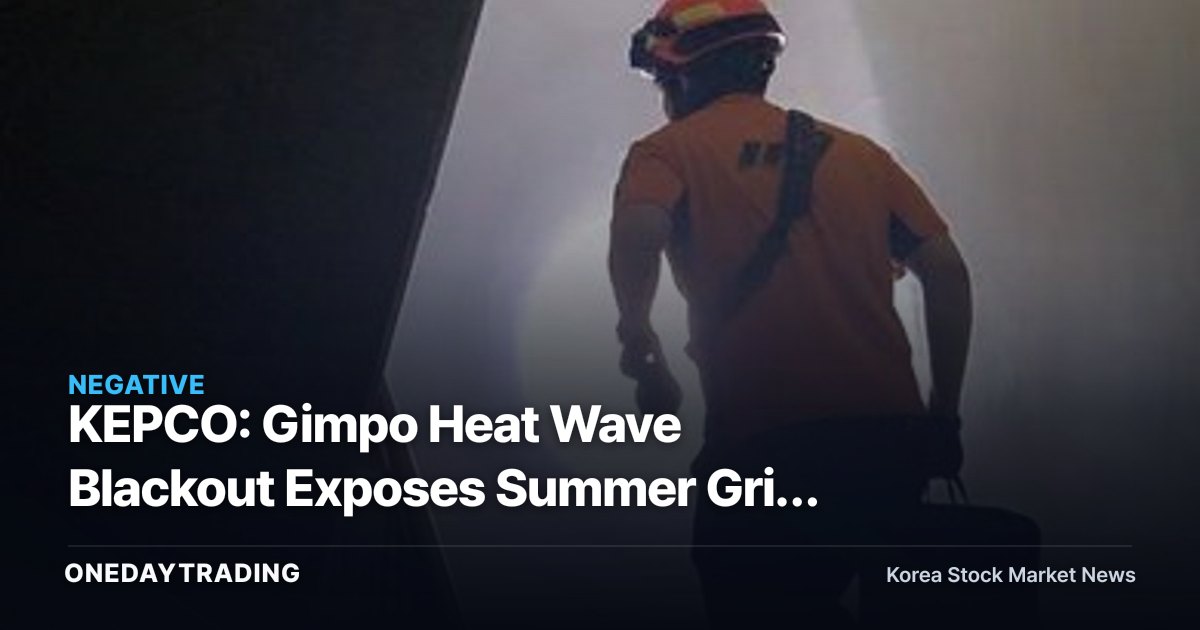
Around 8:05 p.m. on the 3rd, power supply was cut off across the Pungmu-dong area of Gimpo, Gyeonggi Province, and an elevator entrapment incident also occurred. Investors should read this news not as a sign of rising power demand, but as a grid reliability and reinforcement-investment issue.
Why It Matters Now
Heat waves are the most honest stress test for the power industry. When cooling load spikes all at once, it's substations, distribution lines, and in-building receiving equipment — not power plants — that come under pressure first. This blackout in Gimpo's Pungmu-dong doesn't signal a nationwide power supply crisis. But the fact that an evening power outage and an elevator entrapment incident occurred together in a densely populated residential area of the greater Seoul region is enough to put distribution-grid bottlenecks back on the market's radar.
KEPCO faces a two-sided situation. A season of rising electricity sales volume is favorable for revenue. But the burden of outages and restoration work comes back as cost and regulatory pressure. If demands for safety investment and maintenance grow faster than rate hikes or cost recovery, the pace of KEPCO's earnings improvement can't be explained by sales volume alone. What the market has yet to fully price in is not electricity rates, but the priority given to distribution-grid CAPEX.
For power equipment makers, a different reading applies. Transformers, circuit breakers, switchgear, and power automation equipment move to the front of the line for policy budgets and order flow the more blackouts recur. But the benefit should be confirmed through order backlogs and utilization rates, not the stock's reaction on the day of the news. If expanded grid investment doesn't translate into actual orders, the theme won't hold up for long.
Frequently Asked Questions
- Is this blackout a sign of a broader power crisis? Based on what's currently known, it's difficult to interpret this as a nationwide power supply crisis. The key point is that a localized incident in Gimpo's Pungmu-dong occurred during a heat wave and spilled over into everyday infrastructure risk, as seen in the elevator entrapment case.
- Is this a positive catalyst or a negative catalyst for KEPCO? In the short term, it leans toward a negative catalyst. Highlighting grid stability issues raises maintenance and investment pressure. Over the medium to long term, however, the earnings interpretation could shift if rate structures and compensation for grid investment are discussed together.
- Why are power equipment stocks linked to this story? Blackout risk drives demand for distribution-grid reinforcement before it drives demand for new power plants. Makers of transformers, switchgear, and power automation equipment only see the benefit flow into earnings once orders actually increase.
- What indicators should be watched next? Investors should track the frequency of blackouts during the heat wave, KEPCO's distribution-facility investment plans, the government's grid-reinforcement budget, and new order disclosures from related companies.
Related Stocks (Tickers) and Sector Impact
- KEPCO. Its responsibility for power supply stability is coming into focus. The market may price in the burden of distribution-grid maintenance and investment before it prices in higher electricity sales.
- LS ELECTRIC. Tied to demand for distribution and power automation equipment. The actual benefit will be confirmed through growth in public/private orders and an expanding order backlog.
- HD Hyundai Electric. Structural demand in the transformer and power equipment industry could come into focus. Production capacity, delivery lead times, and margin sustainability matter more here than short-term news.
- Hyosung Heavy Industries. Connected to the case for power-infrastructure reinforcement. Still, it's premature to assume domestic distribution-grid issues will directly translate into large-scale orders.
Investment Considerations
- It's risky to extrapolate a single local blackout as evidence of a power-equipment supercycle. Recurrence, root cause, and restoration time all need to be confirmed.
- Some power equipment stocks have already priced in a substantial amount of the global transformer shortage and grid-investment expectations. Valuation burden needs to be weighed alongside the story.
- For KEPCO, the greater the need for grid investment, the more electricity rates, government compensation, and debt management remain variables to watch simultaneously.
- The longer the heat wave lasts, the more power demand rises — but costs and equipment burdens rise along with it. Judging earnings improvement from demand growth alone isn't enough.
Overall Outlook
This blackout in Gimpo's Pungmu-dong has once again put grid quality, not power demand, in front of the market. The bullish scenario is clear: as heat waves and electrification demand overlap, distribution-grid reinforcement investment gets pulled forward, and power equipment makers' order backlogs actually grow.
There's also a trigger for the bearish scenario. If the cause of the incident turns out to be limited and policy-driven orders are delayed, share prices will price in the theme first while earnings fail to catch up. The next things to confirm are the frequency of blackouts during August's heat wave, KEPCO's execution of distribution investment, and quarterly order disclosures from power equipment companies. Until the order volume actually shows up, order flow takes priority over narrative.
KEPCO by the Numbers: Real-Time Data
KEPCO's most recent closing price was 34,500 won (-0.86% vs. the previous day), and the composite signal combining foreign/institutional order flow with news and momentum reads 🟡 Neutral / Wait-and-See. With positive and negative signals mixed, this is a stretch to watch.
- ▼ Trend Alignment — Aligned to the downside in the short and medium term (-0.9% today · -2.5% over 1 week · -8.2% over 1 month)
- ▼ 52-Week Position — Near the 52-week low (bottom 7% of range)
Recent related news skews negative, with 0 positive-catalyst and 1 negative-catalyst stories.
※ Price and foreign/institutional order-flow data are provided by Korea Investment & Securities (KIS) and reflect the time of publication.
This article was automatically summarized and analyzed based on the original news report. View Original (Yonhap News Industry)