
At a Glance
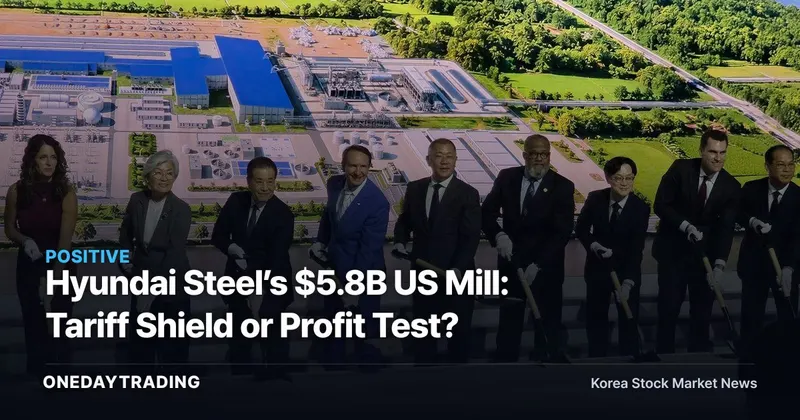
Hyundai Steel’s electric-arc furnace (EAF) steel mill in Louisiana is more than a capacity expansion—it is a restructuring of Hyundai Motor Group’s North American supply chain around local vehicle production. If the plant can steadily absorb automotive sheet steel within its 2.7 million-ton annual capacity, it could reduce US tariffs and logistics costs. However, the $5.8 billion investment is unlikely to translate into earnings until after commercial production begins in 2029.
EAFs are a steelmaking method that emits less carbon than blast furnaces. In March 2025, Hyundai Steel said combining EAFs with direct-reduced iron facilities would cut emissions by about 70% versus its existing blast furnaces.
Why It Matters Now
The project’s key issue is the lag between securing orders and reaching a high operating rate, rather than headline capacity. The Louisiana plant is designed to supply automotive sheet steel to Hyundai and Kia factories in the United States, with sales channels potentially expanding to other US automakers. As Hyundai and Kia increase US production, more externally sourced sheet steel could be replaced with locally made products.
If US steel tariffs remain in place, local production becomes more price-competitive. Conversely, if tariffs ease or US auto demand slows, the 2.7-million-ton facility could start with a low utilization rate, increasing depreciation pressure. Investors should track actual shipments and the automotive-sheet share after initial mass production, not just announced capacity.
Raw-material procurement is another variable. Louisiana’s economic-development authorities have cited plans to import roughly 3.6 million tons of iron ore annually and build a deep-water port on the Mississippi River. If iron ore, direct-reduced iron or power prices rise more than expected, the EAF’s carbon advantage may not flow directly through to margins.
Key Issues
- Tariff-avoidance effect: Producing automotive sheet steel in the United States can reduce trade costs and transport lead times associated with importing Korean steel.
- Quality of demand: Not all 2.7 million tons will be sold as high-value automotive sheet steel. Certification and customer-approval speed for high-strength and low-carbon grades will determine selling prices.
- Investment burden: The $5.8 billion capital expenditure will increase pre-completion cash-flow needs and borrowing pressure. The equity contribution ratio and financing terms will shape shareholder value.
- Carbon premium: Even with emissions reduced by about 70%, environmental gains will not become earnings unless US customers pay extra for low-carbon sheet steel.
Impact on Related Stocks and Sectors
- Hyundai Steel: The core beneficiary, although US-subsidiary investment and depreciation will be reflected before near-term earnings. If automotive-sheet shipments proceed as planned, the product mix could improve over the medium to long term.
- Hyundai Motor: Local sourcing of sheet steel for North American plants could reduce supply-disruption and tariff-change risks. However, there is no guarantee that steel internalization will immediately lower vehicle costs.
- Kia: It could raise local sourcing in conjunction with its Georgia production base, but this depends on growth in US sales.
- POSCO Holdings: Opportunities could emerge if cooperation with Hyundai Steel and low-carbon-materials technology expand. Yet if Hyundai Motor Group internalizes its US volumes, Korean automotive-sheet exports face a competitive headwind.
- US EAF and steelmakers: Competition in automotive sheet steel will intensify against established players such as Nucor. Power costs and scrap/DRI procurement will create differences in unit costs among producers.
Investment Considerations
- After groundbreaking, check company filings for the equity contribution ratio, borrowing scale and any additional capital increases.
- Before commercial production in 2029, Hyundai and Kia’s US production plans and long-term sheet-steel supply contracts matter more than construction progress.
- If US auto sales fall short of expectations, both utilization and fixed-cost absorption will deteriorate.
- Rising power tariffs or iron-ore and DRI prices could increase cost pressure before any low-carbon premium is realized.
Overall Outlook
Hyundai Steel’s US EAF investment is a defensive growth strategy aimed at managing tariff and supply-chain uncertainty. If Hyundai Motor Group expands US production and automotive-sheet sales grow quickly, localization could improve margins. But if utilization remains low and no premium is secured for low-carbon sheet steel, the large facility will increase financial strain more than profitability.
If orders and customer approvals continue, earnings leverage could rise after 2029. If US auto demand turns lower, however, the payback period will lengthen. The next checkpoints are the groundbreaking schedule, major customer supply contracts, US plant utilization and Hyundai Steel’s financing plan.
Frequently Asked Questions
When will Hyundai Steel’s US EAF steel mill begin operations?
Hyundai Steel has targeted commercial production in 2029. Groundbreaking has been discussed for the second half of 2026, but the actual start date will depend on permitting and equipment-installation progress.
Will all 2.7 million tons of capacity be automotive sheet steel?
The total 2.7 million tons includes flat products such as hot-rolled and cold-rolled steel. Public materials indicate automotive products will account for the largest share, but the final product mix and customer allocation will be determined during ramp-up.
Is this a positive catalyst for Hyundai Steel’s stock price?
Over the medium to long term, US localization and tariff protection could be a positive catalyst. But investment and borrowing costs may be recognized first, so the stock’s direction will be determined by supply contracts and initial utilization rather than groundbreaking alone.
Hyundai Steel Key MetricsAs of 2026-09-05
| Period returns | 1 week +1.61% 1 month +13.92% |
|---|---|
| Trading value · Trading volume | 159억원 · 50만 2,816주 |
| Supply-demand (order flow) | Foreign investors −55억 net selling (9th consecutive day) Institutional investors +43억 net buying |
| Recent news tone | Positive catalyst 1 · Negative catalyst 0 |
Price and supply-demand data are real-time values from Korea Investment & Securities (KIS); supply-demand and news-tone aggregates are calculated by One Day Trading.
Supply-Demand & Momentum Signal🟡 Neutral · Watch
Positive and negative signals are mixed, suggesting a period to stay on the sidelines.
- ▼Supply-demand continuityForeign investors net sold for 9 consecutive days (−55억)
Upcoming Dates to Watch
- 09.10Futures and options expirationModerateQuadruple witching — watch for volatility and order-flow disruption
- 09.16FOMC policy-rate decisionHighUS Federal Reserve policy announcement — direction for rates and the dollar
- 10.08Index-options expirationLowKOSPI200 options expiration
- 10.22Bank of Korea Monetary Policy BoardHighBenchmark interest rate decision meeting
This article is automatically summarized and analyzed from the original news report. View original (Yonhap Industry)