
3-Line Briefing
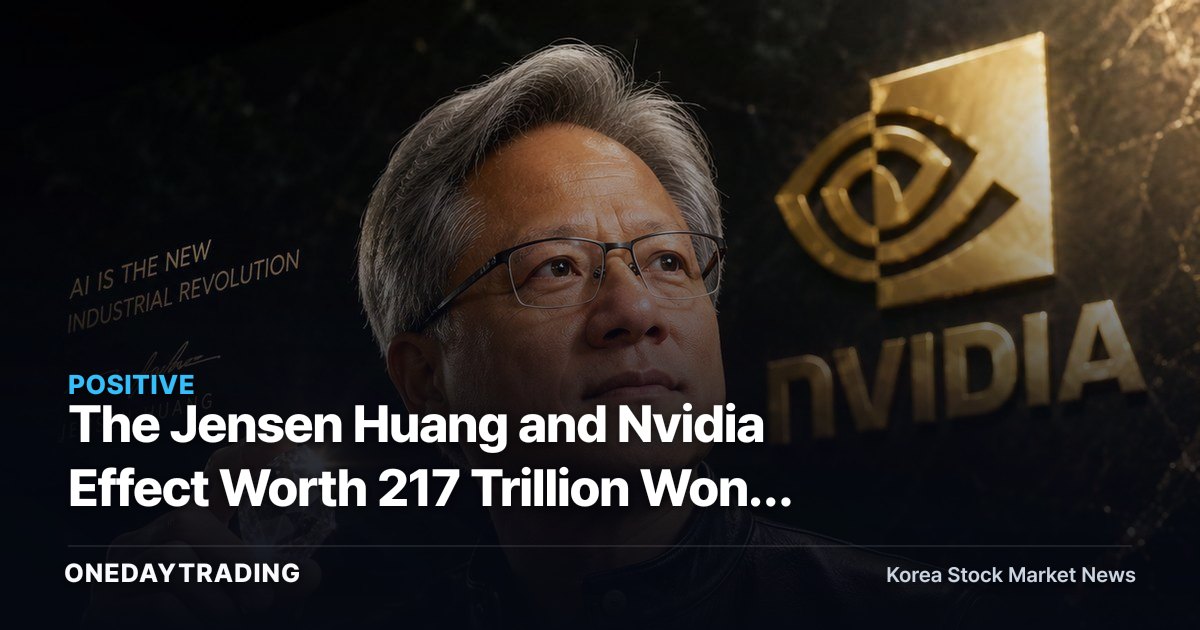
- The fact that Nvidia founder Jensen Huang's personal net worth is cited at around 217 trillion won underscores the key point: a single AI-accelerator stock has grown to a stature rivaling the market capitalization of Korea's large-cap leaders.
- What investors should actually watch is not the fortunes of one man, but the supply-chain link in which demand for the high-bandwidth memory (HBM) loaded onto each Nvidia chip directly drives the earnings of SK Hynix and Samsung Electronics.
- The reason performance diverges even when buying the same semiconductor stocks lies in differences in HBM supply status and the pace of generational transitions.
What Is Changing
Although this topic is dressed up as a fortune-telling story, the meaningful signal for Korean investors lies elsewhere. The fact that the wealth of a single company like Nvidia has swelled to the 217 trillion won range in personal assets alone means that the AI data-center investment cycle has solidified a structure that concentrates profits in specific chip suppliers. The benefits of this structure do not stop at Nvidia; they flow down into the component supply chain that those chips must inevitably contain.
The key channel is HBM. AI accelerators deliver performance only when memory stacked in multiple layers is attached beside the compute chip, and this HBM is effectively a two-horse race in which SK Hynix holds the lead and Samsung Electronics gives chase. Accordingly, the stronger Nvidia's demand, the higher the share of high-value-added revenue at Korea's two memory makers, and the thicker their earnings resilience becomes — independent of the commodity DRAM price cycle.
That said, even within the same memory duopoly, the fork in the road is clear. The two companies' profit leverage plays out differently depending on whether their own HBM is qualified and supplied to Nvidia's new products in time, and on whether they capture share in the transition to the next generation (the next-generation HBM standard).
Viewing It Through Numbers and Context
The figure of 217 trillion won is by itself on par with the market capitalization of the very top stocks on Korea's exchange. While this is a symbol of just how concentrated the AI investment fervor has become, it is ultimately only a valuation of one individual's assets — not a number that guarantees the earnings of suppliers. In the end, the direction of SK Hynix and Samsung Electronics must be confirmed by the share HBM commands within next quarter's memory revenue and by shipment trends.
Beneficiary and Hurt Stocks
- Nvidia: The core engine of AI accelerator demand. As long as data-center investment continues, it sets the direction for the entire component supply chain.
- SK Hynix: As the leading HBM supplier, its share of high-value-added Nvidia-bound revenue is the key to earnings leverage.
- Samsung Electronics: Whether it can recover HBM share and pass qualification for the next-generation standard is the watershed for a re-rating.
- Hanmi Semiconductor: As a supplier of bonder equipment used in HBM stacking, it is a direct beneficiary candidate of expanded memory investment.
- Caution group: Firms with heavy exposure to commodity/legacy memory and non-memory products may feel the warmth of the AI boom relatively late.
Risk Check
- Much of the HBM-boom expectation may already be priced into share prices, leaving a stretch where valuation burden has accumulated.
- If the race to expand HBM capacity overheats, oversupply and falling prices could compress margins.
- With high dependence on a small customer base like Nvidia, shifts in order schedules translate immediately into earnings volatility.
- Export controls on China and won-dollar exchange rate swings act as variables for Korean suppliers' shipments and profitability.
One-Line Conclusion
The structure in which AI chip demand flows through HBM into Korea's two memory leaders is solid, but with expectations already priced in, this is a stretch for separating winners from losers while watching next quarter's HBM revenue share and the results of next-generation standard qualification.
This article is content automatically summarized and analyzed based on the original news report. View original (Maeil Business Newspaper, Corporate)