
At a Glance
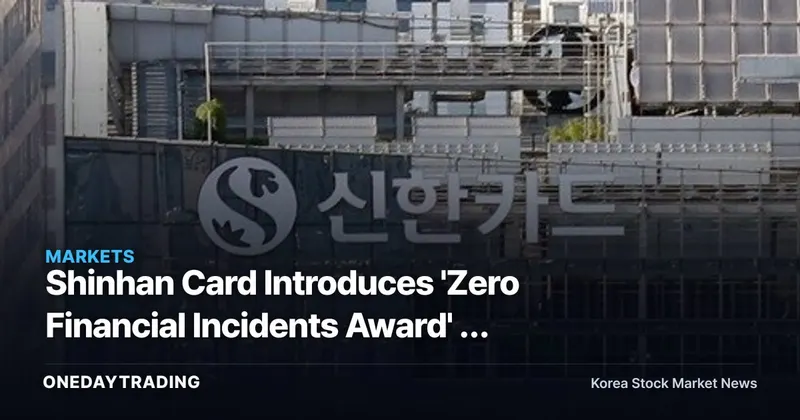
Shinhan Card has introduced a new Zero Financial Incidents Award to recognize employees who contribute to preventing financial incidents and improving business processes. On the surface, this is an internal recognition program, but it can also be read as a signal that across the card and financial industry, internal controls are being elevated from a mere cost item to a variable that shapes profit and loss.
Why It Matters Now
In recent years, the financial sector has seen recurring financial incidents such as embezzlement, fraudulent lending, and system failures, prompting regulators to introduce internal control accountability frameworks and tighten sanctions. In this environment, a single incident can go far beyond simple loss compensation, turning into a tail risk that spreads into fines, business suspension, reputational damage, and customer attrition.
Shinhan Card's new award program can be interpreted as an effort to proactively manage this risk at the level of employee behavior. If incident prevention becomes embedded in practice, it could reduce provisioning and recovery costs as well as dispute-handling expenses, contributing to improved cost efficiency (cost-income ratio, CIR) over the long term. That said, this is a qualitative shift that is difficult to measure through a single award program alone, and it is unlikely to serve as a catalyst with an immediate impact on earnings.
Card companies face limited revenue sources amid pressure to cut merchant fees and the burden of funding costs. This makes defensive cost management — reducing one-off losses from incidents and disputes — a key pillar of protecting profitability.
Frequently Asked Questions
- Is Shinhan Card a listed company? — Shinhan Card is an unlisted subsidiary wholly owned by Shinhan Financial Group, so its value is reflected in the stock market through its parent company, Shinhan Financial Group.
- Is this announcement a stock catalyst? — The introduction of an internal award program does not come with any earnings figures, so it is unlikely to serve as a direct share-price catalyst.
- Why is stronger internal control being discussed? — Financial incidents can lead to fines, sanctions, and reputational losses, so prevention systems serve as a safeguard against downside risk to card and bank earnings.
- What should investors watch? — Rather than the award program itself, investors should track quarterly provisioning trends, one-off incident-related costs, and delinquency rate indicators.
Related Stocks and Sector Impact
- Shinhan Financial Group — As Shinhan Card's parent company, cost management and reduced reputational risk in the card business flow through to the group's consolidated earnings.
- Card and specialized credit finance sector — Amid fee cuts and funding-cost pressure, incident-prevention-oriented cost management is emerging as a common theme across the industry.
- Banks and financial holding companies broadly — With internal control regulations tightening, including the introduction of accountability frameworks, similar preventive investment could spread across the sector.
- Demand for internal control and security solutions — Expanded IT investment in areas such as fraud detection and security systems could be an indirect beneficiary channel.
Investment Considerations
- The introduction of the award program is a qualitative event with limited quantitative impact on near-term earnings or share price.
- The card business is more sensitive to fee regulation and funding rates, so internal control improvements alone are unlikely to change the profitability trend.
- Financial incident risk is not fully eliminated even with prevention systems in place, and if an incident occurs, provisioning and sanction-related variables can still shake earnings.
- Investment decisions on financial holding companies should be based on a comprehensive view of key indicators such as net interest margin, delinquency rate, and dividend policy.
Overall Outlook
On the positive side, if a culture of incident prevention takes hold, reduced one-off losses and reputational costs could support long-term cost efficiency and a more stable dividend base. On the other hand, this announcement is closer to an operational disclosure without concrete figures or earnings improvement, making it unlikely to serve as a factor that determines share-price direction. Investors would be wise to check next quarter's earnings for trends in provisioning, incident-related costs, and delinquency rates to assess whether stronger internal controls are actually translating into earnings.
Shinhan Financial Group: Real-Time Data Snapshot
Shinhan Financial Group's most recent closing price was 100,800 won (-2.23% from the previous day), and the sentiment signal — combining foreign investors and institutional investors supply-demand (order flow) with news and momentum — stands at 🟡 Neutral / Wait-and-see. With positive and negative signals mixed, this is a stretch worth watching closely.
- ▼ News Flow — 4 positive catalysts vs. 9 negative catalysts — negative catalysts dominate
Recent related news skews negative, with 4 positive catalysts versus 9 negative catalysts.
※ Price and foreign/institutional investor supply-demand (order flow) data are provided by Korea Investment & Securities (KIS) and reflect figures as of publication.
This article is automatically summarized and analyzed content based on the original news report. View original (Yonhap News)