
Summary
Timefolio Asset Management has appointed Vice President Cha Moon-hyun as co-CEO and created a new equity investment division. The move is seen as a strategic step by the firm—widely regarded as a premier hedge fund house—to split its decision-making structure and strengthen its traditional equity management capabilities. Because this involves an unlisted asset manager, the direct impact on the stock market is limited, but it serves as a signal for gauging shifts in the competitive landscape of Korea's private and hedge fund markets.
What Happened
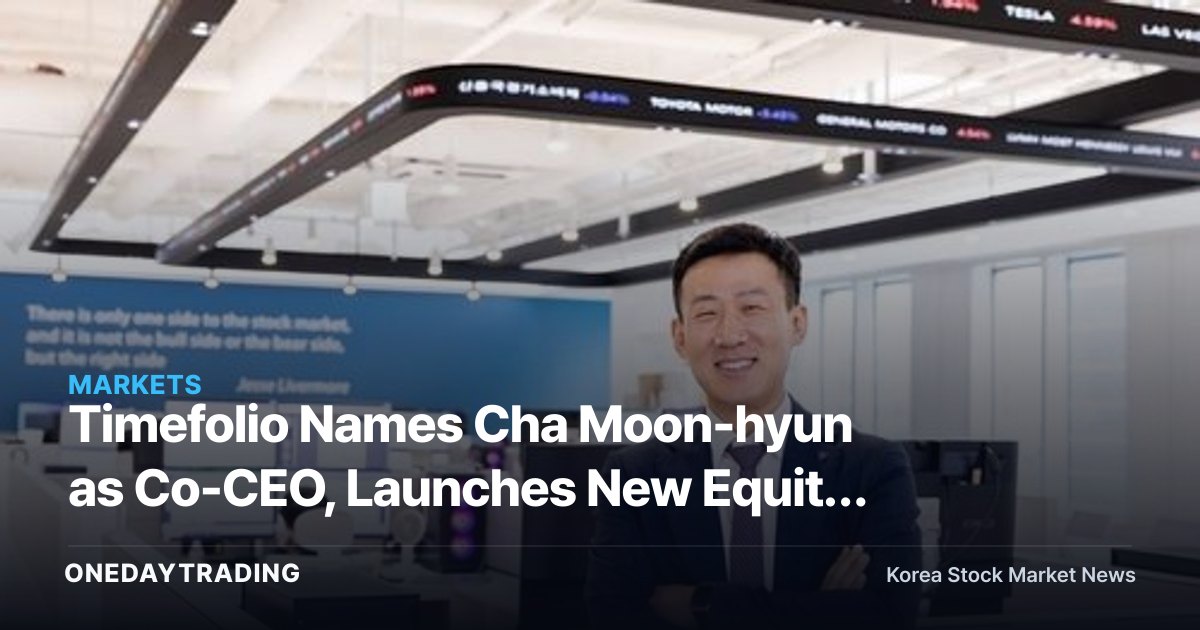
On June 15, Timefolio Asset Management announced the appointment of Vice President Cha Moon-hyun (54) as CEO. The key change is the transition to a co-CEO system, in which he will share decision-making responsibilities with the existing management. Under a co-CEO structure, multiple chief executives independently represent the company and strengthen accountability-based management across their respective areas—a structure adopted by asset managers with expanding business lines to secure both expertise and speed simultaneously.
Alongside this appointment, the firm established a new equity investment division. Timefolio has grown into a multi-strategy hedge fund manager employing a range of strategies including long-short, mezzanine, and pre-IPO investments, and elevating equity investment into a separate division is interpreted as a commitment to further raising the weighting of traditional equity management and the share of specialized personnel.
The equity investment division to be led by the new CEO will oversee strategies for managing domestic and overseas listed equities, and is likely to be run in a way that generates synergy with the firm's existing lineup of absolute-return-oriented hedge funds. The industry views this as an attempt to stabilize investment performance in a highly volatile market environment by placing an experienced figure at the forefront.
Structural Background
Korea's asset management market has recently shown a clear divergence between sluggish public funds and the strong advance of private and hedge funds. As demand for absolute returns from high-net-worth individuals and institutional investors has grown, capital has flowed into multi-strategy managers, and these firms have built their competitiveness through strategy diversification and organizational specialization. Timefolio's establishment of an equity investment division and its transition to a co-CEO system are an extension of this trend.
That said, since personnel and track records are the core assets of the asset management business, organizational restructuring does not immediately translate into performance. It will take time to verify whether the new division can secure meaningful assets under management and returns.
Impact on Stocks and Sectors
- Korean asset management and securities industry: Intensifying competition among private and hedge funds could spur competition for outsourced management mandates and talent, increasing cost and performance pressures across the industry.
- Wealth management (WM) divisions at major brokerages: Strengthening hedge fund sales lineups targeting high-net-worth individuals could work positively for fee income.
- KOSPI and KOSDAQ equity markets: An increase in equity management weighting by multi-strategy managers could contribute to market liquidity and trading vitality over the medium to long term.
- Fintech and management infrastructure: Demand for risk management and trading systems may rise as strategies diversify.
Bull vs. Bear Scenarios
In the bull scenario, the recruitment of an experienced CEO and the specialization of the equity division translate into strong investment performance, accelerating capital inflows and further cementing the firm's standing as a leading hedge fund player. As long as demand for absolute returns holds, multi-strategy managers have substantial room to grow.
In the bear scenario, expanding stock market volatility and intensifying competition in the asset management industry pose the risk that the new division's early performance falls short of expectations. The fact that the appointment's effects are difficult to verify over the short term—given the business's high dependence on key personnel—also weighs as a concern.
Investor Action Points
- Recognize that Timefolio is an unlisted asset manager and therefore not a direct investment target, and use the news as a signal for reading industry trends.
- For listed securities and asset management stocks, weigh both the benefits of an expanding hedge fund market and the risks of intensifying competition.
- If considering investing in a private or hedge fund, carefully compare track records, investment strategies, and fee structures.
- Confirm the actual results of the reorganization through future disclosures of assets under management and returns, and exercise the prudence to hold off on chasing the move.
This article is auto-summarized and analyzed content based on the original news report. View original (Yonhap News Securities)