
Summary
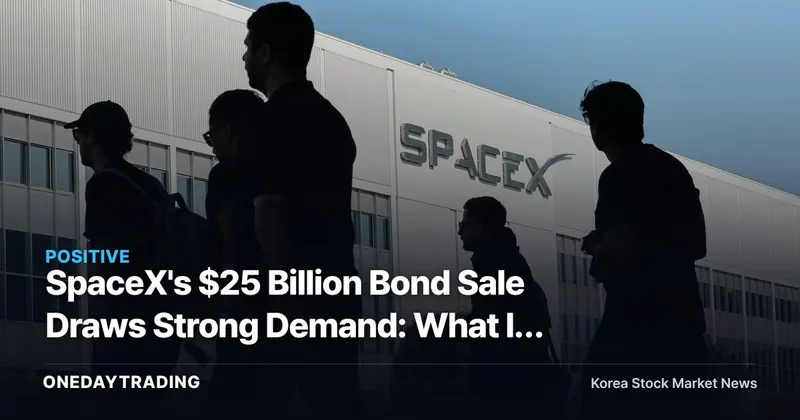
Less than two weeks after going public, SpaceX issued $25 billion in bonds, drawing roughly $90 billion in orders. A major space company lowering its cost of capital and expanding its capacity for aggressive investment is a catalyst that raises medium- to long-term demand expectations for Korean aerospace stocks tied to the satellite and launch-vehicle supply chain.
That said, this is not a direct contract announcement but rather a signal at the level of industry momentum, so any pass-through to earnings at Korean stocks must be confirmed over time.
What Happened
According to foreign press reports, SpaceX raised $25 billion through a bond issuance. What stands out is that the offering drew roughly $90 billion in buy orders—an oversubscription well beyond three times the amount raised. This shows that the bond market places a high value on the company's cash flow and growth potential.
It is especially significant that this financing came less than two weeks after the listing. Typically, immediately following a new listing the equity market's valuation takes precedence, but SpaceX secured large-scale access to capital from both the equity and bond markets simultaneously. Given the enormous capital expenditures required to expand the subscriber base of its Starlink satellite internet service and to develop next-generation launch vehicles, this financing has a strong character of pre-emptively securing investment funding for the years ahead.
Structural Backdrop
The global space industry is in a phase where the center of gravity is shifting from government-led to private-led. As falling launch costs converge with the commercialization of low-earth-orbit satellite communications, a structural increase in launch frequency itself has taken shape. The fact that a major operator can raise large-scale debt on near-low-interest terms is evidence that the industry is beginning to be recognized not as a loss-making venture but as stable, cash-generating infrastructure.
From Korea's perspective, companies are positioned throughout the value chain—launch-vehicle materials and components, satellite bodies and payloads, ground stations and antennas—so rising global launch demand has the potential to translate into downstream demand.
Impact on Stocks and Sectors
- Hanwha Aerospace: The group is expanding its Nuri-rocket-based launch services and satellite business at the group level, making it Korea's flagship stock in the theme of expanding private space investment. That said, it benefits more from industry momentum than from direct dealings with SpaceX.
- Hanwha Systems: It is advancing satellite communications, payloads, and low-earth-orbit communications businesses, so its technology and business opportunities could come to the fore if competition in satellite internet intensifies.
- AP Satellite: It handles satellite terminals and body components, so the direct downstream effect of rising satellite-launch demand is relatively close at hand.
- Intellian Technologies: As a supplier of antennas and ground equipment for low-earth-orbit satellite communications, the spread of Starlink-type services translates directly into rising antenna demand.
- Satrec Initiative: Operating satellite-system and imaging businesses, it is mentioned in the context of expanding satellite-manufacturing demand.
Bull vs. Bear Scenarios
On the bull side, the world's leading private launch company succeeding in raising capital suggests the launch and satellite investment cycle could be longer and stronger, creating trickle-down expectations for Korea's component and equipment makers. Falling launch unit costs can increase satellite orders themselves, spilling over into demand for antennas and terminals.
On the bear side, the risks are equally clear. This event is merely a foreign company's financing and is not an event that directly translates into actual revenue or contract wins for Korean stocks. Korean aerospace stocks have in many cases already built up high valuations on theme expectations alone, so if those expectations fail to be validated by earnings, volatility could rise. Moreover, SpaceX strengthening its self-sufficiency could, in some areas, instead act as competitive pressure.
Action Points for Investors
- Distinguish theme expectations from actual contract wins. Check whether Korean companies' new satellite- and launch-related contract announcements and quarterly earnings actually show rising revenue recognition.
- Examine valuation burden. Compare whether the share-price gains are excessive relative to earnings, using trends in PER and order backlog.
- Track downstream demand indicators. Monitor global launch counts, growth in low-earth-orbit satellite-communications subscribers, and the Korea and Asia rollout schedules of competing services such as Starlink.
- Keep an eye on macro variables. Interest-rate levels and the exchange rate simultaneously affect the profitability of capital-intensive space companies and export-oriented component makers.
Hanwha Aerospace Through Real-Time Data
Hanwha Aerospace's latest closing price is 1,073,000 won (-4.62% from the previous day), and its signal light—combining foreign-investor and institutional-investor supply-demand (order flow) with news and momentum—is 🟢 Buy-Leaning. With foreign investors, institutional investors, and news all positive, it is worth keeping an eye on.
- ▲ Dual Buying — foreign investors +10 billion won · institutional investors +20.4 billion won buying in tandem
- ▼ Trend Alignment — short- and mid-term downside alignment (same day -4.6% · 1 week -9.3% · 1 month -14.0%)
- ▲ News Flow — 8 positive catalysts vs. 3 negative catalysts — positive catalysts prevail
Recent related news is favorable, with 8 positive catalysts · 3 negative catalysts.
※ Price and foreign-investor/institutional-investor supply-demand (order flow) data are provided by Korea Investment & Securities (KIS), as of the time of publication.
This article is content automatically summarized and analyzed based on the original news. View original (CNBC)