
Three-Line Briefing
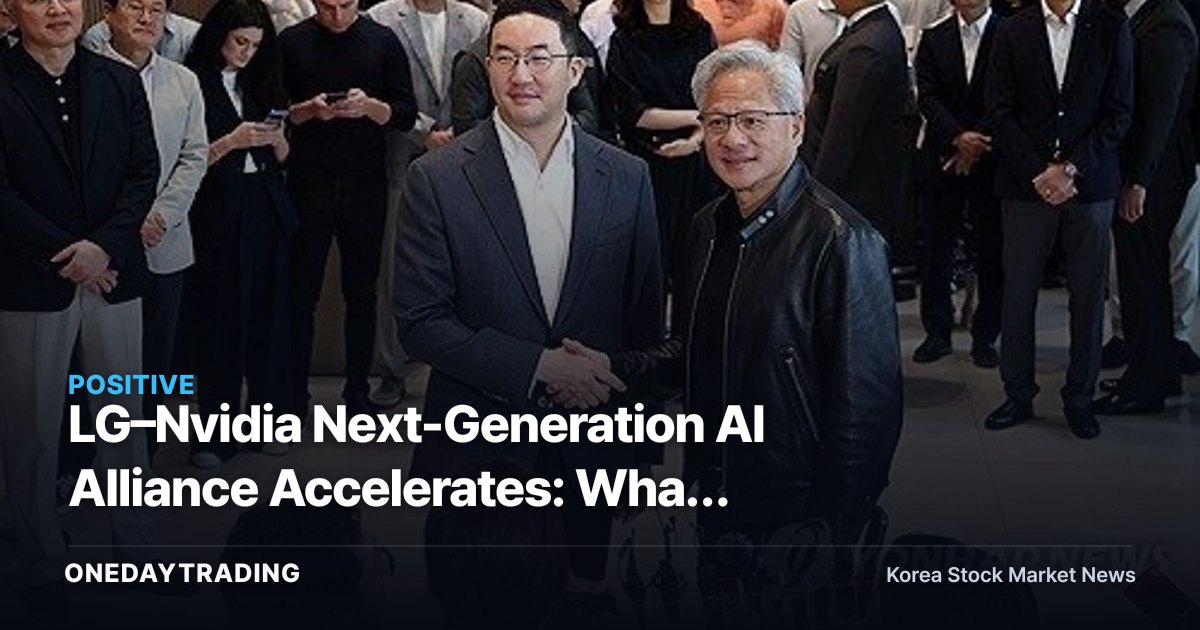
- Spurred by a meeting between LG Chairman Koo Kwang-mo and Nvidia CEO Jensen Huang, group executives are traveling to the U.S. to accelerate talks on next-generation AI collaboration.
- The center of gravity of the partnership appears to lie in areas tied to Nvidia's GPU ecosystem—AI data centers (AI factories), on-device AI, industrial robots, and physical AI.
- The key thing to watch is the intensity and timing of the benefits flowing to the actual operating companies—LG Electronics, LG Innotek, LG Uplus, and LG CNS—rather than to the holding company LG.
What Is Changing
The crux of this meeting is that LG is seeking to bring Nvidia in not merely as a GPU supplier, but as a partner in designing AI infrastructure. Until now, Korean conglomerates' collaboration with Nvidia has often been limited to supplying memory and server components, but LG appears to be structuring a broader scope of cooperation that extends from building and operating AI data centers all the way to the application layer in home appliances, automotive electronics, and robotics. This is an attempt to shift its business identity from a buyer of GPUs to a company that uses GPUs to sell its own AI services and products.
Breaking it down by entity makes the impact paths clearer. As orders for AI data centers and cloud services grow, LG Uplus and LG CNS can deploy Nvidia GPUs at scale and grow AI-factory-style infrastructure revenue. For LG Electronics, this is a channel to embed on-device AI into home appliances and TVs and to strengthen computing platforms for autonomous driving and infotainment in its Vehicle component Solutions (VS) division. LG Innotek is directly connected to demand for the substrates (FC-BGA), camera modules, and semiconductor package substrates used in AI servers and autonomous driving.
That said, it must be made clear that the current stage involves collaboration talks and a U.S. visit schedule, not finalized contracts. Since the specific investment scale, the form of any joint venture, and the timing of revenue recognition have not been disclosed, there will be a lag before expectations translate into earnings.
Reading the Numbers and Context
The currently available information centers on qualitative facts—the meeting and the U.S. visit—and quantitative figures such as investment amounts or supply volumes have not yet been presented. Investors should therefore base their judgments on whether numbers such as the AI data center order backlog, the automotive electronics order backlog, and substrate division utilization rates actually move in future disclosures and earnings releases. Only when the rollout schedule of Nvidia's next-generation platform in Korea aligns with capacity (production capability) expansion announcements from LG affiliates will the substance of the collaboration be confirmed in the numbers.
Beneficiary and Affected Stocks
- LG (holding company): A beneficiary of group-wide AI collaboration headlines, but since its earnings lag behind subsidiary dividends and the value of its stakes, the strength of its reaction may be relatively muted.
- LG Electronics: If on-device AI in home appliances and the automotive electronics division combine with Nvidia's computing platform, there is significant room to improve average selling prices and product mix. However, a slowdown in home appliance demand is an offsetting variable.
- LG Innotek: A direct beneficiary as demand grows for substrates and camera modules used in AI servers and autonomous driving. Highly sensitive to end-market demand and the exchange rate.
- LG Uplus and LG CNS: AI data center and cloud infrastructure orders are the core beneficiary path. The burden of initial GPU deployment costs could weigh on short-term margins.
- Nvidia: A structural beneficiary, securing additional GPU and platform demand through the expansion of the Korean conglomerate ecosystem.
Risk Check
- As this is still at the discussion stage, with binding contracts and investment scale undecided, profit-taking pressure could emerge after expectations are priced in ahead of substance.
- Expanding AI infrastructure investment pressures short-term profitability through upfront depreciation and GPU purchase costs.
- Bargaining power over Nvidia GPU pricing and volumes ultimately rests with Nvidia, which may limit LG affiliates' control over costs and margins.
- Shifts in U.S.–China AI regulation and export controls act as variables affecting the scope and timing of the collaboration.
Bottom Line
LG's collaboration with Nvidia is directionally positive in that it signals a transition from GPU buyer to AI operator. However, until concrete order and investment figures are confirmed through disclosures, a phased approach that accounts for the gap between expectations and substance is reasonable.
LG Through Real-Time Data
LG's latest closing price is 108,900 won (-0.91% from the previous day), and the signal light—combining foreign investor and institutional investor supply-demand (order flow) with news and momentum—is 🟡 neutral / wait-and-see. With positive and negative signals mixed, this is a zone to watch.
- ▲ Order flow continuity — Foreign investors net buyers for 6 consecutive days (+16.5 billion won)
※ Price and foreign/institutional supply-demand (order flow) data are provided by Korea Investment & Securities (KIS), as of the time of publication.
This article is content automatically summarized and analyzed based on the original news. View original (Yonhap News, Industry)