
Key Takeaways
The Nix Leverage ETF — which tracks twice the daily price movement of SK Hynix — reclaimed the top position for weekly retail net buying for the first time in four weeks. Rather than reflecting a stock-specific positive catalyst, this serves as a sentiment indicator showing that retail investors' risk appetite and near-term bullish expectations for SK Hynix have strengthened once again.
Fund flows into leveraged ETFs carry a strong directional-bet character, suggesting that momentum in the memory and HBM industry sector cycle remains alive. That said, the structural volatility drag (negative compounding) inherent in leveraged products must be considered alongside this signal.
What Happened
This week, retail buying activity concentrated heavily in the SK Hynix Single-Stock Leverage ETF — commonly known as Nix Leverage — pushing it to the top of the weekly retail net-buying rankings. Having been displaced from that position for several consecutive weeks, it reclaimed the top spot for the first time in four weeks.
Single-stock leveraged ETFs are designed to deliver approximately twice the daily return of a specific stock (ticker). Accordingly, the fund flow into Nix Leverage is interpreted as a growing number of retail investors placing bets that SK Hynix will rally further in the near term.
The fact that retail net-buying supply-demand (order flow) concentrated not in diversified index ETFs but in a single-stock leveraged product suggests that aggressive risk appetite has partially recovered in the market.
Background and Context
SK Hynix occupies a central position in the supply of high-bandwidth memory (HBM) and AI server memory, making its share price highly sensitive to the memory pricing cycle and AI investment fund flow. The return of retail capital to the leveraged ETF may reflect the possibility that industry sector expectations have reignited as a short-term momentum trade.
Conversely, given the nature of leveraged products, structural friction arises when the underlying moves sideways or oscillates — causing returns to lag those of the underlying asset. This is why the fund inflow itself cannot be equated with a definitive signal on the direction of the share price.
Market and Stock Impact
- SK Hynix: As the underlying asset of Nix Leverage, rising retail demand for the leveraged product directly feeds into short-term supply-demand (order flow) and market sentiment. A mutually reinforcing dynamic may develop in which share price swings further stimulate ETF fund flow.
- Samsung Electronics: Operating within the same memory and HBM competitive landscape, the AI memory expectations tilted toward SK Hynix will influence the overall investment temperature across the industry sector. The semiconductor sentiment recovery could prove either concurrent or result in relative underperformance.
- HBM Materials and Back-End Value Chain: Companies such as Hanmi Semiconductor — involved in HBM bonding, packaging equipment, and materials — have revenue tied to SK Hynix's capital expenditure intensity, making them candidates for momentum spillover.
- Leveraged ETF Managers: Higher trading value in single-stock leveraged products is favorable from a management fee perspective, though increased volatility simultaneously raises the risk of loss-related complaints and regulatory scrutiny.
Investor Checklist
- Monitor DRAM and HBM contract prices alongside memory spot price trends to verify whether the fund inflow is consistent with fundamentals.
- At SK Hynix's next quarterly earnings release, assess the HBM revenue mix, guidance, and capital expenditure plans.
- Track Nix Leverage's trading value, premium/discount rate, and the sustainability of retail net buying on a weekly basis to distinguish a lasting trend from a one-off concentration.
- When holding leveraged products, set stop-loss levels in advance and account for the negative compounding effect in sideways markets.
Outlook
If the AI investment cycle and HBM demand remain intact, retail leveraged capital could act as a supply-demand (order flow) amplifier for SK Hynix's near-term upside. However, in the event of a slowdown in memory prices, valuation headwinds, or heightened volatility, the leveraged structure will amplify losses by the same magnitude. Investors should not focus solely on the direction of fund flows — they must also verify whether the industry sector fundamentals underpinning those flows are confirmed by earnings results and pricing indicators.
SK Hynix — Real-Time Data Snapshot
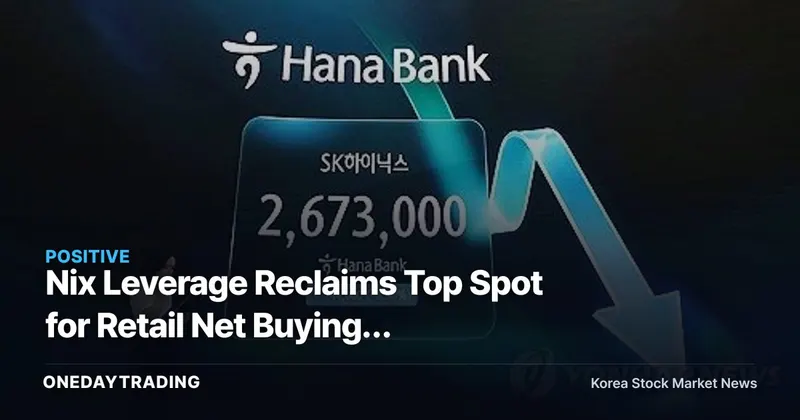
SK Hynix's most recent closing price is 2,673,000 won (−8.36% from the prior session). The composite signal — incorporating foreign investor and institutional investor supply-demand (order flow) alongside news and momentum — reads 🔴 Caution. Foreign investors, institutional investors, and momentum are all negative, warranting careful attention at this time.
- ▼ Supply-Demand (Order Flow) Continuity — Foreign investors have been net sellers for 6 consecutive sessions (−2,315.0 billion won)
- ▼ Dual-Sided Selling — Foreign investors −2,315.0 billion won · Institutional investors −2,834.3 billion won, selling in tandem
- ▲ 52-Week Position — At 89% of the 52-week range — approaching all-time high territory
Recent related news comprises 17 positive catalyst items and 16 negative catalyst items, reflecting a broadly constructive news flow.
※ Price and foreign investor/institutional investor supply-demand (order flow) data are provided by Korea Investment & Securities (KIS) and are current as of the time of publication.
This content was automatically summarized and analyzed based on the original news source. View original article (Yonhap News — Securities)