
At a Glance
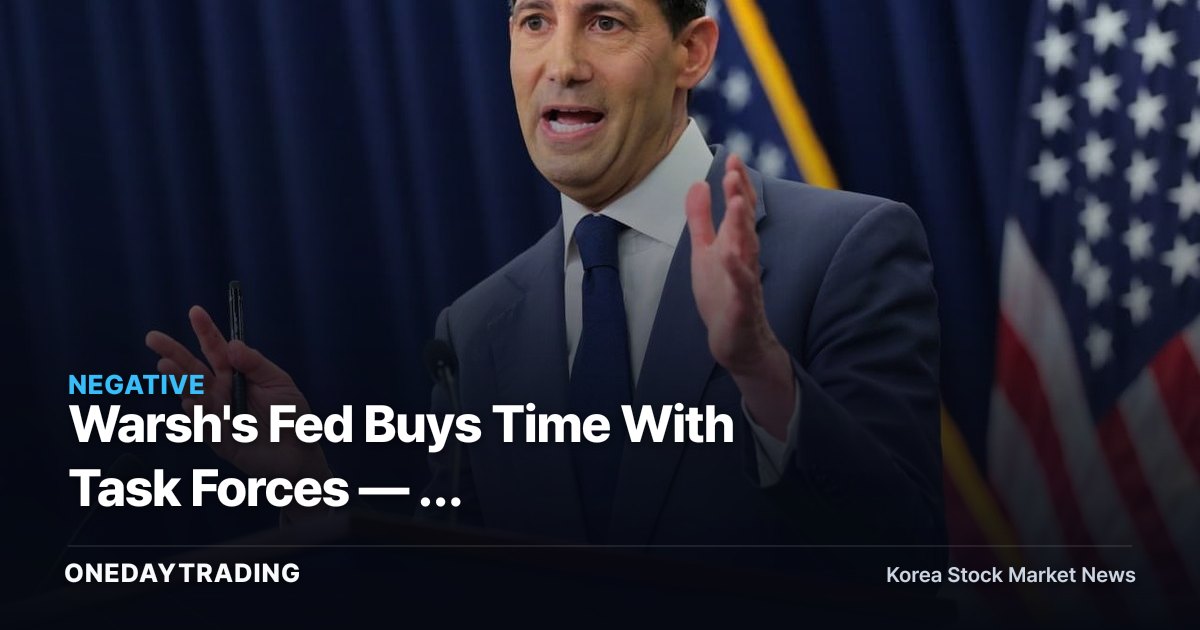
At his first press conference, newly appointed Federal Reserve (Fed) Chair Kevin Warsh repeatedly responded to multiple reporters' questions by saying the matter was under review by a task force. This is read as a move to avoid giving immediate answers on policy direction and to secure justification for deferring a decision until the December meeting. For Korean investors, it signals that the timing of rate cuts could be pushed back, making volatility in the won-dollar exchange rate and rate-sensitive industry sectors a key variable.
Why It Matters Now
The fact that the Chair deferred a concrete policy stance and substituted a review process for a direct answer is interpreted as an intent to watch more data rather than alter the rate path in the short term. If the early-cut prospect the market has been counting on fades, dollar strength could persist and the downside in U.S. government bond yields could be limited. This works in the direction of raising the valuation discount rate across risk assets.
Korean equities are sensitive to foreign investors' supply-demand (order flow) and the exchange rate. If a delayed cut keeps the Korea-U.S. rate gap from narrowing, downward pressure on the won is likely to continue. That is favorable for the won-translated earnings of export companies, but it simultaneously amplifies a double-edged dynamic of foreign capital outflows and higher import-driven inflation. Conversely, the longer high rates persist, the relatively more favorable the interest-income environment becomes for banks that rely on net interest margins.
That said, the Chair's rhetoric does not in itself signal a hawkish decision. An "under review" answer may simply preserve flexibility that leaves the door open to both a cut and a hold, so the employment and inflation data released before the December meeting will determine the actual direction.
Frequently Asked Questions
- Why does the task-force answer matter — Because by withholding an immediate policy signal, the Chair cooled the market's bets on a cut and created room to defer the decision until after the data is confirmed.
- What is the impact on Korea if a rate cut is delayed — A narrowing of the Korea-U.S. rate gap is postponed, increasing won weakness and volatility in foreign investors' order flow, which can weigh on rate-sensitive growth stocks.
- Is it a negative catalyst for every industry sector — No. Prolonged high rates are favorable for banks' interest income, and a weaker won can support the translated earnings of companies with a large export share.
- When will the direction become clear — The trajectory of U.S. employment data and consumer inflation released before the December meeting is the decisive variable.
Impact on Related Stocks and Sectors
- Banks & Financials (KB Financial, Shinhan Financial Group) — If the high-rate environment lasts longer, net interest margins and the interest-income base may stay relatively solid.
- Large-cap Exporters (Samsung Electronics, Hyundai Motor) — If won weakness continues, the won-translated value of overseas revenue rises, which can work favorably for earnings.
- Semiconductors (SK hynix) — Sensitive to foreign investors' order flow and the exchange rate, so volatility could widen if global risk appetite weakens on a delayed cut.
- High-valuation Growth & Bio — Vulnerable to a rising discount rate, these are prone to multiple compression in a phase where the downside in rates is limited.
Points to Watch When Investing
- The Chair's rhetoric may be about preserving two-way flexibility rather than locking in a hold, so beware of categorically hawkish interpretations.
- Won weakness is a positive catalyst for export stocks while also carrying the opposite effect of foreign capital outflows and import-driven inflation pressure.
- The U.S. employment and inflation data released ahead of the December meeting are the key variables that could overturn the scenario.
- You can only gauge the direction by checking government bond yields, the won-dollar exchange rate level, and the trend in foreign net buying together.
Overall Outlook
In the optimistic scenario, the delayed cut amounts to no more than temporary time-buying, and once inflation stability is confirmed the policy pivot resumes, bringing stability for bank stocks and exchange-rate tailwinds for export stocks to the fore. The opposite risk is a phase in which, if higher-for-longer rates become entrenched, dollar strength and a rising discount rate on risk assets shake foreign investors' order flow and amplify the valuation burden on rate-sensitive growth stocks. Ultimately, the next round of employment and inflation data and the outcome of the December meeting become the dividing line between the two scenarios.
This article is auto-summarized and analyzed content based on the original news. View Original (MarketWatch)