
Summary
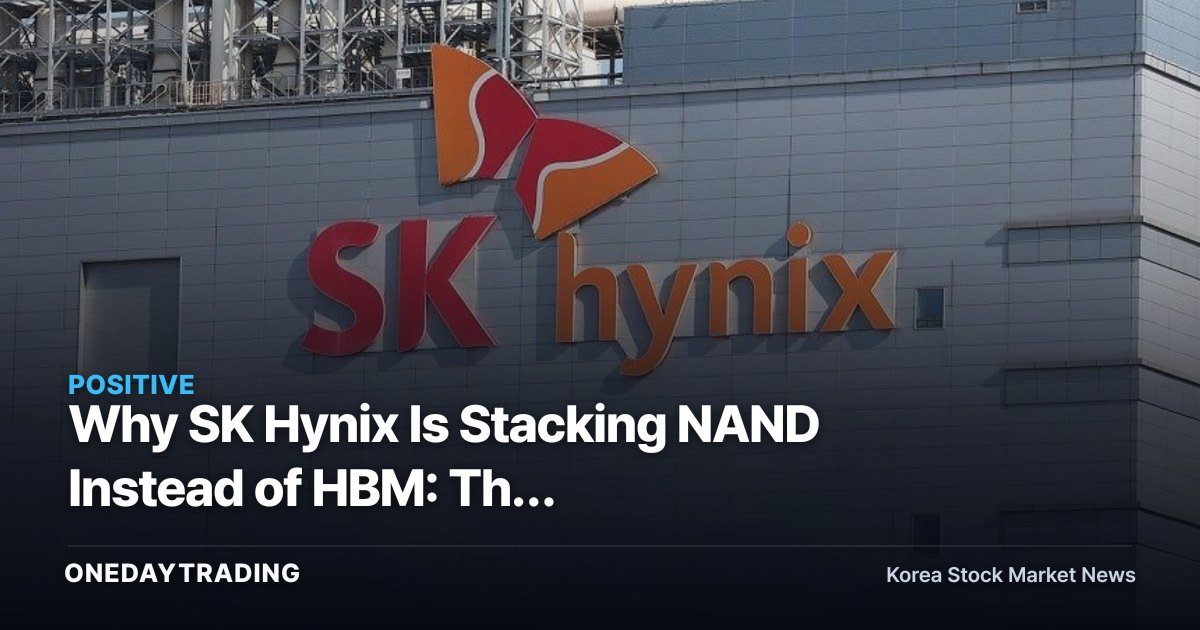
SK Hynix has teamed up with SanDisk to enter the race for HBF (High Bandwidth Flash), a next-generation memory standard. It's a bold bet to fill the high-capacity memory demand in AI inference — a workload HBM is struggling to keep up with — using stacked NAND flash technology. The key question is whether this technology can establish itself as an industry standard and translate into actual mass production and adoption.
What Happened
The point of collaboration between SK Hynix and SanDisk is NAND, not DRAM. HBM boosts bandwidth by stacking DRAM vertically, but the catch is that DRAM's own cost and die area are finite. There's a physical ceiling on how much HBM capacity can fit into a single AI server, and pushing that ceiling higher drives costs up sharply. HBF gets around this ceiling by using NAND flash instead. The idea is to vertically stack NAND — whose per-cell cost is lower than DRAM's — to create memory that falls short of HBM on speed but delivers a dramatic increase in capacity.
Behind the timing of this concept is a shift in the center of gravity of AI computing. AI investment has so far been concentrated on training large models, a phase where data-transfer speed per second is critical — and where HBM has enjoyed a near-monopoly. But as the industry moves into the service phase, where inference handles real user queries, the requirement is shifting from raw speed toward how much context and data can be held in memory at once. In this phase, NAND-based low-cost, high-capacity memory may be a better fit than HBM's expensive bandwidth.
It's significant that SK Hynix has put its name on this from the early stage. The fact that a company that has stayed at the front of every HBM generational shift is also reaching for a NAND-based alternative standard suggests it has concluded that HBM alone won't be enough to absorb all AI memory demand as the inference market grows.
Structural Background
In the memory industry, no new standard takes hold in the market just because a single company pushes it. Success hinges on approval from standards bodies like JEDEC, the surrounding ecosystem of controllers and interposers, and above all, whether system designers like Nvidia adopt the standard for their next-generation AI accelerators. HBM itself was just one of several competing standards when it first appeared, and it took several generations to become the established standard. For HBF as well, forming a consortium is only the first step — actual adoption still requires standardization, validation, and mass production.
Impact on Stocks and Sector
- SK Hynix: Extending the stacking and packaging know-how built up in HBM to NAND-based HBF would broaden its AI memory portfolio across both DRAM and NAND. As the inference market grows, this could also help reduce its reliance on HBM revenue.
- Samsung Electronics: As an integrated semiconductor company producing both NAND and DRAM, being left out of the HBF standardization process could mean losing a foothold in the next-generation AI memory race — whether it unveils its own competing technology is worth watching.
- Micron: As the No. 3 player in HBM, Micron is a competitor that may need to reconsider its DRAM-centric strategy if a NAND-based alternative standard becomes established.
- SanDisk: As a NAND specialist, if HBF becomes an established standard, it would give SanDisk's NAND business a path to expand from low-margin commodity memory into high-value, AI-specific applications.
- HBM packaging and equipment partners: If stacking technology expands from DRAM to NAND, demand for TSV (through-silicon via) and bonding equipment could spread to NAND production lines as well.
Bullish vs. Bearish Scenarios
The bullish scenario is one where HBF is finalized as a JEDEC standard and AI accelerator makers adopt it in inference-dedicated chips. In that case, SK Hynix would hold a core position in the AI memory supply chain on both the DRAM (HBM) and NAND (HBF) fronts, which could trigger a valuation re-rating. The bearish scenario, conversely, is one where standardization is delayed, or a competing standard or existing lower-cost HBM lineups absorb the same demand first. Since the consortium is still closer to an early-stage declaration of cooperation, there is also a risk that a premium built purely on expectations becomes excessive before an actual product roadmap and mass-production timeline materialize.
Investor Action Points
- Check first whether the HBF specification is actually approved by standards bodies such as JEDEC, and on what timeline.
- Watch whether major AI accelerator designers such as Nvidia mention HBF or a similar concept in their next-generation roadmaps.
- Track SK Hynix's quarterly earnings releases for concrete updates on HBF development progress and NAND division investment plans.
- Compare whether competitors such as Samsung Electronics and Micron introduce similar NAND-based high-bandwidth storage technologies of their own.
SK Hynix in Real-Time Data
SK Hynix's most recent closing price is 1,577,000 won (0.00% vs. the previous day), and the composite signal combining foreign/institutional order flow with news and momentum is 🔴 Caution. Foreign investor flow and news sentiment are negative, so caution is warranted right now.
- ▼ News Flow — 2 positive catalysts vs. 5 negative catalysts — negative catalysts lead
Recent related news skews negative, with 2 positive catalysts versus 5 negative catalysts.
※ Price and foreign/institutional order-flow data are provided by Korea Investment & Securities (KIS) and are as of publication time.
This article is automatically summarized and analyzed based on the original news report. View original (Maeil Business Newspaper, Corporate)