
Key Takeaways
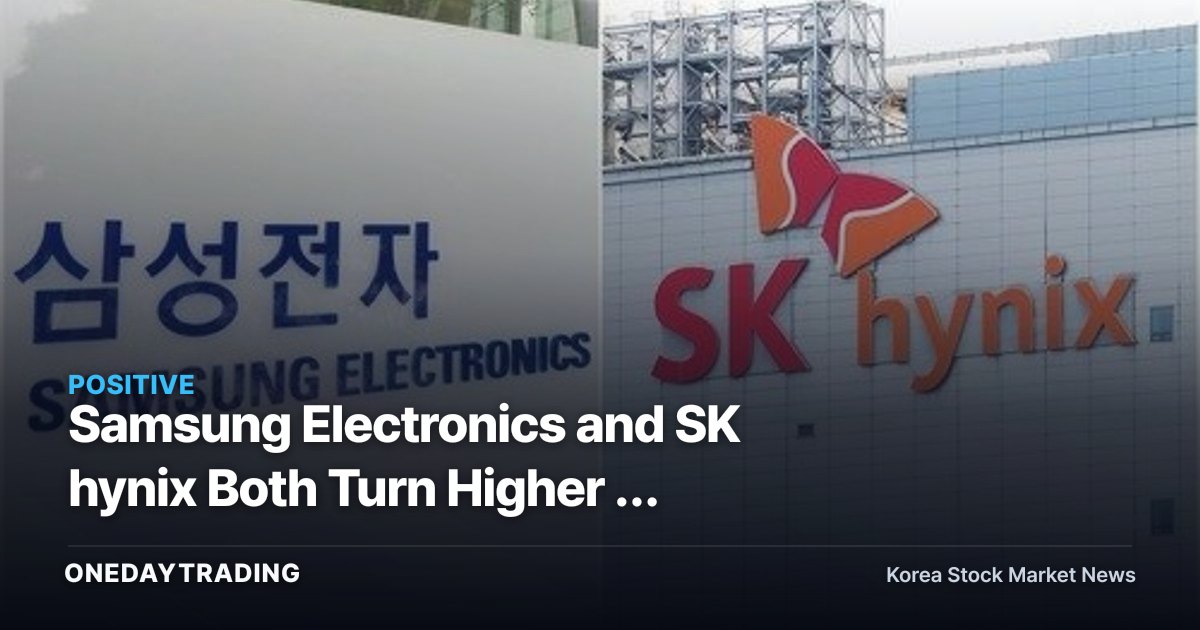
Even in a session where Middle East geopolitical risk came to the fore, Samsung Electronics and SK hynix recouped their early losses and turned higher. This is read as a signal that the semiconductor sector's own demand cycle — rather than a macro shock rattling the broader index — is driving share prices. For investors, the point to watch is not the event headlines but the slope of the industry curve traced by HBM and memory prices.
What Happened
As military tension between the United States and Iran escalated, risk-off sentiment took hold, and large-cap KOSPI names also opened weak in early trading. However, Samsung Electronics and SK hynix — the first and second largest by market capitalization — rebounded relatively quickly and shifted direction to a joint advance.
Some in the market see the view that the strong semiconductor cycle will continue at least through next year as having supported the floor under share prices. In other words, geopolitical variables are merely a short-term factor amplifying volatility, and the judgment that the fundamental axis of memory demand and pricing remains intact translated into buying.
In particular, the fact that the two stocks recovered ahead of the index suggests that foreign investors and institutional investors are treating semiconductors not as a macro hedge but as earnings-momentum stocks.
Background and Context
The core of the current semiconductor cycle is demand for high-bandwidth memory (HBM) stemming from AI data center investment. With prices for commodity DRAM and NAND having passed the bottom and entering a recovery phase, HBM — as a high-value-added product — sits in a zone that magnifies both companies' profitability leverage. The logic holds that as long as external shocks such as war or oil prices do not immediately dampen downstream semiconductor demand (AI servers, smartphones, PCs), the industry trend itself is maintained.
Impact on the Market and Stocks
- Samsung Electronics: As an integrated semiconductor company spanning memory, foundry, and set products, a rebound in memory prices is directly reflected in company-wide operating profit. The pace of HBM customer diversification is the key to further upside.
- SK hynix: With revenue heavily concentrated in memory, its earnings sensitivity to rising DRAM and HBM prices is the highest. The expanding share of AI-server-bound HBM is the structure lifting its margins.
- Hanmi Semiconductor: By supplying back-end equipment such as TC bonders needed for HBM production, it is a downstream-linked beneficiary in which memory makers' HBM capacity-expansion investment translates directly into orders.
- Materials and components suppliers: Rising memory utilization works positively on the utilization rates and pricing power of the upstream supply chain, including photoresists, CMP, and substrates.
Investor Checkpoints
- Check the HBM share of revenue and the trend in memory average selling prices (ASP) in quarterly earnings releases to gauge whether the industry is accelerating or slowing.
- Track the monthly direction of Taiwan and U.S. memory price indicators (DRAM and NAND contract prices) to verify whether the outlook holds true.
- Watch whether the Middle East situation spills over into oil and logistics costs. If rising costs weigh on downstream IT demand, the rebound thesis could be undermined.
- Check foreign investors' supply-demand (order flow) — in particular, whether net buying in the two semiconductor stocks persists — on a daily basis.
Outlook
If the scenario of an industry recovery extending into next year remains valid, a pullback driven by geopolitical shocks could function as an opportunity to increase semiconductor exposure. That said, the opposite scenario is equally clear. The two stocks are already in a zone that has substantially priced in recovery expectations, so valuation burdens have accumulated; if a slowdown in the pace of AI investment or a Middle East-driven oil price surge stokes the inflation and interest-rate path, there is room for foreign capital to exit risk assets. Ultimately, this is a phase where the big picture of a sustained boom coexists with heightened short-term volatility, and the authenticity of the trend needs to be continually checked against price indicators and supply-demand (order flow).
Samsung Electronics Through Real-Time Data
Samsung Electronics' latest closing price was 359,000 won (+1.41% versus the prior day), and the signal light combining foreign investor and institutional investor order flow with news and momentum is 🟢 Buy-leaning. News and momentum are positive, making it worth attention.
- ▲ Trend alignment — short- and medium-term upward alignment (intraday +1.4% · 1 week +6.5% · 1 month +30.1%)
- ▲ 52-week position — upper 95% of the 52-week range — new-high territory
- ▲ News flow — 23 positive catalysts vs. 7 negative catalysts — positive-leaning
Recent related news is favorable, with 23 positive catalysts and 7 negative catalysts.
※ Price and foreign investor/institutional investor order-flow data are provided by Korea Investment & Securities (KIS) and are as of the time of publication.
This article is content automatically summarized and analyzed based on the original news report. View original (Maeil Business Newspaper, Securities)