
Summary
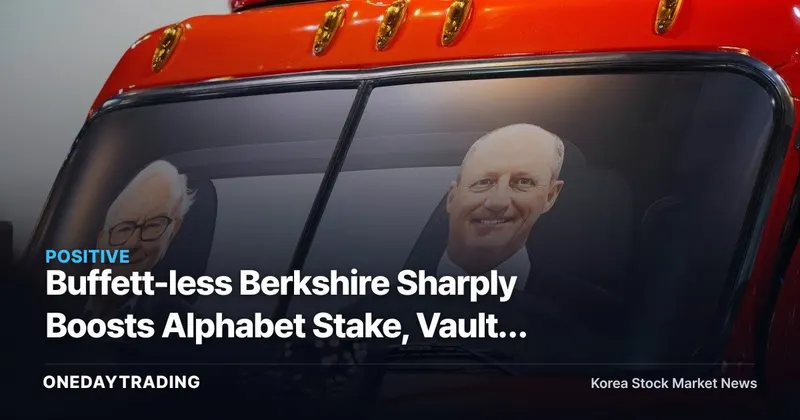
Berkshire Hathaway's second-quarter (April-June) 2026 fiscal year 13F filing with the U.S. Securities and Exchange Commission has confirmed a substantial increase in its holdings of Alphabet, Google's parent company, lifting the position into the top three of its overall portfolio. This is the first disclosure of holdings changes since Warren Buffett stepped down as CEO and the company transitioned to Greg Abel's leadership, and it is being read as a sign that Berkshire's portfolio — long built around undervalued blue-chip stock (ticker)s like Apple, Bank of America, and American Express — is shifting its center of gravity toward mega-cap technology stock (ticker)s. However, since 13F filings can be delayed by up to 45 days after quarter-end, there remains a possibility that actual holdings today already differ from what is reflected in this filing.
What Happened
13F is a mandatory quarterly disclosure of U.S. equity holdings required of institutional investors managing $100 million or more in assets, and Berkshire's 13F draws market attention every quarter as the only window into what the Oracle of Omaha has been buying and selling. The centerpiece of this filing is the expansion of the Alphabet stake. Berkshire first disclosed a small Alphabet position in its third-quarter 2023 filing, and in this second-quarter filing that stake has grown noticeably, climbing into the top three of the portfolio.
The timing stands out. Because this is the first holdings disclosure since Buffett stepped down as CEO and Abel took over, the market is split on whether to interpret the expanded Alphabet position as one of Buffett's final decisions or as an early signature of the Abel era. Berkshire's buy and sell decisions have traditionally been split among Buffett and his two deputy managers, Todd Combs and Ted Weschler, and the filing alone does not identify who was actually behind this quarter's purchases.
Structural Background
Berkshire's Alphabet bet looks less like a pivot away from value-investing principles into technology stock (ticker)s, and more like a widening of the door that was already opened by the 2016 purchase of Apple. Apple has held a top spot in Berkshire's portfolio for nearly a decade, during which Berkshire has steadily trimmed part of its stake to manage position size. Alphabet's climb into the top three looks less like a fresh bet and more like accumulated conviction in Alphabet's cash-generating power across search, cloud, YouTube, and self-driving (Waymo). The fact that Alphabet's price-to-earnings ratio sits on the lower end relative to Big Tech peers fits Berkshire's buying logic — a technology stock (ticker) that can nonetheless be justified on value-investing terms.
Impact on Stock (Ticker)s and Industry Sectors
- Alphabet: Berkshire's move into the top three, given its reputation as smart money, functions as a signal that boosts institutional investors' confidence. With advertising, cloud, and AI businesses all growing in tandem, the added appeal of its valuation could serve as grounds for further institutional investors inflows.
- Berkshire Hathaway: The portfolio reshuffling is directly tied to investor confidence in the direction of capital allocation following the CEO transition. Whether the Abel era carries forward Buffett-style principles or charts a new course will affect the stock (ticker)'s valuation premium.
- Apple: If Apple's relative weighting within Berkshire's portfolio continues to shrink, investor sentiment that leans on the "Buffett premium" could fade. That said, this is a separate issue from any deterioration in Apple's own fundamentals.
- Bank of America / American Express: As the relative standing of Berkshire's once financial-heavy portfolio declines, the persuasiveness of the Buffett-style financial-stock (ticker) narrative — which had been closely tied to the interest rate cycle — will also need to be reassessed.
Bull vs. Bear Scenarios
The bull case: if Berkshire's expanded Alphabet stake reflects a proven valuation rationale, it lends weight to the market consensus that Alphabet is being reclassified from an overvalued growth stock (ticker) to an undervalued blue-chip stock (ticker). If the narrative strengthens that Alphabet is a Big Tech name whose earnings power backs continued AI investment, that becomes grounds for further upside.
The bear/risk case centers on the lag in disclosure. Since the 13F is only a snapshot as of the end of June, the possibility cannot be ruled out that Berkshire had already trimmed its position sometime between July and August. There's also a risk that if the early portfolio changes under the Abel era are overinterpreted as Buffett's legacy and an unwarranted premium gets attached to Alphabet's stock (ticker) price, the pullback could be sharper if next quarter's earnings fall short of expectations.
Investor Action Points
- Check Berkshire's third-quarter 13F filing, due out in mid-November, to see whether the Alphabet stake has grown further or has pulled back on profit-taking.
- At Alphabet's next earnings release, check cloud and advertising revenue growth alongside AI-related capital expenditure guidance, to confirm whether the valuation logic Berkshire is betting on is backed by the numbers.
- To gauge whether the capital allocation direction is holding steady after Berkshire's CEO transition, track the size of share buybacks together with the nature of any new stock (ticker) purchases.
- Given the lag inherent in 13F disclosures, be wary of making short-term bets on Alphabet-related news based solely on the narrative that "Buffett is buying."
This article was automatically summarized and analyzed based on the original news report. View original (Yonhap News Agency, Securities)