
Three-Line Briefing
- Daechang Danjo’s treasury-share acquisition trust contract is a mechanism to reduce shares in circulation and demonstrate its commitment to shareholder returns. However, until the contract amount and acquisition scale are disclosed, it should not be viewed as a filing that increases earnings itself.
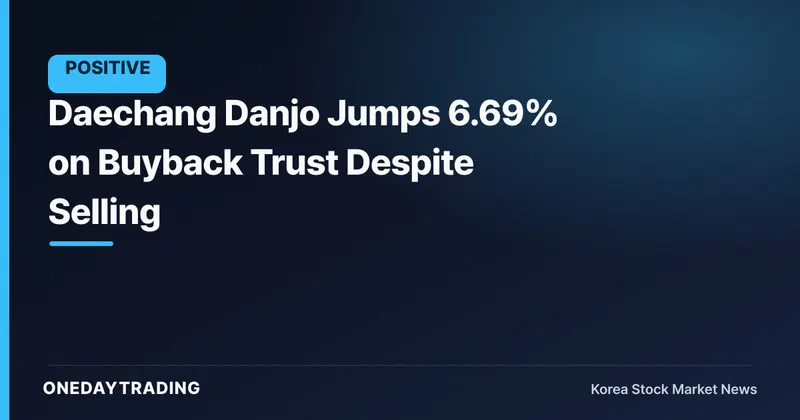
- On the filing date, Daechang Danjo shares rose 6.69% to 6,540 won from the previous session. OneDayTrading’s proprietary data show short- and medium-term uptrends, but foreign investors sold 19 million won and institutional investors sold 23 million won in tandem, putting the signal light on “caution.”
- The key variable is whether treasury-share purchases can continue long enough to offset slowing demand for construction-equipment components. Investors should monitor the execution rate of purchases together with subsequent operating cash flow.
What Changes
A treasury-share acquisition trust contract is an arrangement under which a company entrusts funds to a financial institution to purchase its own shares in the market over a set period. Unless the acquired shares are canceled, they do not immediately increase profit, but reducing shares available to the market lowers the denominator for earnings per share and book value per share. For a stock (ticker) such as Daechang Danjo, with trading value of about 1.2 billion won, the key to price elasticity is how much the actual purchase volume represents of average daily trading volume.
Daechang Danjo forges and processes link assemblies, link shoe assemblies and rollers for the undercarriages of excavators and bulldozers, supplying them to customers. With a heavy-equipment components structure that has a high share of overseas revenue, its treasury-share purchases are closer to a financial measure that protects shareholder value during cycle fluctuations than a policy that creates new demand. Purchase effects will translate into operating profit only when construction-equipment OEM orders recover and utilization rates rise.
What the market has already priced in is the company’s “commitment to returns” and expectations for short-term supply-demand (order flow). Less reflected in the price are execution data such as the contract amount, acquisition period and actual number of shares purchased. If these figures are small or purchases are delayed, the filing’s psychological impact could fade quickly.
By the Numbers and in Context
According to OneDayTrading’s proprietary data, Daechang Danjo posted a one-week return of +3.81% and a one-month return of +14.14%; its current price is at 59.1% of the 52-week range of 5,170–7,490 won. With the short-term trend already rising, treasury-share disclosure can become an additional positive catalyst only if new purchase demand exceeds existing profit-taking supply.
At the same time, the fact that foreign investors and institutional investors were net sellers on the same day warrants a review of the rally’s quality. If both groups continue selling as the share price rises, the move may be retail-investor-led event trading. A shift in foreign-investor and institutional supply-demand (order flow) to buying would make the treasury-share filing a signal for medium-term reassessment; expanding selling, however, would raise the likelihood of prolonged supply absorption above 6,540 won.
Beneficiary and Affected Stocks
- Daechang Danjo — If treasury-share purchases are executed in the market, the company would directly benefit from reduced shares in circulation and improved per-share metrics. The effect remains conditional because the scale has not been disclosed.
- Doosan Bobcat — A recovery in North American demand for small and mid-sized construction equipment could increase undercarriage-component orders and help improve Daechang Danjo’s utilization.
- HD Hyundai Infracore — A comparative indicator: if excavator sales and aftermarket demand slow, component suppliers’ orders and pricing power are likely to weaken together.
- Heavy-Equipment Components Sector — If steel raw-material prices and the KRW/USD exchange rate rise simultaneously, higher costs for forging companies could offset the treasury-share effect.
Risk Check
- Until the trust contract’s amount, duration and planned number of shares to be acquired are confirmed, it is difficult to assess the strength of shareholder returns.
- Even if treasury shares are acquired, the improvement in per-share value will be limited if they are not canceled, and the possibility of future disposal remains.
- If foreign investors and institutional investors continue their tandem selling, the day’s +6.69% gain could reverse as an event-driven rebound.
- If construction-equipment orders fail to recover while steel prices rise, margins will come under pressure before revenue.
Bottom Line
Daechang Danjo’s treasury-share trust is a positive catalyst that supports the downside, but with the stock already up 14.14% over one month, an extended trend can be inferred only after actual purchase execution and a recovery in foreign-investor and institutional supply-demand (order flow) are confirmed.
Frequently Asked Questions
What is Daechang Danjo’s treasury-share acquisition trust contract?
It is a contract under which Daechang Danjo entrusts funds to a financial institution to purchase its own shares in the market. The per-share value impact depends on whether the acquired shares are canceled and on the contract’s scale.
Why did Daechang Danjo’s share price rise?
The filing stimulated expectations for shareholder returns, lifting the stock to 6,540 won, up 6.69% from the previous session. However, OneDayTrading’s proprietary data show foreign investors and institutional investors were net sellers of 19 million won and 23 million won, respectively, so the rally’s durability requires verification.
What should Daechang Danjo investors check next?
They should review the trust contract’s amount and duration, actual acquisition details and next quarter’s operating cash flow. If supply-demand (order flow) turns to buying and heavy-equipment orders recover, the scope for reassessment will expand; if selling intensifies, the filing’s effect will be limited.
Daechang Danjo Key MetricsAs of 2026-09-03
| Period Returns | 1 Week +3.97% 1 Month +14.31% |
|---|---|
| Trading Value · Trading Volume | 1.2 billion won · 181,753 shares |
| Supply-Demand (Order Flow) | Foreign Investors −19 million Net Selling Institutional Investors −23 million Net Selling |
Market and supply-demand (order flow) data are real-time values from Korea Investment & Securities (KIS); supply-demand and news-tone aggregates are calculated by OneDayTrading.
Supply-Demand & Momentum Assessment🔴 Caution
Foreign investors and institutional investors are negative, so caution is warranted.
- ▼Tandem SellingForeign investors −19 million · Institutional investors −23 million selling together
- ▲Trend AlignmentShort- and medium-term uptrend alignment (Day +6.8% · 1 Week +4.0% · 1 Month +14.3%)
Upcoming Dates to Watch
- 09.10Futures and Options ExpirationModerateQuadruple witching — watch for volatility and supply-demand disruptions
- 09.16FOMC Policy Rate DecisionHighU.S. Federal Reserve monetary-policy announcement — interest-rate and dollar direction
- 10.08Index Options ExpirationLowKOSPI200 options expiration
- 10.22Bank of Korea Monetary Policy BoardHighBenchmark interest rate decision meeting
📑 This article is an analysis based on Daechang Danjo’s electronic filing (Major Matters Report (Decision to Enter into a Treasury-Share Acquisition Trust Contract), 20260903). View the original DART filing