
Three-Line Briefing
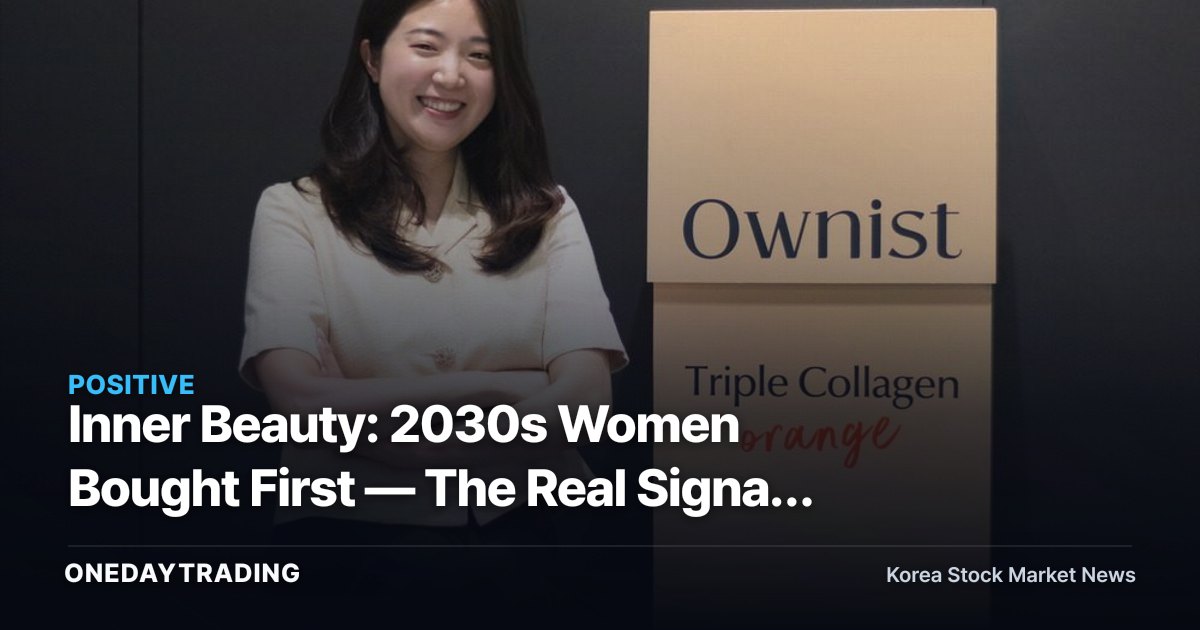
- A Maeil Business Newspaper report highlighted a shift in skin-elasticity care from external cosmetics toward "inner beauty" products targeting health from within the body.
- The core consumers are women in their 20s and 30s. This age group is adopting collagen, ceramides, and vitamins as routine products faster than they adopt functional cosmetics.
- Investors should look past the buzz to repeat purchase rates, H&B channel turnover, and raw-material sourcing costs. For inner beauty, the profit-and-loss structure matters more than the brand.
What's Changing
Sera Park, OneDayTrading Editorial Board Member What has changed in the skincare market is the product's positioning. Inner beauty is no longer a supplementary product sitting alongside cosmetics. Consumers no longer view skin purely as a surface-level problem to cover up, but increasingly as a reflection of the body's collagen-synthesis capacity and internal nutritional state. That is the core point Maeil Business Newspaper conveyed: expensive external treatments alone struggle to prevent declining skin elasticity, and the growing recognition of skin as part of the body's defense system is driving inner-beauty consumption.
This shift cuts both ways for cosmetics companies. For firms that have only sold basic skincare, it's an opportunity to raise average spending per customer. For brands with weak health-functional food manufacturing capabilities, it's a threat. For inner beauty, revenue is generated not by advertising copy but by ingredient formulation, functional labeling, ease of consumption, and repurchase cycles. When consumers come to see a product as something they take daily, revenue becomes recurring. But if perceived efficacy is weak or price resistance emerges, churn can be swift.
It's also notable that women in their 20s and early 30s were the first to respond. This group does not compartmentalize spending on clinical procedures, cosmetics, and supplements. At H&B channels like Olive Young, they compare skin, diet, gut health, and sleep products all at once. That means inner beauty's competitors aren't limited to other collagen products — they compete for the same wallet against sunscreen, ampoules, protein drinks, and probiotics.
Reading the Numbers in Context
The one concrete figure confirmed in this report is the consumer segment itself: women in their 20s and 30s. From an investment perspective, this figure isn't just a demographic label — it describes the nature of demand. Consumers in their early 20s to early 30s tend to spend on prevention rather than anti-aging treatment. That means repeat purchases of low- to mid-priced products are more advantageous than one-off, high-priced purchases. Turnover is driven less by brand loyalty than by ease of consumption and perceived-effect reviews.
That said, this doesn't mean inner beauty is automatically a high-margin business. Ingredients such as collagen, hyaluronic acid, and ceramides offer limited differentiation, and as platform sales grow, discounting and advertising costs pile up. Profitability hinges less on revenue growth than on the share of direct-to-consumer (owned-mall) sales, subscription conversion rates, and outsourced manufacturing costs. The press narrative tells a growth story, but what the data needs to show is repurchase rates and margins.
Stocks to Watch: Beneficiaries and Laggards
- Amorepacific: Can leverage its cosmetics brand credibility and H&B/online channels to expand into inner-beauty product lines. However, if this simply substitutes for existing cosmetics revenue, the net incremental effect will be limited.
- LG Household & Health Care: With touchpoints spanning household goods, cosmetics, and health-functional foods, cross-selling potential exists. The question is how much inner beauty can offset weakness in premium cosmetics.
- Kolmar BNH: Health-functional food ODM capability is a direct beneficiary pathway. As brand owners expand their product lines, formulation development and production volume could increase.
- Novarex: Could benefit as demand grows for functional ingredients and health-functional food manufacturing. However, if client orders remain limited to short-term promotions, improvement in capacity utilization will be delayed.
- CJ Olive Young-linked consumer-goods value chain: The H&B channel that dominates traffic from women in their 20s and 30s is the gateway for inner beauty's spread. Listing fees and promotional cost burdens weigh on brand owners' margins.
Risk Check
- Perceived-efficacy risk: Ingestible products take time to show results. If reviews turn lukewarm, repurchase rates are the first to wobble.
- Limited ingredient differentiation: A collagen-and-vitamin combination alone is hard to sustain as a price premium over time.
- Advertising cost burden: The market targeting women in their 20s and 30s relies heavily on influencers and platform advertising. Revenue growth may not translate into profit growth.
- Regulatory variables: For health-functional foods, functional claims and labeling standards matter as much as the bottom line. Overstated efficacy marketing can boomerang into brand risk.
Bottom Line
Inner beauty opens a new growth line for cosmetics stocks, but what share prices should reflect isn't the skincare narrative — it's next quarter's H&B sales turnover, repurchase data, and actual order growth at health-functional food ODM makers.
Amorepacific: Real-Time Data Snapshot
Amorepacific's most recent closing price was 130,000 won (-2.99% versus the prior session), and the signal light combining foreign investor/institutional investor supply-demand (order flow) with news and momentum reads 🔴 Caution. With foreign investor flows and momentum both negative, caution is warranted for now.
※ Price and foreign/institutional investor supply-demand (order flow) data are provided by Korea Investment & Securities (KIS) and reflect the time of publication.
This article was automatically summarized and analyzed based on the original news report. View original (Maeil Business Newspaper, Corporate)