
3-Line Briefing
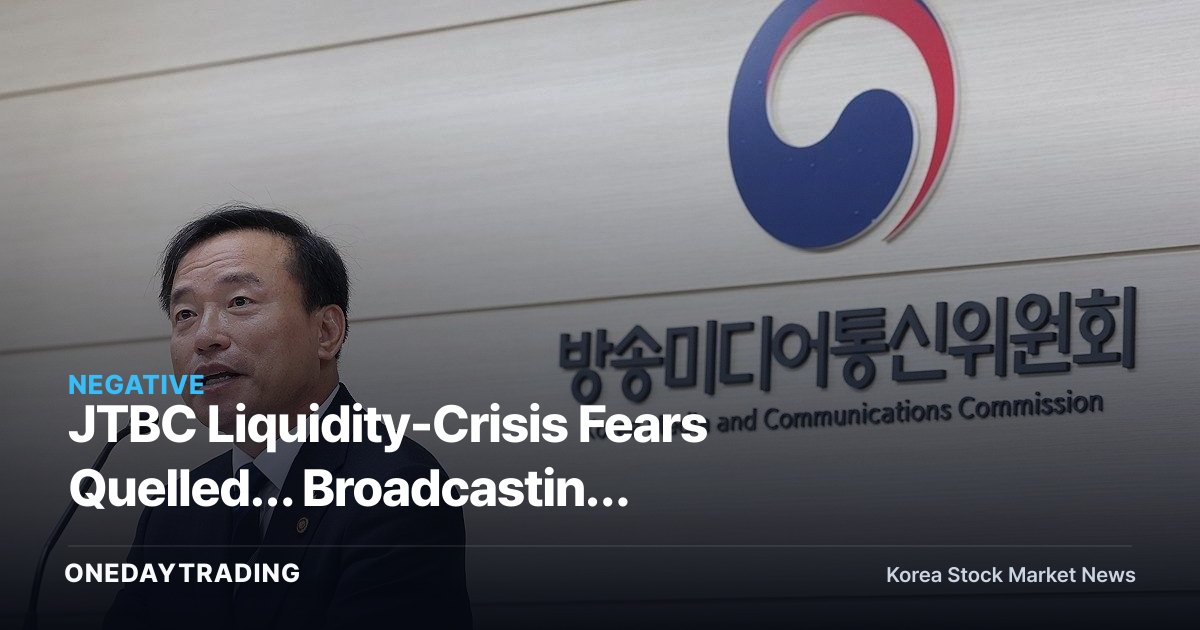
- Kim Jong-cheol, Chairman of the Broadcasting, Media and Communications Commission, sought to calm market concerns on the 15th by stating that, as of now, there has been no disruption to JTBC's broadcasting despite rumors of a management crisis.
- Since the launch of comprehensive programming channels, JTBC is understood to have faced liquidity pressure as accumulated losses, a slowing advertising market, and the burden of content production costs all converged.
- While JTBC itself is unlisted, the ripple effects on its content-producing affiliates and on investor sentiment across the media sector are unavoidable.
What's Changing
The key point of these remarks is that regulators, while acknowledging JTBC's financial difficulties themselves, have officially confirmed that there are no problems with the broadcast transmission and programming that directly affect viewers. Since the spread of crisis rumors could lead to an advertiser exodus and a contraction in dealings with production partners, the authorities' preemptive reassurance reads as a message that reduces uncertainty in the short term.
That said, the chairman's remarks are merely a guarantee of broadcasting continuity, not an indication that the liquidity crisis itself has been resolved. The media industry faces a triple bind: the offensive from global streaming players such as Netflix, a simultaneous decline in advertising revenue at both terrestrial broadcasters and comprehensive programming channels, and a high-cost drama production structure. JTBC's funding strain can be seen as a case that symbolizes the structural deterioration in profitability of Korea's broadcasting and content industry, beyond an issue affecting a single company.
By the Numbers and Context
Korea's broadcast advertising market has been on a multi-year contraction trend as the shift to digital advertising accelerates, and the production cost of a single drama has soared from hundreds of millions of won per episode to several billion won. In a structure where a content hit does not immediately translate into profit, large-scale upfront investment directly translates into liquidity risk. The situation JTBC faces is also interpreted as arising at the intersection of this cost structure and the advertising slowdown.
Beneficiary and Affected Stocks
- Contentree JoongAng: Closely tied to JTBC's drama and content production value chain; if the funding burden on the group's media business comes to the fore, it would weigh directly on investor sentiment.
- Studio Dragon: A same-industry peer that shares the same high-cost drama production structure, raising the risk that sector-wide concerns could spread.
- SBS and terrestrial-affiliated media stocks: Exposed to the common negative catalyst of an advertising-market slowdown, raising the possibility of a concurrent decline.
- Cheil Worldwide and the advertising-agency sector: If the contraction in broadcast advertising drags on, it would act as downward pressure on revenue.
Risk Check
- A gap may later emerge between the authorities' statement that there is no broadcasting disruption and the actual situation regarding fundraising and borrowing.
- If the advertising-market recovery is delayed, there is a risk that the loss-making structure across the media industry sector becomes entrenched.
- If the crisis rumors spread, the departure of production partners and advertisers could create a self-fulfilling vicious cycle.
- Depending on the financial response — restructuring, asset sales, capital increases, and the like — share-price volatility at related listed companies could increase.
Bottom Line
The authorities' reassurance has eased fears of a short-term sharp drop (plunge), but since JTBC's liquidity crisis is a signal revealing the structural deterioration in profitability of the media industry, related stocks such as Contentree JoongAng warrant a cautious approach while watching for concrete funding measures and a recovery in the advertising market.
This article is content automatically summarized and analyzed based on the original news. View Original (Yonhap News)