
Key Takeaways
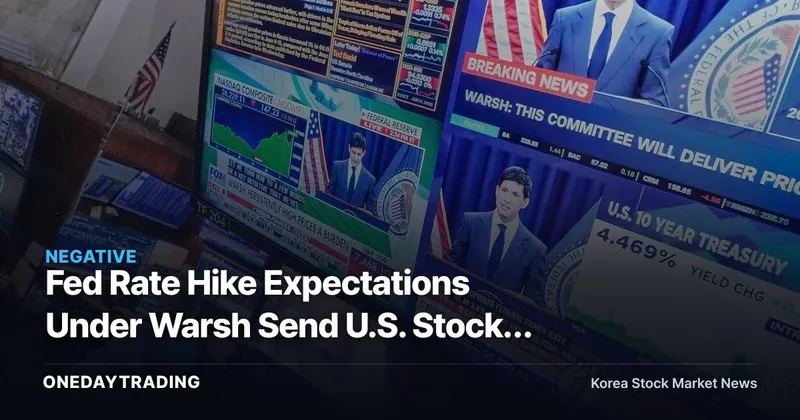
As expectations grow that the Federal Reserve under new Chair Kevin Warsh could raise interest rates before the end of the year, U.S. stocks and bonds retreated simultaneously while the dollar turned stronger. Signals of a renewed monetary tightening cycle push up the discount rate applied to risk assets broadly, weighing on growth stocks — while the dollar's strength, via a weaker won, could work in favor of exporters' translated earnings.
With the market's direction split along these lines, Korean investors need to track the exchange rate and U.S. government bond yields together as a single axis.
What Happened
With the launch of the new Warsh-led Fed, the market quickly priced in the view that the central bank could abandon its accommodative stance and begin raising rates before year-end. This produced the unusual pattern of U.S. stocks and bonds declining together, while the dollar — now more attractive on rising rates — strengthened against major currencies.
Stocks and bonds typically move in opposite directions during risk-off episodes, but when rising rates themselves are the trigger — as in this case — both assets can weaken together. Bond prices fall as yields rise, while stocks correct in tandem on concerns over a higher discount rate and tighter liquidity.
Background and Context
Chair Warsh has long been categorized as a hawkish figure, and the market is inclined to interpret his appointment itself as a signal that tightening is resuming. In the period of heightened policy uncertainty right after a change in Fed leadership, the market reacts sensitively to every remark and every personnel decision.
A stronger dollar and rising U.S. rates increase the pressure for global capital to flow out of emerging markets and into the United States. For the Korean market, which is highly sensitive to foreign investor supply-demand (order flow), this creates an environment where the exchange rate and foreign trading trends must be monitored together.
Impact on the Market and Stocks
- Large-cap exporters (Samsung Electronics (005930), Hyundai Motor): A rising won-dollar exchange rate increases the won-translated value of overseas revenue, which is favorable from an FX-gain perspective. However, if a global demand slowdown accompanies it, the FX benefit could be offset by weaker sales volume.
- Financial stocks (KB Financial Group, Shinhan Financial Group): A rising-rate environment widens the loan-deposit margin, which is positive for net interest income. On the other hand, potential deterioration in asset quality and valuation losses on bond holdings remain variables.
- Growth and tech stocks: A higher discount rate directly weighs on the valuations of growth stocks, whose worth relies heavily on future cash flows.
- Airline and travel stocks: A stronger dollar increases the burden of foreign-currency debt and fuel/lease costs, which is negative for profitability.
Investor Checkpoints
- The level and pace of change in the won-dollar exchange rate — check daily for any short-term sharp gain (surge).
- The trend in the U.S. 10-year government bond yield, official remarks from Fed officials, and the FOMC schedule.
- Whether foreign investors turn to net buying in the KOSPI and KOSDAQ, and their futures positioning.
- Whether the FX effect actually shows up as profit in exporters' next-quarter earnings releases.
Outlook
If the resumption of tightening proceeds gradually and the U.S. economy stays resilient, the Korean market could see divergent performance, led by exporters benefiting from a stronger dollar and financial stocks benefiting from higher rates. Conversely, if the pace of rate hikes exceeds market expectations, foreign capital outflows combined with a correction in growth stocks risk amplifying volatility across the broader index. Until the Warsh-led Fed's actual policy moves are confirmed, it is reasonable to view this as a period where expectations and caution intersect.
This article is automatically summarized and analyzed content based on original news reporting. View Original (Yonhap News Agency, Securities)