
At a Glance
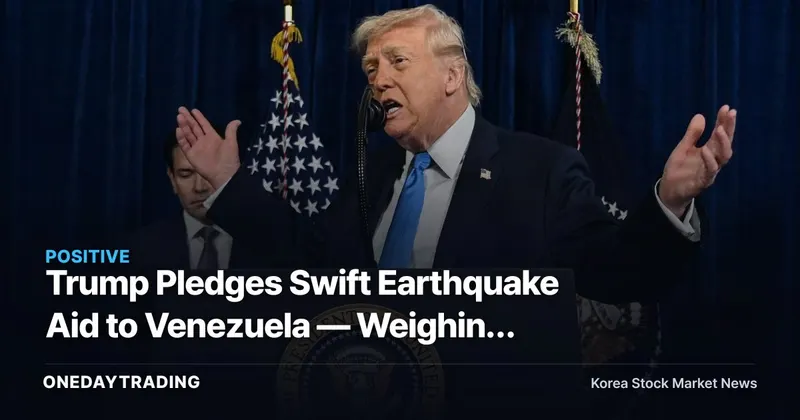
The Trump administration has pledged rapid humanitarian assistance to Venezuela, where a historic-scale earthquake has left dozens dead. Because this signals more than simple disaster diplomacy — pointing to a partial reset in bilateral relations — markets have begun to weigh the prospect that Venezuelan crude, long shut out, could re-enter international circulation.
Why It Matters Now
Venezuela holds one of the world's largest crude reserves — exceeding even Saudi Arabia's — yet years of sanctions and aging infrastructure have left output far below its potential. A rapprochement between Washington and the interim government, mediated through earthquake relief, becomes a meaningful supply-side variable if it eventually leads to eased sanctions or expanded licenses. The core mechanism is simple: if shut-in barrels are released to the market, global crude supply gains slack, which works to cap any further rise in international oil prices.
Because South Korea relies on imports for nearly all of its crude, the direction of oil prices is essentially a question of cost structure. For airlines and shipping, where fuel and freight costs loom large, downward pressure on oil prices is a margin-improvement factor; refiners, by contrast, are directly exposed to oil-price movements through refining margins and inventory valuation gains and losses. That said, this remains an early-stage development rooted in the humanitarian rationale of earthquake response — not a confirmed signal that the sanctions framework itself has changed.
Frequently Asked Questions
- Why does disaster aid become an oil-price issue — Because a diplomatic normalization triggered by the aid could be the starting point for reopening Venezuela's crude export routes. Even the mere expectation of expanded supply affects sentiment around oil prices.
- Will crude come flooding out right away — No. Restoring and investing in aging facilities, along with sanctions-license procedures, must come first, so there is a long lag before any actual output increase.
- Is this a positive catalyst or a negative catalyst for the Korean economy — From an importer's standpoint, downward pressure on oil prices is favorable for the trade balance and inflation. By industry sector, however, the impact diverges: airlines benefit, while refiners face margin volatility.
- What's the biggest variable — The actual scale and pace of sanctions relief, and whether OPEC+ responds with production cuts.
Affected Stocks and Sectors
- Airline stocks (Korean Air, Asiana Airlines) — With jet fuel making up a large share of operating costs, lower oil prices translate directly into cost savings and operating-profit leverage.
- Refining stocks (S-Oil, SK Innovation, GS) — Lower crude acquisition costs are favorable on the expense side, but a sharp drop in oil prices can bring inventory valuation losses and narrowing refining margins, making the impact two-sided.
- Shipping and Transport — A reduced fuel-cost burden, such as for bunker oil, works positively on profitability relative to freight rates.
- Chemicals — Lower feedstock costs, such as for naphtha, create room for spread improvement, but the effect only materializes if downstream demand holds up.
Points to Watch When Investing
- Sanctions relief is heavily swayed by political variables and can reverse direction at any time. A one-off diplomatic gesture should not be over-interpreted as a structural expansion of supply.
- Oil prices do not move on the Venezuela variable alone. OPEC+ policy, Middle East geopolitics, and the global demand cycle are bigger drivers.
- Investors should note that falling oil prices are not always a positive catalyst for refining stocks. Inventory gains/losses and margins must be viewed separately.
- Because the lag until actual output increases is long, share-price moves built on expectations alone carry the risk of a pullback.
Overall Outlook
In the optimistic scenario, improved bilateral relations lead to eased sanctions, Venezuelan volumes are gradually released, the global supply burden eases, and a virtuous cycle of stable oil prices and lower costs for importers emerges. In this case, airlines and transport would be the first industry sectors to react. In the opposite scenario, the humanitarian aid amounts to no more than a diplomatic gesture, or OPEC+ throttles supply with production cuts, limiting any downside in oil prices. As confirmation indicators, it is reasonable to monitor U.S. crude-license announcements for Venezuela, actual export shipment data, the next OPEC+ meeting decision, and WTI and Brent price levels together.
This article is content automatically summarized and analyzed based on the original news report. View original (CNBC)