
Three-Line Briefing
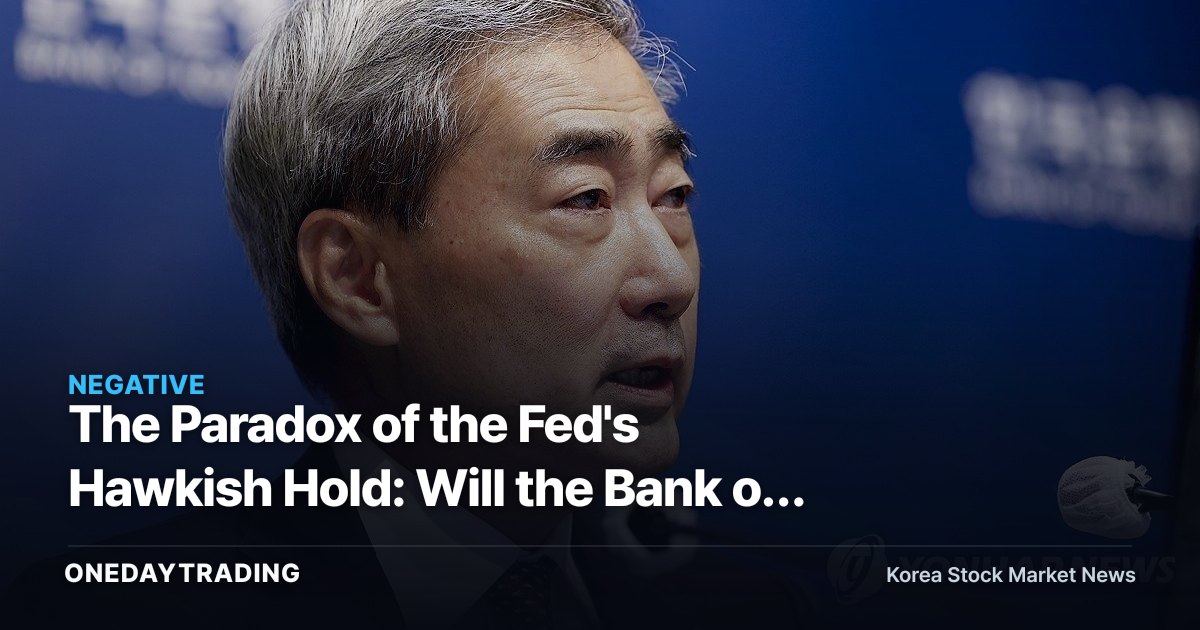
- The U.S. Federal Reserve held its benchmark interest rate steady, but the tone of its statement and the committee's dot plot turned even more hawkish.
- Signals that high rates will persist longer than expected have pushed back expectations for a narrowing of the interest rate gap between South Korea and the U.S.
- The Bank of Korea appears increasingly likely to shift its stance from caution about raising rates toward recalibrating the pace of tightening.
What's Changing
What caught the market's attention wasn't the hold decision itself but the fine print that came with it. The fact that the Fed kept rates unchanged without committing to a timeline for cuts suggests that the early-cut expectations currently priced into the market could be pushed back by several months. For the Bank of Korea, this signal points in two possible directions: continuing its accommodative stance by citing domestic economic slowdown, or moving up the timing of a rate hike to prevent the interest rate gap with the U.S. from widening further.
If the Bank of Korea leans toward the latter, the real motivation is likely to be defending the exchange rate and preventing capital outflows rather than controlling inflation. As the rate gap widens, the relative appeal of won-denominated assets declines, increasing the incentive for foreign bond and equity capital to chase higher yields elsewhere. Whether or not the Bank of Korea actually moves to raise rates, the market will likely begin pricing in this probability across bond and currency markets in the run-up to the next Monetary Policy Board meeting.
Numbers in Context
When the interest rate path shifts, valuations are the first to react. If the consensus solidifies that discount rates will stay elevated for longer, growth stocks whose earnings lie further in the future are the first to see their target-price multiples cut. Bank stocks, by contrast, where interest income forms the core of earnings, gain relative defensiveness on expectations of a wider lending-deposit margin. This divergence won't be settled by this single decision — it will keep playing out through capital rotation across sectors until the Bank of Korea actually pulls the trigger on a rate hike.
Stocks to Watch: Winners and Losers
- KB Financial Group (105560) and Shinhan Financial Group (055550) — leading beneficiaries in a rising-rate environment, as wider lending-deposit margins strengthen their interest income.
- Exporters such as Samsung Electronics (005930) and SK Hynix (000660) — a weaker won benefits dollar-denominated revenue and price competitiveness, but prolonged high rates also weigh on their valuations as growth stocks.
- Construction and real estate stocks such as GS Engineering & Construction (006360) — if funding costs remain elevated, heavier interest burdens on project financing (PF) could compound with weaker demand for new housing sales.
- High-valuation platform stocks such as Kakao (035720) — since their worth hinges on discounting far-future earnings back to the present, prolonged high discount rates tend to compress target-price expectations.
Risk Check
- If the Bank of Korea does move to raise rates, household loan interest burdens would rise immediately, eroding consumer spending power.
- Conversely, if a hike is delayed, a widening rate gap with the U.S. could weaken the won and trigger foreign capital outflow pressures that shake the market first.
- The Fed's next stance could shift again depending on upcoming U.S. inflation and employment data, so the current hawkish interpretation isn't set in stone.
- Whether the KRW/USD exchange rate breaks back above a key psychological resistance level could be the trigger that moves up the Bank of Korea's decision.
Bottom Line
The Fed's hawkish hold didn't hand the Bank of Korea a clear answer in favor of raising rates — it left the central bank with a choice between defending against inflation and defending the exchange rate first. Until the next Monetary Policy Board meeting, the key is watching which way the KRW/USD rate and U.S. inflation data tilt that decision.
This article was automatically summarized and analyzed based on the original news report. View original (Yonhap News)