
At a Glance
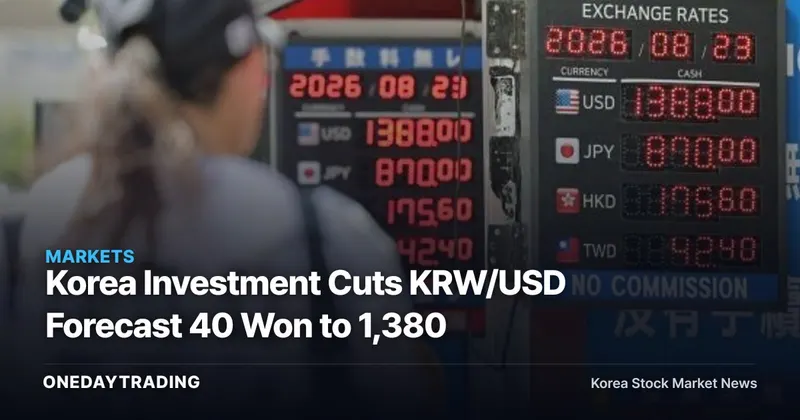
Korea Investment & Securities on Sept. 12 lowered its average KRW/USD exchange rate forecast for the second half of this year by 40 won, from 1,420 to 1,380. Korea Investment & Securities researcher Moon Da-woon said the rate had decisively broken below 1,340 this week and forecast that the fourth-quarter average would settle in the 1,300s even if the daily rate occasionally entered the 1,400s. Moon also left open the possibility of a move into the 1,200s by year-end.
Why It Matters Now
The key figure in an exchange rate report is not merely the forecast itself, but how sharply it has been lowered. Korea Investment & Securities cut its projection by 40 won. Lowering the second-half average forecast by 40 won in one move suggests that the recent trend can no longer be explained by the gradual, mildly bearish scenario the market had previously priced in. Moon cited two factors: a sharp increase in dollar selling by exporters and additional dollar weakness driven by the yen’s rapid appreciation. Together, these forces pushed the rate below 1,340 this week. Korea Investment & Securities interpreted the breakdown not as a temporary correction, but as a sign that the expected trading range itself had shifted lower.
According to Moon, July and August marked a period when accumulated supply-demand (order flow) imbalances were being resolved, while September is a process of finding an appropriate level based on the macroeconomic environment, including dollar supply-demand (order flow), growth, and interest rates. The revision also reflects the firm’s assessment that selling pressure has persisted even after the KRW/USD exchange rate fell into the 1,300s on Aug. 23. Korea Investment & Securities believes there is still no clear signal of a shift toward net buying.
Key Issues
- The rate broke below 1,340 this week — dollar selling by exporters and yen weakness occurred at the same time.
- Korea Investment & Securities expects the fourth-quarter average to remain in the 1,300s even if the daily rate occasionally enters the 1,400s.
- A move into the 1,200s by year-end has been presented as a possibility, but whether or when that level will be reached remains unconfirmed.
- Dollar purchases by the Foreign Exchange Equalization Fund and the National Pension Service’s suspension of currency hedging and resumption of dollar buying were mentioned, but no specific scale or timing was disclosed.
Two Forces Shaping Supply-Demand (Order Flow)
One notable aspect of this revision is that policy measures aimed at moderating the pace of the exchange rate’s decline have emerged at the same time. According to Asia Business Daily Securities, reports surfaced that the Foreign Exchange Equalization Fund was buying dollars and that the National Pension Service had suspended currency hedging and resumed dollar purchases. Korea Investment & Securities said this appeared to indicate a shift in the government’s policy stance toward slowing the decline. However, it remains unclear when or to what extent these measures will actually be implemented.
Moon also warned that while downside resistance is likely to strengthen near 1,300, the lower bound could fall rapidly if that level is breached. Under this assessment, a market holding at 1,300 and one trading below it would represent entirely different scenarios. As long as 1,300 holds, net selling pressure would gradually ease. If the rate falls below 1,300, however, discussion of a move into the 1,200s would immediately become a realistic scenario.
Investor Considerations
- Korea Investment & Securities’ forecast is a second-half average. The daily exchange rate could still jump into the 1,400s during the fourth quarter, so applying the same standard to the average forecast and daily volatility could lead to flawed conclusions.
- A move into the 1,200s by year-end is a possibility identified by Korea Investment & Securities, not a confirmed forecast. Whether it materializes remains uncertain.
- Only the direction of the Foreign Exchange Equalization Fund and National Pension Service measures was mentioned; their scale and implementation schedule were not disclosed. Until those details emerge, there is no basis for calculating the extent of their policy impact.
- Moon’s assessment that “signals of a shift toward net buying remain weak” reflects current conditions. Investors should respond differently once such a signal emerges than while it remains absent.
Overall Outlook
Korea Investment & Securities’ base case is for the exchange rate to settle in the mid-1,300s. The firm sees a relatively high probability that once accumulated imbalances from July and August are resolved and September’s price-discovery process is completed, the exchange rate will temporarily decline further before returning to the mid-1,300s. Under this path, the fourth-quarter average would remain in the 1,300s.
A break below 1,300 would present a different picture. Moon said the lower bound could drop rapidly in that range. If net selling pressure persists without easing, a year-end move into the 1,200s could shift from a scenario to an actual market level. Even then, however, Korea Investment & Securities expects the pace of decline itself to moderate after the rate reaches the 1,200s. In other words, the firm’s outlook is effectively conditional on both “further declines” and “a slower pace of decline.”
Frequently Asked Questions
Will the KRW/USD exchange rate actually fall into the 1,200s?
Korea Investment & Securities has left open the possibility of a move into the 1,200s by year-end, but this is not a confirmed forecast. Moon said downside resistance could strengthen near 1,300, while also noting that the lower bound could fall rapidly if the exchange rate breaks below that level.
Why did the exchange rate suddenly break below 1,340 this week?
Moon attributed the move to the simultaneous effects of aggressive dollar selling by exporters and pressure from a weaker dollar following the yen’s rapid appreciation. The firm believes these two factors combined to break the 1,340 level, which had previously served as support.
Can the government slow the exchange rate’s decline?
According to Asia Business Daily Securities, reports emerged of dollar purchases by the Foreign Exchange Equalization Fund and the National Pension Service’s suspension of currency hedging and resumption of dollar buying. Korea Investment & Securities interpreted these developments as a sign that the policy stance had shifted toward moderating the pace of decline, although the specific scale and timing of the measures remain unconfirmed.
KRW/USD Exchange Rate IndicatorsAs of 2026-09-12
| Performance by Period | 1 Week -0.30% 1 Month -5.35% |
|---|
Index, commodity, and exchange rate figures are based on global markets and reflect values at the time of publication.
This article was automatically summarized and analyzed based on the original news report. View Original Article (Asia Business Daily Securities)