
Summary
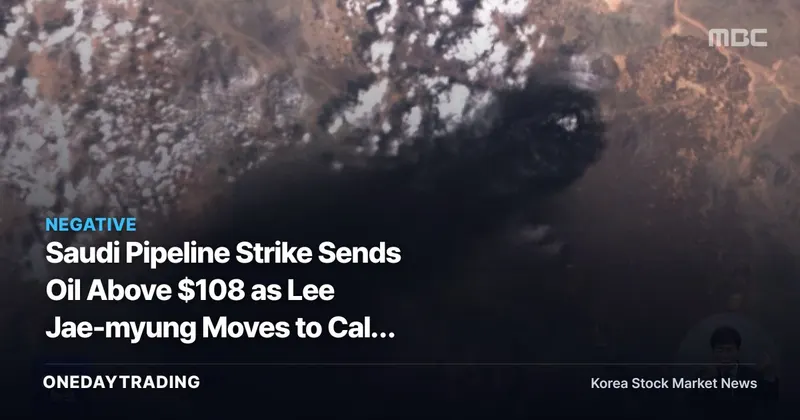
More noteworthy than the headline figure of $108 a barrel is the path that produced it. According to a New York Times report cited by Newsis, Houthi rebels on the 11th (local time) seized the Yemeni Red Sea port city of Mocha and went on to capture Perim Island, a strategic chokepoint in the Bab-el-Mandeb Strait (the maritime gateway linking the Red Sea and the Indian Ocean). Per a Reuters report cited by Herald Corporation, drone strikes hit the Riyadh and Medina areas of Saudi Arabia the same day, halting the East-West pipeline that had been carrying 5 million barrels a day. With the detour routes and overland pipeline shaken at the same time as the Strait of Hormuz, international oil prices jumped to around $108 a barrel — roughly 50% above pre-war levels — and President Lee Jae-myung said on the 12th that domestic refined-product prices would remain stable.
How It Unfolded — Two Detour Routes Blocked on the Same Day
After the U.S. and Israel struck Iran on February 28 and Iran restricted passage through the Strait of Hormuz, Saudi Arabia had relied on the East-West pipeline and the Bab-el-Mandeb Strait as alternate routes (Newsis). This week, both of those alternatives were shaken within a day of each other. According to Kpler data, only two Saudi crude cargoes passed through the Bab-el-Mandeb Strait and out of the Red Sea over the past week. Strait of Hormuz traffic has also fallen from 130 vessels a day before the war to a monthly average of 19 this month, dropping to just 9 on the 10th (Newsis). In July and August, at least 23 vessels were attacked in waters near Oman alone.
Iraq's prime minister's office confirmed on the 12th that the drones targeting the pipeline had been launched from Iraqi territory. At Iraq's request, Saudi Arabia's foreign ministry decided not to retaliate for now, and while it directly requested U.S. support, Washington reportedly declined for the time being (Herald Corporation). The same day, at a 9/11 25th-anniversary memorial, President Trump criticized Iran as "the world's biggest state sponsor of terrorism," while Iranian President Masoud Pezeshkian countered by citing the U.S. military's mistaken bombing of an elementary school in southern Iran on February 28 that killed 182 people, saying "those devils" were the ones criticizing Iran (Herald Corporation).
Structural Backdrop — Prices Now Track Routes, Not Reserves
Saudi Arabia's crude exports already fell to 3.2 million barrels a day last month, the lowest in 13 years — less than half the pre-war level of 7 million barrels a day (Herald Corporation, Kpler). By Windward's estimate, total exports from Gulf oil producers excluding Iran have fallen to two-thirds of pre-war levels (Newsis). In this environment, what determines price is not whether the oil is in the ground but whether a route remains to move it. With the East-West pipeline (1,200 km, 5 million barrels a day, 4-5% of global supply) and the Bab-el-Mandeb Strait — Saudi Arabia's two detour routes — both blocked in the same week, the kingdom is now facing the loss of its alternatives on top of the Hormuz blockade. Markets have already priced in the narrowing of the Strait of Hormuz; what isn't yet fully priced in is this week's development — that even the detours around that narrowed passage have now been cut off in two places at once.
Sector and Stock Impact
- Refiners (S-Oil, SK Innovation, GS): Disruption to crude transport routes raises volatility in both import costs and volumes. If international oil prices continue holding above $108, feedstock procurement costs and refining margins will both come under pressure at once.
- Airlines (Korean Air): Jet fuel is a major cost item. If international oil prices remain roughly 50% above pre-war levels, the fuel-cost burden will flow through to earnings.
- Chemicals: Since naphtha prices track crude, prolonged transport-route instability — given naphtha's large share of feedstock cost — will widen spread pressure.
Bull vs. Bear Scenarios
On the case for further oil-price gains: with Strait of Hormuz traffic already down to about one-seventh of pre-war levels (19 vessels a day) and the detour routes now blocked as well, a quick resolution to the transport disruption looks unlikely. Saudi Arabia's decision not to retaliate immediately against the Iraq-launched attack (Herald Corporation) could be read as a sign it is choosing containment over escalation — though that stance could still reverse. On the other hand, the fact that Iraq's prime minister's office itself confirmed the launch came from its own territory, and that Saudi Arabia opted for diplomacy over immediate retaliation, is also grounds to think this won't spiral into all-out war. If international oil prices keep holding above $108, cost burdens for refiners, chemical makers, and airlines will grow; conversely, if Hormuz and Bab-el-Mandeb traffic recovers, much of this rally could be reversed. However, the timing of any reversal — that is, when the Iran-Israel-U.S. conflict ends and how Saudi Arabia chooses to respond going forward — remains unconfirmed.
Investor Action Points
- Watch whether international oil prices hold above the $108 level — a sustained move above this level would accelerate how quickly cost pressure on refiners, chemical makers, and airlines shows up in earnings.
- Track daily traffic changes through the Strait of Hormuz and Bab-el-Mandeb Strait — whether the monthly average of 19 vessels falls further or shows signs of recovery will be the next key signal.
- Monitor whether and when Saudi Arabia retaliates — its foreign ministry has decided not to retaliate for now at Iraq's request (Herald Corporation), but a reversal of that decision would raise escalation risk again.
- Confirm through upcoming announcements how the diversification of crude import sources and the strategic-reserve swap system President Lee Jae-myung cited actually feed through to domestic refined-product prices.
FAQ
Why does Saudi Arabia's East-West pipeline matter?
The East-West pipeline is an approximately 1,200 km line crossing the Arabian Peninsula to the Red Sea port of Yanbu, and it has been the key route Saudi Arabia has used to transport around 5 million barrels a day since Iran restricted passage through the Strait of Hormuz (Herald Corporation). That volume equals 4-5% of global oil supply, so blocking this route would leave Saudi Arabia without an alternative on top of the Hormuz blockade.
Will domestic fuel prices rise too?
President Lee Jae-myung said on the 12th that diversifying crude import sources, subsidizing long-distance crude transport costs, and introducing a strategic-reserve swap system had lowered Korea's dependence on Middle Eastern crude from 70% to the 50% range, and that domestic gasoline and diesel prices would remain stable (Seoul Economic Daily, Seoul Shinmun). Still, how the rise in international oil prices feeds into domestic prices will need to be confirmed through the next refiners' supply-price announcement.
How long will this situation last?
At Iraq's request, Saudi Arabia's foreign ministry decided not to retaliate for now, and the U.S. reportedly declined Saudi Arabia's request for direct support, at least for the time being (Herald Corporation). The timing of an end to the Iran-Israel-U.S. conflict, and Saudi Arabia's future response, remain unconfirmed.
WTI Crude IndicatorsAs of 2026-09-12
| Period Performance | 1W +9.58% 1M +20.15% |
|---|
Indices, commodities, and exchange rates reflect global market data as of publication time.
S-Oil Key IndicatorsAs of 2026-09-12
| Period Return | 1W -4.64% 1M +6.01% |
|---|
Price and order-flow data are real-time figures from Korea Investment & Securities (KIS); order-flow and news-tone aggregation are OneDayTrading's own calculations.
Upcoming Events to Watch
- 09.16FOMC Policy Rate DecisionHighU.S. Federal Reserve monetary policy announcement — direction for rates and the dollar
- 10.08Index Options ExpirationLowKOSPI200 options expiration
- 10.22Bank of Korea Monetary Policy BoardHighBenchmark interest rate decision meeting
- 10.28FOMC Policy Rate DecisionHighU.S. Federal Reserve monetary policy announcement — direction for rates and the dollar
This article was automatically summarized and analyzed based on the original news report. View original (MBC News)