
Key Takeaways
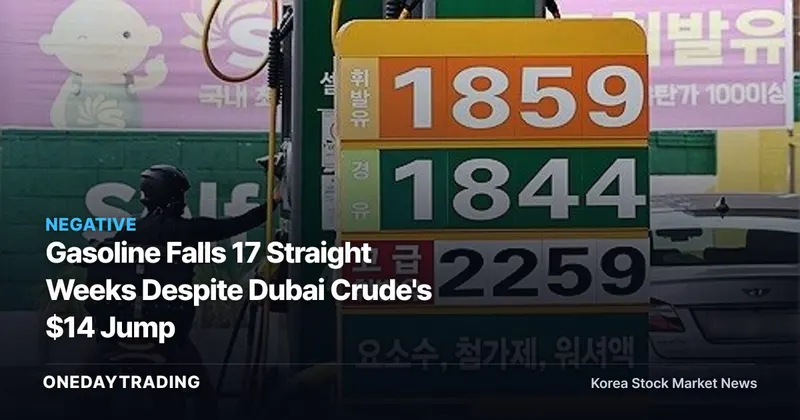
International oil prices surged on Middle East tensions, but pump prices at Korean gas stations actually fell, held down by the government's petroleum price cap system. According to Yonhap News, citing data from state-run Korea National Oil Corporation's Opinet, the national average gasoline price for the second week of September (Sept. 6-10) fell 1.1 won per liter from the prior week to 1,859.1 won, extending its decline to 17 straight weeks. Over the same period, Dubai crude — the benchmark for imported crude oil pricing — rose $14.4 per barrel to $114.7, putting international crude prices and domestic pump prices on directly opposite trajectories.
Why Did Pump Prices Fall While Crude Surged?
This divergence isn't a coincidence — it's the result of policy. Opinet data show the decline was nationwide: Seoul's average gasoline price fell 1.3 won to 1,905.3 won, while Daegu's fell 0.9 won to 1,832.1 won. By brand, GS Caltex posted the highest price at 1,862.3 won, while budget "Alttle" stations were lowest at 1,849.2 won. Diesel's average price also slipped 0.5 won to 1,844.0 won. Changes in international crude prices typically take two to three weeks to filter through to domestic prices, but the government cut off that pass-through channel when it set the ninth petroleum price cap on August 21 at the same level as the eighth cap (gasoline 1,784 won, diesel 1,773 won, kerosene 1,380 won). What the market has already priced in is the rise in Dubai crude and international gasoline ($131.2/barrel) and diesel ($170.4/barrel); what remains unresolved is whether refiners' margins or consumer prices will absorb that increase.
The Math Squeezing Refiner Margins
The price cap acts as a shield for consumers, but for refiners it narrows the buffer between input costs and selling prices. With Dubai crude up $14.4 per barrel, international gasoline up $9.9, and international diesel up $5.6 — while the domestic price ceiling stays fixed — refining margins are structurally pressured by exactly that gap.
- GS Caltex (GS group): Held the highest selling price among brands in this survey (1,862.3 won), but is first in line to absorb rising international feedstock costs within the price cap ceiling.
- S-Oil, SK Innovation: Face the same margin-compression structure under the price cap. If international gasoline and diesel prices keep climbing, this pressure could reach next quarter's earnings.
What Investors Should Watch Next
This setup could flip in one of two ways: either Dubai crude's rally cools as concerns about Middle East supply disruptions ease, or the government raises the tenth petroleum price cap — due to be announced later this month — giving refiners more room to pass costs through. If international oil prices keep rising, the ceiling could be adjusted upward in the tenth announcement, though the size and timing remain unconfirmed.
- Tenth petroleum price cap announcement (late this month): whether and by how much the ceiling is adjusted
- Further moves in Dubai crude and international gasoline/diesel prices, and their two-to-three-week pass-through
- Whether next week's Opinet data extends the 17-week decline streak, and whether brand-to-brand price gaps narrow
WTI Crude Oil MetricsAs of 2026-09-12
| Period Performance | 1 Week +9.52% 1 Month +20.08% |
|---|
Indices, commodities, and exchange rates reflect global market data as of publication time.
GS Key MetricsAs of 2026-09-12
| Period Return | 1 Week -3.95% 1 Month +17.82% |
|---|
Price and order-flow data are real-time figures from Korea Investment & Securities (KIS); order-flow and news-tone aggregates are OneDayTrading's own calculations.
Upcoming Events to Watch
- 09.16FOMC Policy Rate DecisionHighUS Federal Reserve monetary policy announcement — direction for rates and the dollar
- 10.08Index Options ExpirationLowKOSPI200 options expiration
- 10.22Bank of Korea Monetary Policy BoardHighBenchmark interest rate decision meeting
- 10.28FOMC Policy Rate DecisionHighUS Federal Reserve monetary policy announcement — direction for rates and the dollar
This article was automatically summarized and analyzed based on original news reporting. View original article (Yonhap News, Securities)