
Key Takeaways
The annual erosion of coastal sand and the beach nourishment (養濱) projects designed to restore it represent both an environmental agenda and an industrial issue tied to marine civil engineering and construction contracts. The stronger the government's commitment to ocean policy, the greater the potential demand for related civil engineering and aggregate work — yet because contract volume and timing hinge on budget and policy schedules, this is better treated as a medium-to-long-term theme rather than a short-term momentum play.
What Is Happening
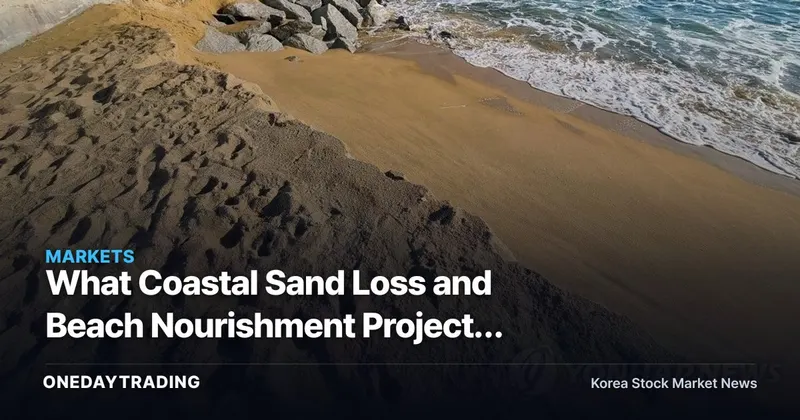
As the Ministry of Oceans and Fisheries — now headquartered in Busan — marks its 30th anniversary by reviewing policy achievements and challenges in maritime safety and ocean research, coastal erosion and beach restoration have re-emerged as flagship issues. Wave action, tidal currents, and the influence of man-made structures such as ports and breakwaters are steadily drawing sand away, narrowing beaches and placing certain stretches in a high-erosion-risk category.
The primary engineering solution for reversing this trend is beach nourishment — importing sand from external sources to replenish the shoreline. Nourishment goes beyond a one-time sand placement: it encompasses the installation of structures such as submerged breakwaters (artificial reefs) and groins, combined with periodic sand replenishment, making it a comprehensive coastal management program.
Background and Context
Coastal erosion is structurally worsening, driven by climate-change-induced sea-level rise and increasingly frequent high-wave events. Because replenished sand erodes again over time, beach nourishment is not a one-off construction project but a recurring maintenance program — a key distinction from an industry standpoint. The scale of procurement is ultimately determined by how central and local governments allocate their marine environment and coastal management budgets.
Market and Stock Impact
- Marine Civil Engineering & Construction: Beach nourishment and the installation of submerged breakwaters and groins require dredging, reclamation, and coastal structure expertise, potentially adding to the order pipeline of large construction firms with meaningful marine civil engineering exposure.
- Dredging & Aggregate Supply: Because nourishment projects require large volumes of externally sourced sand, the business chain around marine sand and aggregate extraction and transport becomes a critical variable for both project costs and supply reliability.
- Marine Engineering & Environmental Consulting: Erosion assessment, wave modeling, and ongoing monitoring must precede and accompany nourishment work, generating associated demand for professional services contracts.
- Regional Tourism & Leisure: Beach restoration translates into higher beach amenity value and a recovery in coastal tourism demand, providing an indirect positive catalyst for locally based leisure and accommodation businesses.
Investor Checkpoints
- Ministry of Oceans and Fisheries and local government budget proposals for coastal management and marine environment, along with execution schedules — the primary indicator for gauging contract volume.
- Changes in the marine civil engineering segment's share of large construction companies' quarterly earnings and order disclosures.
- Trends in marine sand extraction regulations and environmental impact assessment requirements — supply disruptions would directly affect project costs and timelines.
- The actual share of revenue attributable to these projects — it may be marginal for large-cap companies, so investors should distinguish between thematic expectations and genuine earnings contribution.
Outlook
As climate risks intensify, structural demand for coastal management is likely to grow, and the recurring nature of nourishment contracts could make it a stable revenue source. That said, the current news cycle is primarily a policy and research review — specific new contracts or budgets have yet to be finalized, which limits near-term catalysts. Project unit values are relatively low, and revenue contribution for large construction firms is likely modest, making it difficult to view this as a single stock (ticker) price driver; budget cuts or tightening of marine sand extraction regulations could act as negative catalysts in the opposite direction.
Hyundai Engineering & Construction — Live Data Snapshot
Hyundai Engineering & Construction's most recent closing price was ₩103,300 (–8.26% vs. the prior session). The composite signal — integrating foreign investor and institutional investor supply-demand (order flow), news flow, and momentum — reads 🟡 Neutral / Wait-and-See. Positive and negative signals are mixed, suggesting a watchful stance.
- ▲ Order Flow Continuity — Foreign investors have net-bought for 6 consecutive sessions (+26.1 billion won)
- ▼ Trend Alignment — Short- and medium-term downtrend (day: –8.3% · 1 week: –19.7% · 1 month: –28.1%)
Recent related news counts 2 positive catalysts and 0 negative catalysts, indicating a favorable news backdrop.
※ Price and foreign investor/institutional investor supply-demand (order flow) data are provided by Korea Investment & Securities (KIS) and are current as of the time of publication.
This content is an automatically summarized and analyzed version of the original news article. View Original (Yonhap News Industry)