
At a Glance
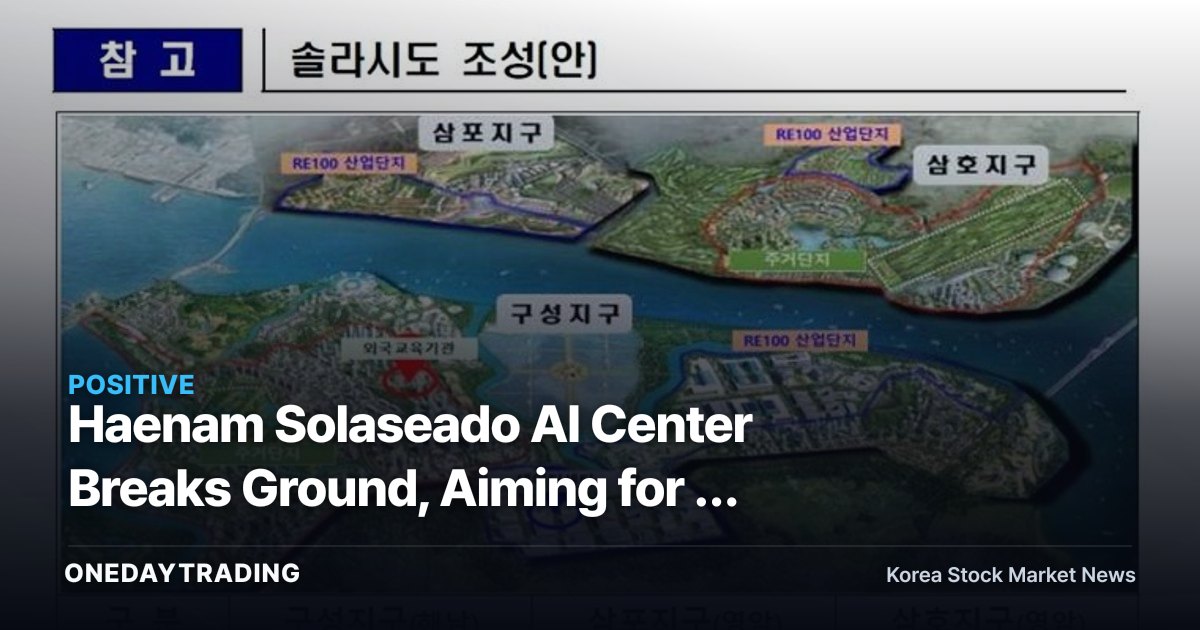
Construction has begun on a national artificial intelligence (AI) computing center at the Solaseado site in Haenam County, South Jeolla Province — a site that has had not a single registered resident for nearly 20 years since being designated an enterprise city in 2005. Haenam County is using this project as an opportunity to revive its long-standing goal of building a self-sufficient city of 100,000 people. However, since large-scale state infrastructure investment and actual residential inflow are separate matters, there is much to examine before concluding that this groundbreaking will directly lead to population growth.
Why It Matters Now
The purpose of the enterprise city system was to use private capital to build self-sufficient cities equipped with industrial, residential, educational, and medical functions. However, Solaseado has effectively had no resident population for nearly 20 years since its designation. Industrial complexes and power generation facilities were built, but the urban infrastructure needed for people to actually live there — housing, commercial facilities, education — never followed. This AI computing center groundbreaking is significant as the first tangible investment to fill that gap.
That said, data center-type facilities are an industry sector where a large workforce is needed during the construction phase, but relatively few permanent staff are required once operations begin. Given that such facilities are centered around servers and cooling equipment and are highly automated, the resident workforce may not be large enough to drive a population of 100,000 on its own. For the self-sufficient city vision to materialize, what matters more than the data center itself is whether the housing sales and rental market, along with residential infrastructure such as schools, transportation, and medical services, develop alongside it.
On the other hand, the symbolic significance of hosting a national AI computing center cannot be dismissed. Government-led infrastructure can attract follow-on private investment — from partner companies to related industrial park tenants — which in turn can drive housing demand. The key question is how concretely the actual plans for residential supply, sales, and move-in schedules take shape following the groundbreaking.
Frequently Asked Questions
- What is Solaseado? - It is a development site in Sanyi-myeon, Haenam County, South Jeolla Province, designated as an enterprise city in 2005, and it has had no registered resident population since that designation.
- What facility just broke ground? - A national artificial intelligence (AI) computing center — a project to build national-level AI computing infrastructure at this site.
- Is the goal of a self-sufficient city of 100,000 a confirmed plan? - It is a goal Haenam County has revived on the occasion of this groundbreaking, and its feasibility can only be assessed once concrete housing supply and relocation plans follow.
- Does a data center actually help increase the local population? - It does create construction-phase employment, but because the operational phase is highly automated, its effect on generating a resident population is often limited.
Related Stocks (Tickers) and Sector Impact
- Construction companies involved in regional industrial complex and enterprise city development - If residential development follows, there could be opportunities for civil engineering and housing contracts.
- Data center-related infrastructure (power equipment, cooling systems) industry sector - AI computing centers require substantial power, so related equipment investment may follow.
- Regional real estate and REITs - If this leads to genuine residential demand, it could affect the value of nearby land and commercial facilities, though this remains at the planning stage for now.
- Businesses related to regional public institutions and development corporations - Given the enterprise city's heavy reliance on public-led development, the allocation of policy budgets will determine the pace of the project.
Investment Considerations
- The groundbreaking is only a starting point — the success of the self-sufficient city plan hinges on when concrete follow-on housing and commercial infrastructure supply plans materialize.
- It should also be considered that many past enterprise cities and innovation cities fell short of their initial target populations.
- Investors should watch for follow-up announcements on the actual size of permanent employment during the data center's operational phase, as well as housing sales and move-in schedules.
- It is advisable not to rush into investment decisions regarding specific complexes or regions based on plans that have not yet been finalized.
Overall Outlook
On an optimistic view, this symbolic state project — a national AI computing center — could become the catalyst that restarts development that had been stalled for 20 years. There is room for government infrastructure investment to act as a primer, drawing in follow-on private investment and residential demand. However, given the industry characteristic that data centers themselves generate relatively limited employment, and the precedent of past enterprise cities and innovation cities falling short of their target populations, the goal of a self-sufficient city of 100,000 should be judged not by the declaration made at groundbreaking, but by how concrete the subsequent housing and residential infrastructure plans turn out to be.
This article is automatically summarized and analyzed content based on the original news source. View original (Yonhap News Industry)