
Summary
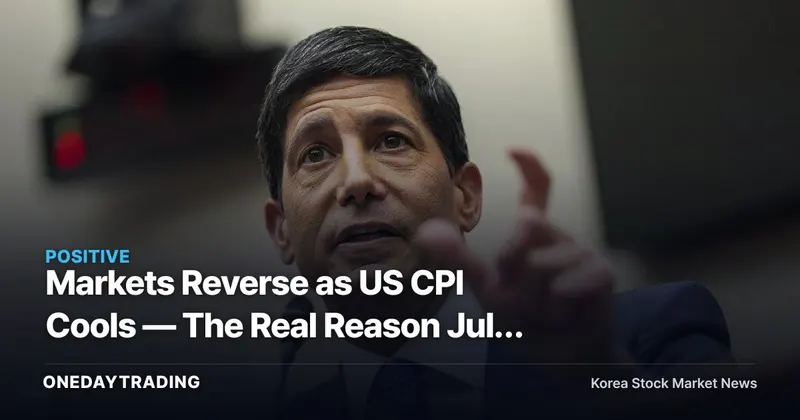
US Consumer Price Index (CPI) data came in well below market expectations, and the probability of a July benchmark interest rate hike that Wall Street had been pricing in plunged nearly 10 percentage points in a single day. New York equities, which had been wobbling, staged a rebound on this one data point alone. Yet Fed official Waller, who is classified as a hawk, reaffirmed price stability as the top priority, pushing back against expectations for a slower pace of monetary tightening. What the market has priced in is a delay in the rate hike — not its abandonment.
What Happened
What unfolded immediately after the data release was not a simple relief rally, but a recalculation of probabilities in the bond market. The odds of a July hike, as priced into the futures market, dropped nearly 10 percentage points in a single day, with that probability shifting entirely into a September–October hike scenario. The hike itself hasn't disappeared — only its timing has been pushed back — but the market initially took this as a signal that "the peak in rates is drawing near" and bet on risk assets accordingly.
This is where Waller's remarks cooled the mood. Even in light of this CPI slowdown, he reaffirmed price stability as the top priority. This suggests that a single month's improvement in data is not enough grounds to reverse the tightening stance, and amounts to something close to a warning that the market's optimism may have gotten ahead of itself. The very fact that a hawkish official didn't change his tone even in the face of dovish data is itself a seed of volatility — if the next data print comes in hot again, the probabilities could snap right back.
Structural Background
A 10-percentage-point shift in rate-hike probability means discount-rate expectations in the bond market have shifted by a corresponding degree, and that immediately transmits into equity valuation multiples. The lower the discount rate used to convert future earnings into present value, the greater the re-rating in share prices — especially for high-valuation growth stocks whose earnings realization lies further out. The problem is that this re-rating rests on the tentative condition of a "delayed hike," not a "confirmed rate cut." If the next CPI print again comes in above expectations, this multiple expansion could be given back in full.
Impact on Stocks and Sectors
- US high-valuation growth stocks such as Nvidia and Tesla — the biggest beneficiaries of expectations for a lower discount rate, reacting first to any recalibration of the rate path
- Samsung Electronics (005930) and SK Hynix (000660) — large-cap KOSPI stocks (tickers) that move in tandem with the Nasdaq rebound and the recovery in foreign investors' risk appetite, though it's worth noting this rally is being driven by liquidity expectations rather than earnings momentum
- US small- and mid-cap growth stocks (Russell 2000 constituents) — the segment most sensitive to funding costs, showing the highest beta to shifts in the rate path
- US regional banks and REITs — benefiting from expectations of eased short-term funding cost pressure, though the relief is limited given this is a delayed hike, not a pivot to cuts
Bullish vs. Bearish Scenarios
The bullish scenario is one in which the next CPI print reconfirms the slowing trend and hawkish officials, including Waller, gradually soften their tone. In that case, even the September–October hike probability could retreat further, extending the valuation re-rating centered on growth stocks (tickers). Conversely, the bearish scenario is one in which this CPI slowdown proves to be driven by temporary factors (fluctuations in energy and services prices) and rebounds in the next reading. In that case, the roughly 10 percentage points that dropped in a single day would snap right back, and today's rally could be revisited as "premature optimism" in a subsequent pullback. The fact that Waller didn't shift his stance keeps this second scenario very much on the table.
Investor Action Points
- Check the dates of the next CPI and PCE releases, and confirm with at least one more data point whether this slowdown is a genuine trend or a one-off
- Track any softening in the tone of Fed officials' remarks (whether hawkish comments start to ease) as a signal of further adjustment in September–October hike probabilities
- For portfolios heavily weighted toward high-valuation growth stocks (tickers), reassess risk sizing given that volatility could rise if the rate path reverses
- Monitor the KRW/USD exchange rate and foreign investors' supply-demand (order flow) trends together, to distinguish whether the KOSPI rebound is being driven by liquidity expectations rather than earnings
This article is automatically summarized and analyzed based on the original news report. View original (Maeil Business Newspaper, Securities)