
Key Takeaways
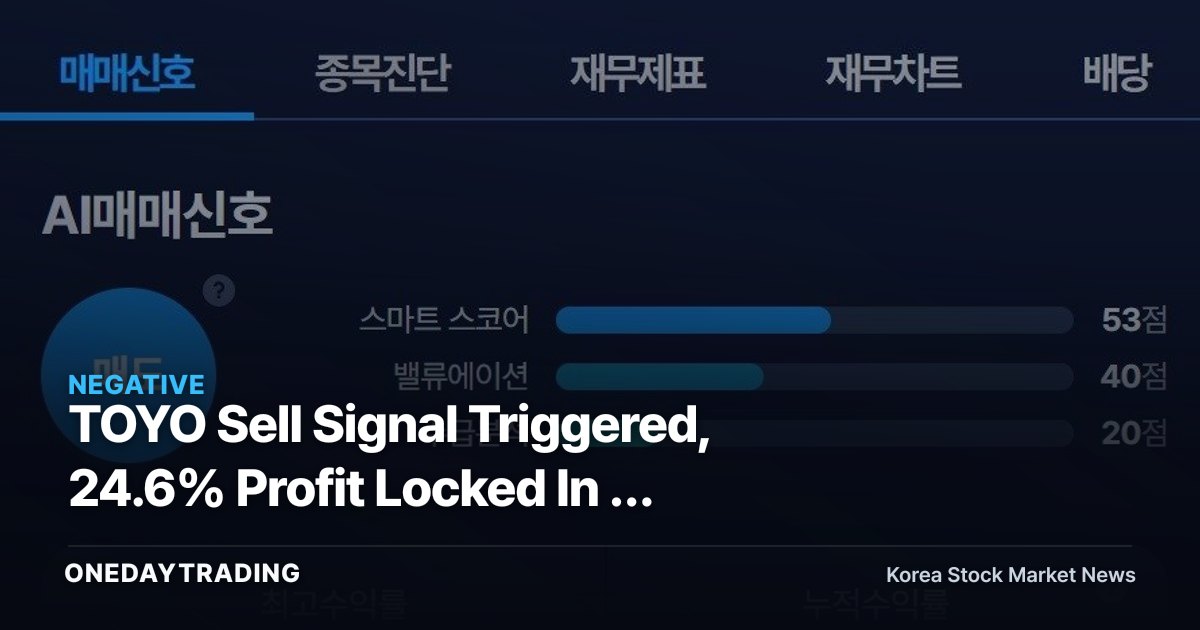
An AI-based signal service issued a sell signal on Nasdaq-listed solar company TOYO, presenting a profit-taking case of 24.67%. This is not based on an individual company's earnings release but is a technical signal grounded in price and supply-demand (order flow) patterns — a snapshot that simultaneously illustrates the high volatility characteristic of the solar sector and the concentration of short-term momentum.
From an investor's standpoint, what matters more than the 24.6% figure itself is that this pattern — a sell signal emerging after such a sharp gain (surge) — recurs broadly across small- and mid-cap solar stocks. Separate from the validity of the signal, investors should also watch for the potential for profit-taking supply to hit the market.
What Happened
As of the 22nd, TOYO (TOYO) entered a sell-signal zone in the signal service, and a cumulative return of 24.67% relative to the prior buy point was reportedly calculated. TOYO is a company engaged in the manufacture of solar cells and modules, and it belongs to a group of stocks (tickers) with erratic trading volume amid the trend of expanding U.S. production capacity and diversifying supply chains.
This signal is closer to capturing the overheating and pullback of a short-term price move rather than a change in fundamentals. In other words, it does not mean the company's order book or quarterly earnings have been updated; it is more accurately interpreted as a technical sell zone that harvests part of the gains.
Background and Context
Small- and mid-cap solar stocks react sensitively to policy momentum (U.S. IRA tax credits, domestic production incentives) as well as interest rate and tariff variables. They frequently surge on a single line of positive-catalyst news only to be quickly pushed back by profit-taking supply, creating fertile ground for short-term signal trading. Because these stocks have small market capitalizations, even a small amount of order flow can widen price swings considerably.
Impact on the Market and Stocks
- TOYO (TOYO): The sell-signal zone suggests short-term profit-taking pressure. When the price has run ahead without any fundamental positive catalyst, the risk of a pullback is relatively high.
- U.S. solar module and cell makers: Since expectations of benefits from domestic production policy are the key driver of share prices, the entire sector can swing in tandem depending on policy and tariff variables.
- Korean solar value chain (Hanwha Solutions, etc.): Linked to U.S. solar demand and policy trends, the volatility of locally listed solar stocks can indirectly affect investor sentiment.
- Investors following signal/quant trading: If funds tracking the same signal pile in, supply could overlap in the sell zone, potentially amplifying volatility.
Investor Checkpoints
- Check TOYO's next-quarter earnings and disclosures on orders and production capacity to verify whether the price increase is backed by earnings.
- Confirm on daily and weekly charts whether a pullback follows a surge in trading volume, and scrutinize verifiable evidence such as the average holding period and hit rate of the signal trading.
- Monitor how the schedule of U.S. solar-related tariff and tax-credit policies, as well as the direction of interest rates, affects sector valuations.
- Given the nature of small- and mid-cap stocks, factor in liquidity risk together with exchange rate (won-dollar) fluctuations.
Outlook
If expectations of policy benefits and expanding domestic production hold, room remains for a trend rebound in solar stocks. However, in zones where sell signals recur after a surge — as in this case — profit-taking supply and valuation burdens can act as short-term correction pressure. Rather than generalizing the return of a single signal, an approach that also checks the direction of the fundamental drivers — earnings and policy — is advantageous for managing volatility.
This article is auto-summarized and analyzed content based on the original news report. View original (Maeil Business Newspaper, Securities)