
Key Takeaways
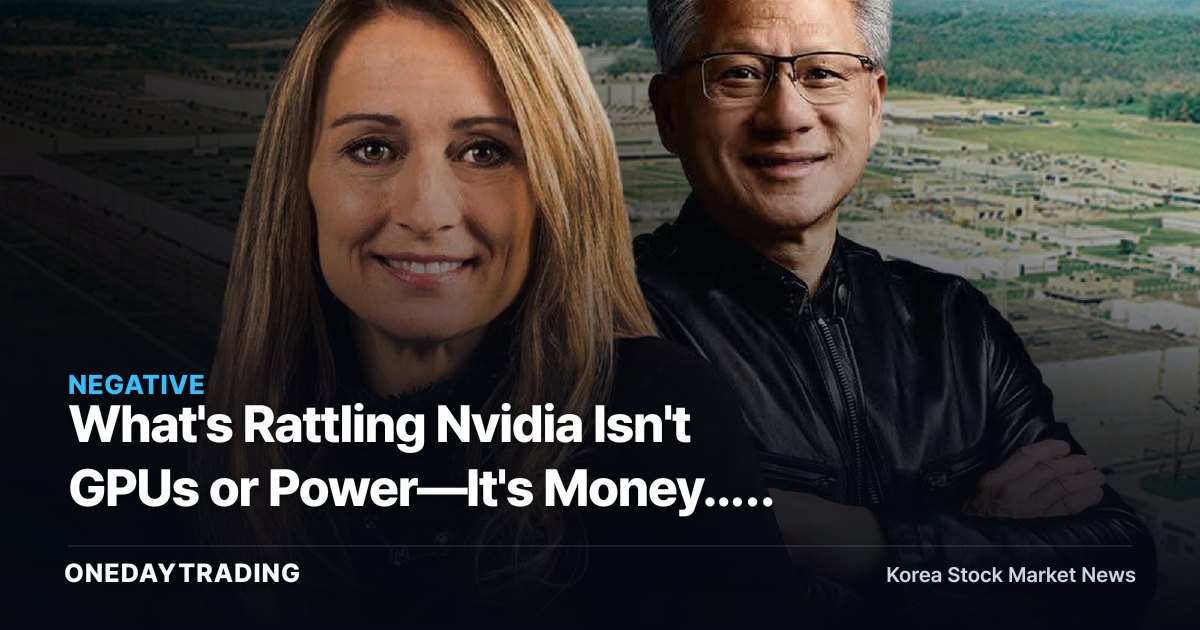
Nvidia's GPU orders remain solid, but recently the market's attention on earnings calls has shifted from CEO Jensen Huang's remarks on technology to CFO Colette Kress's remarks on financial structure. This signals that financing—the means of funding that demand—rather than chip demand itself, has emerged as the new variable rattling the stock (ticker).
What Happened
In the semiconductor market, GPU orders remain so strong that supply shortages are a concern. Yet the stock price has become more sensitive to who is funding these orders and how than to the order volume itself. Data center expansion is a massive capital expenditure that bundles not just GPU costs but servers, power, and real estate—so what determines balance-sheet health is not the orders themselves, but whether that funding comes through debt, leasing, or circular investment arrangements tied to customers.
This is where Nvidia's CFO's remarks become important. While the CEO's message on the technology roadmap confirms that demand hasn't weakened, the CFO's message on financing structure and cash flow lets investors gauge how sustainable the money backing that demand really is. The market's growing sensitivity to the latter shows investors have shifted from asking "Is the AI boom real?" to "Is the money propping up the AI boom real?"
Background and Context
AI data center investment has grown into a structure where chipmakers, cloud companies, and customers are intertwined through cross-equity stakes and advance equipment purchases. While this circular financing structure makes individual companies' revenue growth rates look stronger, it also carries the vulnerability that if one company's funding dries up, it could set off a chain reaction that shakes demand across the others. Where physical constraints like GPU supply and power availability have so far been cited as factors slowing the pace of AI investment, the quality and structure of the financing needed to sustain that investment is now emerging as the new bottleneck.
Impact on the Market and Stocks (Tickers)
- Nvidia: GPU demand itself remains solid, but as accountability over capital expenditure financing structure grows, stock (ticker) volatility could increasingly hinge on the CFO's remarks rather than earnings figures.
- SK Hynix and Samsung Electronics (005930): HBM (High Bandwidth Memory) orders are directly tied to GPU demand, so if concerns over AI capex financing intensify, the effects could indirectly spill over into the memory order cycle.
- TSMC and other foundries: Investment in advanced packaging and process capacity is premised on multi-year contracts with customers, making the stability of customers' financing a key variable determining the pace of capacity expansion.
- Major cloud and data center operators: As the share of capex funded through debt and leasing grows, changes in the interest-rate environment will have a correspondingly larger impact on their ability to sustain investment.
Investor Checkpoints
- At Nvidia's next earnings report, watch for changes in the CFO's disclosures on capex partnering and revenue-recognition methods—the mix between direct sales versus equity-stake or lease-linked arrangements.
- Track disclosures from major customers' data center investment announcements to see how the ratio of debt/lease financing to their own cash changes.
- Watch memory suppliers' next-quarter guidance, including HBM providers, for signs of order cancellations or schedule extensions.
- Keep an eye on how interest-rate direction and credit market conditions affect the cost of financing AI capital expenditure.
Outlook
On the optimistic side, the fact that GPU orders haven't weakened underscores the underlying strength of AI demand. The diversification of financing structures can also be read as evidence that major tech companies are actually executing on their growth investments. Still, the risk is clear. As circular investment and leasing arrangements grow larger, a funding squeeze at one link in the chain could simultaneously rattle demand expectations across multiple companies—and in that scenario, stock (ticker) prices could react far earlier and far more sharply than actual GPU sales volumes would suggest. Ultimately, what needs to be confirmed next earnings season isn't order volume, but the source and sustainability of the money backing those orders.
This article is automatically summarized and analyzed content based on the original news report. View Original Article (Maeil Business Newspaper, Corporate)