
Summary
What matters more than the fact that the president is meeting Jensen Huang in San Francisco is where the bottleneck in the AI supply chain lands. In Korea's equity market, this first opens the door to a re-rating of the semiconductor and AI infrastructure value chain running through Samsung Electronics (005930), SK Hynix (000660), Naver, and Hyundai Motor.
Still, a declaration is not a purchase order. For the share-price move to be sustained, cooperation with Nvidia, OpenAI, Anthropic, and Broadcom needs to translate into actual investment, data centers, chip supply, and software ecosystems.
What Happened
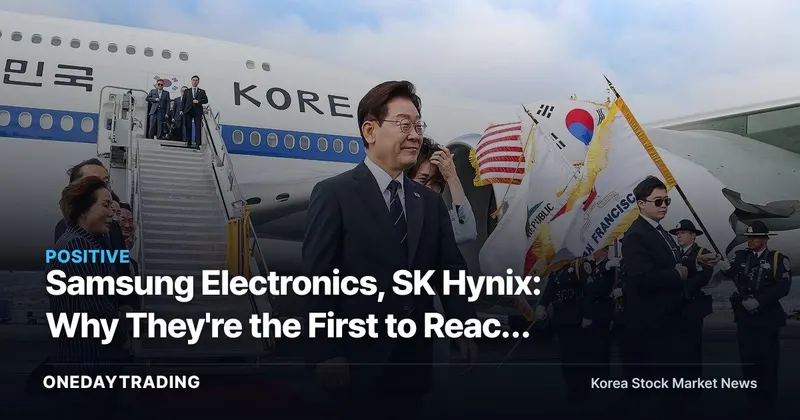
President Lee Jae-myung arrived in San Francisco on the 24th, local time, and kicked off a schedule of AI cooperation meetings with U.S. Big Tech executives. According to Yonhap News Agency, the itinerary includes meetings with Nvidia's Jensen Huang, OpenAI's Sam Altman, and executives from Anthropic and Broadcom. He is also set to unveil Korea's AI industry development direction and global cooperation vision through a San Francisco AI Declaration.
The itinerary itself is diplomatic news. But the sentence the market needs to read is not about diplomacy — it's about the supply chain. Nvidia sits atop GPUs, Broadcom covers networking and custom silicon, and OpenAI and Anthropic sit at the very top of model demand. When these four pillars are placed at the same table, Korean companies' position gets recalculated — not as simple manufacturers, but across memory, foundry, data centers, and services.
The trip is reportedly an 11-day schedule, continuing on to state visits to Brazil, Chile, and Argentina after the U.S. leg. That structure allows AI and semiconductors to be addressed in the U.S., while resources and supply chains are handled in South America. Once battery metals and power infrastructure are folded in, AI infrastructure investment won't remain a story confined to the semiconductor sector alone.
Structural Backdrop
The bottleneck in AI investment has shifted from models to power, chips, memory, and networking. Competition over a single GPU's performance has already scaled up into a competition over efficiency at the data-center-rack level. In this context, HBM is not a peripheral component sitting next to the GPU — it is the key constraint determining AI server throughput. That's why the point of contact with Nvidia connects directly to Samsung Electronics (005930) and SK Hynix (000660).
Broadcom's presence in this lineup is not trivial either. AI data centers don't run on GPUs alone. Switches, optical communications, custom silicon, and packaging all need to move in tandem. For Korea, the key question is whether it can leverage its memory strength to expand into foundry, packaging, telecom equipment, and cloud operations. The declaration gains real value only when this pathway turns from a document into a contract.
Stock (Ticker) and Sector Impact
- Samsung Electronics (005930): exposed on both the HBM and foundry fronts. The stronger the expectations for Nvidia cooperation grow, the more likely the market is to focus first on high-value-added product certification and yields rather than memory prices.
- SK Hynix (000660): a direct beneficiary of AI memory demand. The key question is whether discussions of additional supply translate into long-term volume commitments without eroding prices.
- Naver: representative of domestic AI services and cloud demand. Cooperation with global model companies could ease the cost burden of its own AI strategy.
- Hyundai Motor: there is read-through into physical AI, autonomous driving, and robotics. That said, for the stock to actually move, what's needed is a vehicle-application timeline and a software revenue model, not just the declaration.
- AI data centers and power infrastructure: GPU deployment spills over into power, cooling, and network investment. This creates indirect demand expectations for domestic power equipment and telecom equipment sectors (industry sectors).
Bull vs. Bear Scenarios
The bullish scenario is clear-cut: if memorandums of understanding between Korean companies and Big Tech firms are fleshed out following the San Francisco AI Declaration, and those in turn translate into chip supply, data center investment, and joint development, the market could start discounting capex and long-term supply contracts beyond 2027 ahead of near-term earnings.
The bearish scenario starts from the same point. If the declaration stays at the level of policy language, without order volumes, investment amounts, or technology certification timelines, share prices will give back expectations first. Semiconductors in particular are already pricing in a substantial AI premium. If any of HBM yields, foundry customer acquisition, or power infrastructure bottlenecks are delayed, multiple expansion will be limited.
Investor Action Points
- Check the parties, scope, and whether investment amounts are specified in any MOUs between Korean companies and Big Tech that emerge after the San Francisco AI Declaration.
- For Samsung Electronics (005930) and SK Hynix (000660), watch HBM shipments, customer certifications, and the share of high-value-added memory at the next earnings releases.
- Broadcom-related cooperation should be tracked separately to see whether it leads to demand for networking chips, packaging, and data center equipment.
- Policy momentum moves fast; the numbers come late. If share prices move first, the biggest risk is the gap between actual orders and reflection in government budgets.
Samsung Electronics: A Real-Time Data Snapshot
Samsung Electronics (005930)'s most recent closing price was 249,500 won (down 7.59% from the previous session), and the signal combining foreign investor/institutional investor supply-demand (order flow) with news and momentum reads 🔴 Caution. Foreign investors, institutional investors, and momentum are all negative, so caution is warranted right now.
- ▼ Dual sell-off — foreign investors sold −₩868.0 billion, institutional investors sold −₩858.8 billion, in tandem
- ▼ Trend alignment — short- and medium-term downtrend alignment (same-day -7.6% · 1-week -10.7% · 1-month -19.5%)
- ▲ News flow — 10 positive catalysts vs. 4 negative catalysts — positive catalysts prevail
Recent related news skews favorable, with 10 positive catalysts versus 4 negative catalysts.
※ Price and foreign/institutional investor supply-demand (order flow) data is provided by Korea Investment & Securities (KIS) and reflects the time of publication.
This article was automatically summarized and analyzed based on the original news report. Read the original (Yonhap News Agency, Industry)