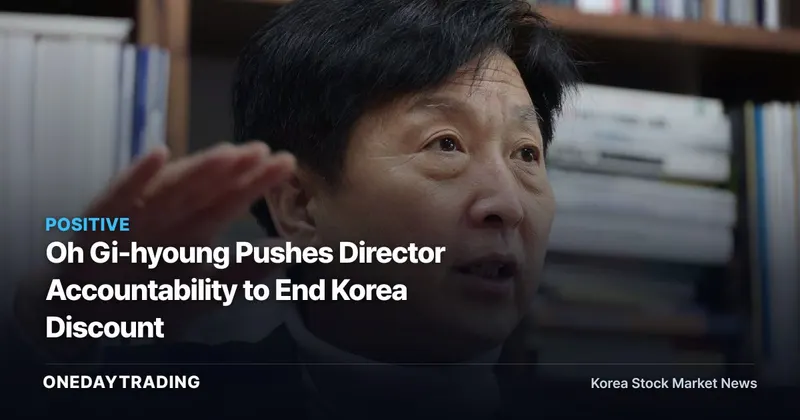

Oh Gi-hyoung’s Proposal to Resolve the Korea Discount
Democratic Party of Korea lawmaker Oh Gi-hyoung proposed strengthening directors’ fiduciary duty to shareholders as a solution to the Korea discount in a Maeil Business Newspaper Securities interview on the 30th of last month. For investors, the key issue is not the name of the framework but the standard governing corporate decisions. His proposal seeks to establish a practice in which directors represent the interests of all shareholders, rather than a particular controlling shareholder, and are accountable for explaining major decisions and their outcomes.
Strengthening directors’ fiduciary duty means requiring boards to put shareholder interests at the center of decision-making and take responsibility for both the process and the outcome. “At the heart of the Korea discount is being stabbed in the back—in other words, the betrayal of shareholders,” Oh said. In effect, he framed the market’s undervaluation as a matter of trust rather than price alone.
Market Trust and Concentration in Samsung Electronics and SK Hynix
Maeil Business Newspaper Securities reported that Samsung Electronics and SK Hynix were both cited as stocks driving concentration in the Korean market. That fact alone does not indicate the direction of either company’s share price. Investment decisions regarding these stocks should be considered separately from expectations for broader corporate-governance reform.
Oh expressed concern that investors cannot build long-term trust unless shareholder interests are adequately protected. His argument is that stronger board accountability, if sustained in practice, would give shareholders a clearer basis for evaluating major corporate decisions. Whether genuine accountability practices take root will also determine how investors distinguish expectations already priced into the market from outcomes that remain unconfirmed.
Protecting Parent-Company Shareholders Is the Test for Dual Listings
Oh explained that with dual listings, the central issue is not where a company lists but whether the parent company’s shareholders are protected and have given their consent. The standard is whether the board has explained the need for its decision, demonstrated its benefits to shareholders, and secured their approval. His statement that “directors represent shareholders; they are not the hands and feet of a particular controlling shareholder” reflects the same principle.
Solidigm was cited as an example in the discussion of dual listings. Oh drew a clear line, saying he was not considering measures to encourage voluntary delisting and that the matter was not yet at the discussion stage. Investors therefore should not assume that the specific provisions or effective date of dual-listing rules have been finalized.
Years of Established Practice Matter More Than Three Commercial Act Amendments
Oh said the three rounds of amendments to the Commercial Act were beginning to take hold as market practice. At the same time, he said those practices would need to accumulate over several years before becoming a tangible reality. His view is that policy credibility depends less on the number of legislative amendments and more on whether boards actually explain their decisions to shareholders and accept accountability for them.
“I do not believe we need to change many laws and regulations,” he said. He also suggested that even a single case in which a director is held accountable for failing to fulfill their fiduciary duty could help establish a new standard of conduct. His statement that “directors who betray shareholders will be held accountable to the end” emphasizes consistent enforcement of accountability.
Status of the Mandatory Tender Offer System and Anti-Share-Price Suppression Bill
The mandatory tender offer system is under discussion by the National Assembly’s National Policy Committee. Provisions of the bill aimed at preventing share-price suppression are also being refined. Its final content, implementation date, statutory language, and legislative timetable have not been confirmed, so investors have no basis for treating the policy direction as a finalized rule.
The K-Capital Market Special Committee was originally launched as the KOSPI 5000 Special Committee before being renamed. The change was described as a shift in focus from a price target to establishing ground rules investors can trust. The Lee Jae-myung administration’s capital-market policy has likewise presented stronger shareholder interests as a means of resolving the Korea discount.
Conditions Separating the Bull and Bear Cases
The bull case is that directors consistently explain decisions to shareholders and accept accountability, while protection for parent-company shareholders is demonstrated in actual dual listings and corporate decisions. In this scenario, the policy’s significance would emerge through consistently applied decision-making standards rather than slogans.
The bear case is that the details of the proposed frameworks remain unresolved or that accountability principles fail to translate into actual practice. Their real impact on stock prices and market volatility is also still unknown. It is therefore too early to conclude that a particular stock will rise or that market volatility will ease.
What Investors Should Monitor Next
- National Assembly National Policy Committee discussions: Watch whether the final provisions and implementation date of the mandatory tender offer system become more specific.
- Legislative wording: Monitor whether the final statutory language and legislative timetable for the anti-share-price suppression bill are disclosed.
- Dual-listing rules: Assess how the principles of parent-company shareholder protection and consent are reflected in the specific provisions and implementation timeline.
- Board practices: If companies consistently explain decisions to shareholders and accept accountability in practice, investors will have a basis for assessing policy credibility.
Samsung Electronics Key MetricsAs of 2026-11-05
| Period Returns | 1 Week -13.15% 1 Month -25.92% |
|---|---|
| Trading Value · Trading Volume | 193 billion won · 38,560,685 shares |
| Supply-Demand (Order Flow) | Foreign Investors Net selling of 1.269 trillion won (3 consecutive days) Institutional Investors Net buying of 67.9 billion won |
| Recent News Tone | Positive Catalysts 3 · Negative Catalysts 6 |
Price and supply-demand (order flow) data are real-time figures from Korea Investment & Securities (KIS), while supply-demand (order flow) and news-tone tallies are calculated independently by OneDayTrading.
Supply-Demand (Order Flow) and Momentum Assessment🔴 Caution
Foreign investor activity, news, and momentum indicators are showing negative signals.
- ▼Order-Flow ContinuityForeign investors net sold for 3 consecutive days (−1.269 trillion won)
- ▼Trend AlignmentShort- and medium-term bearish alignment (Today -7.6% · 1 week -13.1% · 1 month -25.9%)
- ▼News Flow3 positive catalysts vs. 6 negative catalysts — negative catalysts dominate
Upcoming Events to Monitor
- 11.12Index Options ExpirationLowKOSPI 200 options expiration
- 11.26Bank of Korea Monetary Policy BoardHighBenchmark interest rate decision meeting
- 12.09FOMC Policy Rate DecisionHighU.S. Federal Reserve monetary policy announcement — direction of interest rates and the dollar
- 12.10Futures and Options ExpirationMediumQuadruple witching — watch for volatility and supply-demand (order flow) disruptions
This article was automatically summarized and analyzed based on the original news report. View Original Article (Maeil Business Newspaper Securities)